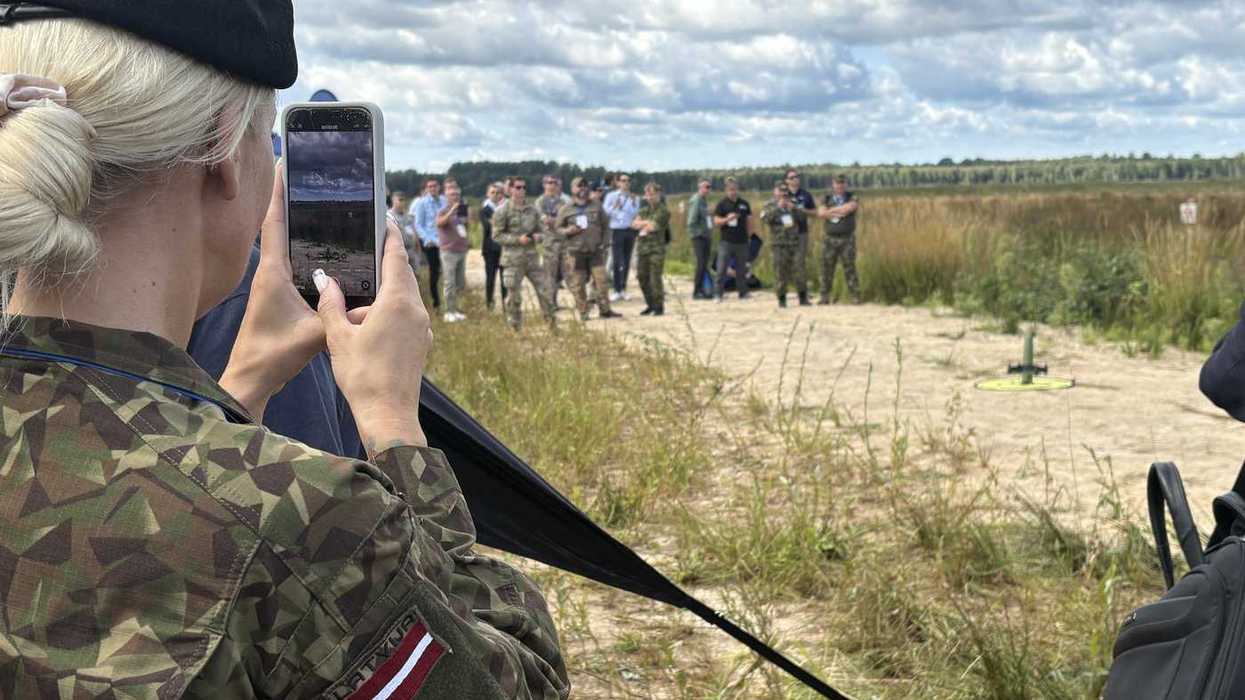
As Russian threats escalate in Latvia, a Canadian-led NATO mission is strengthening its presence near the Russian and Belarusian borders.
The Canadian Press observed the increasing tensions on the ground.
In the early hours of Aug. 14, residents in four areas of the region received a phone alert, including in Daugavpils, Latvia’s second-largest city.
The alert urged citizens to take shelter due to a “potential threat” detected in the airspace.
Jana, a Russian-speaking Latvian woman whom The Canadian Press met outside a church in Daugavpils, was among the tens of thousands of people who received the alert.
“Obviously, it’s very worrying to receive this kind of message. We worry about our family, about our loved ones. Only crazy people aren’t worried,” said Jana, who did not want to give her full name to the media.
A few hours after the alert, authorities announced that a drone loaded with explosives originating from Belarus had violated Latvian airspace before being shot down by NATO fighter jets.
No injuries were reported.
Tensions between Latvia, Moscow and Minsk have increased to the point where Latvian Prime Minister Evika Silina was forced to resign last May, following repeated incursions by unmanned aerial vehicles into the country’s territory.
The Canadian Press met with Canadian Col. David Brassard, the newly appointed commander of the NATO Multinational Brigade in Latvia, at the Adazi military base, located in the centre of the country.
He took office on June 10, two weeks after Silina’s resignation. Since then, he says three drones have been shot down.
“The security situation we are currently experiencing in the east is what I call a ‘hybrid’ situation,” he said.
“Hybrid” attacks refer to hostilities that do not necessarily constitute formal acts of war but aim to destabilize governments and sow confusion among the population. Those responsible for such acts are not always easily identifiable.
“It’s not as if there were Russian flags attached to the drones; it can be difficult to assign blame,” said Brassard.
Some of these drones are reportedly Ukrainian drones that were diverted into Latvian airspace by Russian jamming, he added.
Maj.-Gen. Arnoud Stallmann of NATO’s Allied Command Transformation does not hesitate to use the word “war” to describe the situation.
“We have truly come to terms with the threat from Russia; even though, at this stage, we call it hybrid war, I think we are actually at war,” Stallmann said during a NATO exercise in Selijas, central Latvia, in mid-August.
The Canadian mission aims to “reassure, deter, and defend,” and is adapting to the escalation of hostile acts.
Since the mission’s launch in 2017, Canadian troops — numbering between 1,500 and 1,600 — have been stationed in Adazi.
But they will now be increasingly deployed, sometimes on a permanent basis, to various strategic locations near the borders with Russia and Belarus.
“This is just the beginning. We’re in the process of expanding between now and Christmas,” said Brassard, noting that a first permanent platoon is now stationed in the Russian-speaking city of Daugavpils.
“There are subversive activities taking place around Daugavpils, a culturally Russian region with strong ties to Russia,” Brassard said.
In Latvia, Russian speakers account for about 30 per cent of the total population. In Daugavpils, the proportion is closer to 80 per cent.
On the streets of Daugavpils, several residents interviewed by The Canadian Press are opposed to NATO’s military presence in their city.
“We don’t need NATO. I see Canadian soldiers in the city, always eating kebabs. Why are they here? I don’t understand what purpose they serve,” said Mikhail, a 55-year-old man who served in the Soviet Army.
Inna Plavoka, editor-in-chief of the independent media outlet Chayka, which publishes content primarily in Russian, is more sympathetic to NATO.
“It may be hard for a Canadian to understand their position, but you have to realize that Russian propaganda is so effective at brainwashing people,” she said.
When the war in Ukraine broke out, she says many believed “the Russians will take care of the Ukrainians and then come to save us.”
When she asked who they wanted to be saved from, “they made the usual argument that the Russian language is being suppressed.”
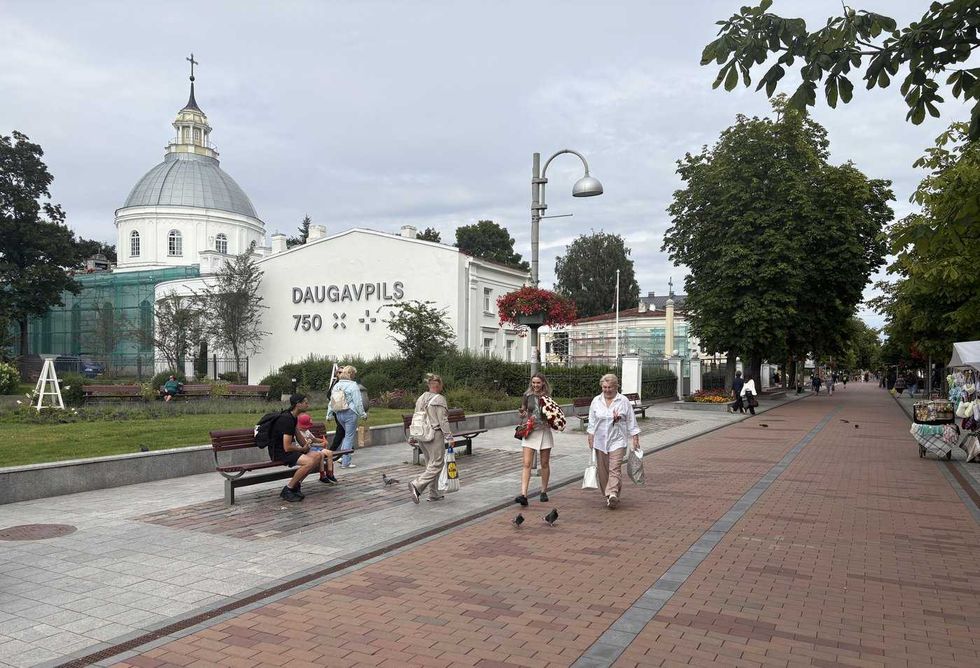 Passersby walk past the Church of St. Peter in Chains in Daugavpils, Latvia, on Aug. 14, 2026, the day NATO fighter jets shot down an armed drone that violated Latvian airspace.THE CANADIAN PRESS/Stéphane Blais
In Latvia, a country that endured 50 years of Soviet occupation, many Russian speakers feel discriminated against due to national policies that restrict the use of Russian in education and public spaces.
Russian President Vladimir Putin often uses the pretext of defending Russian-speaking populations to justify his offensives in Ukraine.
Latvian speakers generally hold a very positive view of the Canadian presence.
A 2022 study by the University of Greifswald in Germany in collaboration with the Latvian research centre SKDS found that 79 per cent of them described Canadian soldiers as being professional or friendly.
The same study shows that 34 per cent of Russian speakers find it difficult to characterize Canadian troops.
Brassard says his troops are “prepared” for a Russian incursion into Latvia, adding he has “all the capabilities (he) needs” to deal with an attack.
How likely is a Russian attack?
“It’s a question of capabilities and intentions,” answers Janis Kazocins, who served as the Latvian president’s national security adviser from 2016 to 2023.
He says the Kremlin would “certainly” intend to take economic, political and military control of the Baltic states if possible.
“The real question is whether the Russians are willing to risk a nuclear war over a small town in northeastern Estonia or Latvia,” he argued.
But Kazocins, who is now with the Riga Center for Geopolitical Studies, does not believe there’s a serious risk of a conventional attack against NATO.
“Russia does not have the capacity to open a new front,” he says. “It simply wouldn’t work, especially since we have people — like your fellow Canadians — who actively support us on the ground and who, in the event of an attack, will fight.”
Young people have also expressed their willingness to fight for their country.
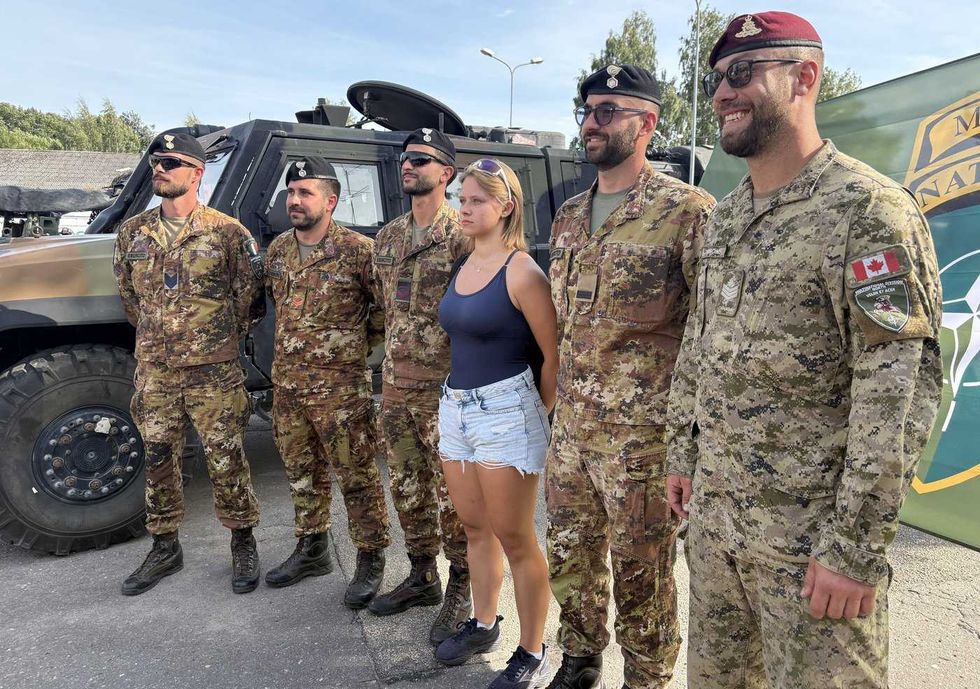 Loreta Munda, a Latvian teenager who plans to pursue a career in the military, poses with Italian soldiers and a Canadian soldier during an activity organized by NATO in front of the railway museum in Riga, Latvia on Aug. 15, 2026. The Canadian Press/Stéphane Blais
A drone believed to come from Belarus, was shot down on the eve of the 825th anniversary of Latvia’s capital of Riga.
As the city celebrated, NATO organized a public event in front of a museum. Tanks were on display, and soldiers, flanked by NATO and Canadian flags, were talking with residents.
Among them was Loreta Munda, a 17-year-old who plans to pursue a career in the military.
“When I was younger, in 2014, I saw on the news what was happening in Ukraine. I thought to myself, ‘My God, if that happens here, I want to be among those who protect my country.’”
With NATO forces present, Loreta says she feels safe.
“I know there are soldiers ready to help us, but there are also plenty of people my age who are ready to defend our country.”
In a country where the scars of Soviet history remain raw, Latvia is caught between Russian threats and the support of its NATO allies.
-- This report was produced with a grant from the Fonds québécois en journalisme international.
This report was first published by The Canadian Press Aug. 22, 2026.
By Stéphane Blais | Copyright 2026, The Canadian Press. All rights reserved.