Thousands march in Toronto for Grassy Narrows, seeking justice for mercury poisoning
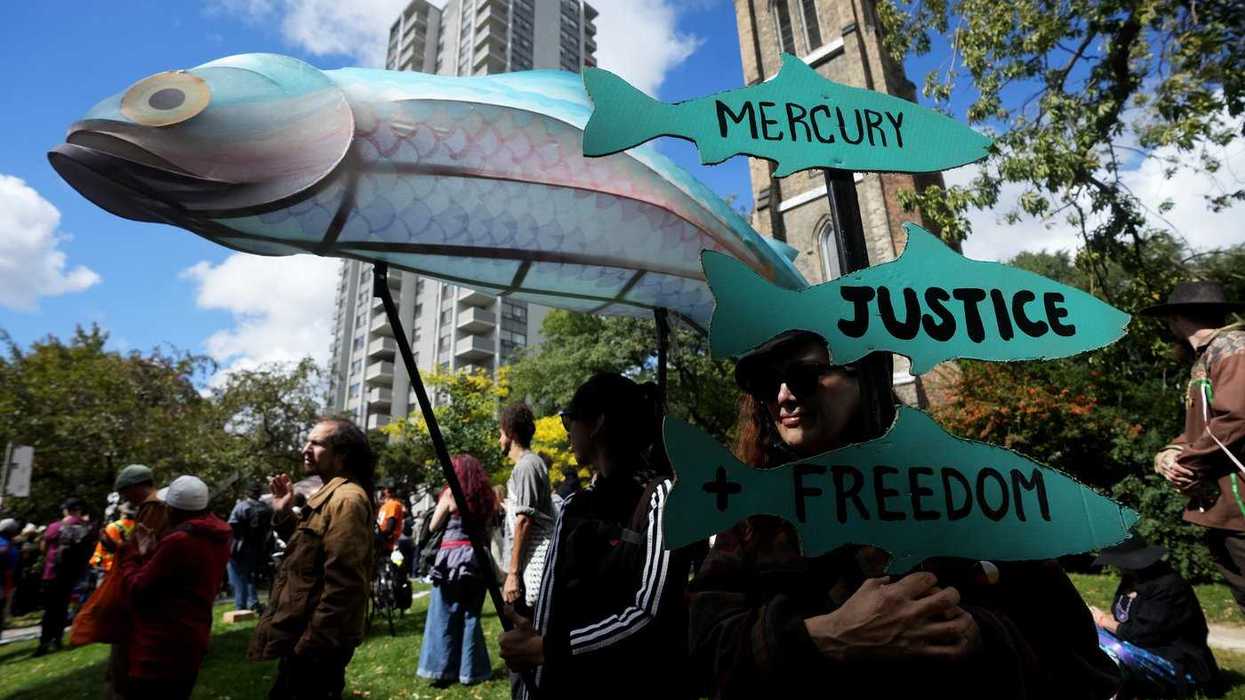
The smell of burning tobacco and the sounds of banging drums hung in the air in Toronto's downtown core as thousands of supporters of the Grassy Narrows First Nation marched to Queen’s Park on Wednesday.
Members of Grassy Narrows, alongside labour unions, environmental groups, and faith-based organizations, took to the streets to call for justice for the Ojibwe community in northwestern Ontario, which has for decades suffered from the aftershocks of thousands of kilograms of mercury being dumped in their river system in the 1960s and 1970s.
Grassy Narrows Chief Sherry Ackabee said the First Nation has lost untold members to the effects of mercury poisoning.
“Everybody’s lost somebody,” she said. “I myself have a child who was born with one functioning kidney … And my other children have been sick as well.”
One study estimated that 90 per cent of the Grassy Narrows population suffers from some degree of mercury poisoning. The heavy metal can be passed from mothers to babies they carry, making it a problem that spans generations.
The protesters are calling for Premier Doug Ford and Prime Minister Mark Carney to close the Dryden Paper Mill responsible for the mercury contamination, and to provide compensation for the community’s hardship.
The mill, which operates upstream from Grassy Narrows on the English-Wabigoon River, stopped using mercury in its industrial process in the 1970s, but mercury levels downstream from the plant haven't decreased significantly since the 1980s.
A 2024 study from Western University found emissions from the mill, including sulphate, continue to wreak havoc on the community by generating methylmercury — the most toxic form of mercury.
“We need cleanup. We need justice. We need compensation, and we need our people to try and live a healthy life again. But how can you do that when Dryden's still operating their mill?” Ackabee questioned.
Children from Grassy Narrows led the protesters to the Indigenous Services Canada office on Bay Street, where a moment of silence was observed to honour those who had died, before the rally continued to Queen’s Park.
Some held photos of Grassy Narrows members who had died prematurely. Ackabee said portraits of her nieces and nephews were among them, as well as a photo of Simon Fobister, a former Grassy Narrows chief who died at age 63.
Toronto police estimated that about 2,000 people marched in the rally, though organizers put the number much higher. Police spokesperson Nadine Ramadan said the force uses drones to estimate crowd sizes but pinning down an accurate number can be difficult because crowds are fluid and people come and go during protests.
Among the supporters was Donna Mergler, a professor emeritus at the University of Quebec in Montreal, who authored a 2020 Lancet study that first demonstrated a link between premature mortality and long-term mercury exposure from freshwater fish consumption in Grassy Narrows.
Among the study’s findings was that Grassy Narrows members who died before the age of 60 had higher mercury levels than those who died after 60. Mergler said that in Canada, a person who dies before the age of 75 is considered to have died prematurely, but there weren’t enough people in the nation over the age of 75 to do an adequate statistical analysis using that benchmark.
“All of the studies that I've done with Grassy for the past 10 years have shown that mercury is having devastating effects on this community. And I think as a scientist, one needs to take a stand,” she said. “I can't tell you how many funerals I have been to of people 20, 30, 40 years of age.”
Chrissy Isaacs, a member of Grassy Narrows, said she drove more than 1,800 kilometres from the northwestern Ontario community to Toronto to participate in the march.
She said she faces mental and physical health issues due to five generations of mercury poisoning in her family.
“Sometimes I'm in a wheelchair … I get tremors from time to time and I lose co-ordination when I'm walking,” she said. “There's days where I just lay in bed because of nerve pain.”
Isaacs drew headlines earlier this year after she protested outside a Toronto press conference held by Carney and Ford. The prime minister said “I can outlast her” as the voices of protesters could be heard shouting in the background.
She says she has yet to receive an apology from the prime minister and invited him to visit Grassy Narrows First Nation to “see our people that are suffering.”
The Prime Minister’s Office said at the time that Carney could not hear what protesters were saying and that members of staff met with them after the event to understand their concerns.
This report by The Canadian Press was first published Sept. 23, 2026.
-- With files from Alessia Passafiume
By Kathryn Mannie | Copyright 2026, The Canadian Press. All rights reserved.