Prime Minister Carney rallies Liberal MPs ahead of Parliament's return
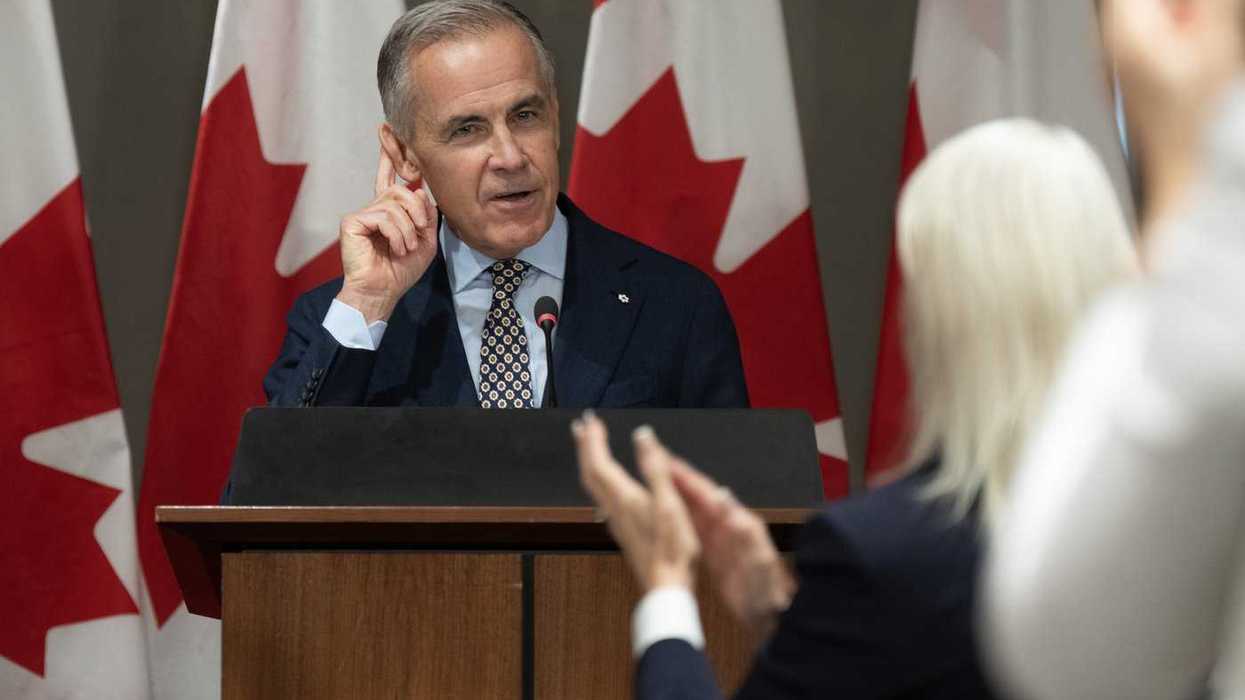
Prime Minister Mark Carney said Friday his government is focused on bringing down costs for Canadians and defending the country's sovereignty, though he acknowledged some of those efforts are in their early stages.
"As we build Canada strong, we remain laser focused on bringing down costs for Canadians and keeping Canadians safe. Because we know that the full benefits of our plan will take some time," he said to a room full of Liberal MPs.
Speaking to the Liberal caucus on Friday as MPs prepared to return to the House of Commons next week, Carney welcomed three new members who won byelection races in August.
The Opposition Conservatives have been sharpening their lines of attack on the government. Conservative Leader Pierre Poilievre asked at a press conference this week whether Canadians feel their lives have improved since Carney took office.
Carney, who just wrapped a busy week that included an investment summit in Toronto and a speech to the European Parliament in France, told MPs that was "just the warm-up."
"This is a crucial session of the House of Commons," he told the caucus. "We are going to introduce some of the most consequential legislation not just of this government, but in decades."
Carney said the government will introduce legislation this fall to streamline project reviews, to be known as the Building Canada Strong Act.
"For projects and supply chains, our standard will be simple — one project, one review, one year," he said.
"If we're going to say no, say no quickly. If we are going to say yes, say yes on time. When Canada decides a project should go ahead, that project will go ahead."
Canada can maintain its high standards for projects while moving quickly, he said.
Government House leader Steven MacKinnon said just before Carney's speech that "very significant" economic legislation will be the "centrepiece" of the fall sitting.
He did not go into specifics, citing parliamentary privilege, but suggested there are plans for several different parts of the economy.
"We've talked for a long time about several things: improvements to the Canada Labour Code, improvements to project reviews, and more generally making supply chains more certain and better planned across the board," MacKinnon said.
MacKinnon, who is also transport minister, said the government will advance plans to change how airports are operated. Carney said Tuesday he wants private investors to take over operations at airports in Toronto, Montreal, Calgary and Vancouver.
The minister said there is "intense" interest from investors.
The prime minister said the government will also push ahead with its social media and AI regulation bill this fall.
"We've been hearing the concerns of families and educators, medical practitioners in our community, children falling victims of sexual abuse, cyberbullying and extreme violence online," he said.
"The status quo is failing our kids. The tech companies won't fix it. We will not stand by."
The Liberal government is also set to release a new budget in the fall sitting.
Carney said the government will "manage spending and optimize our balance sheet" through its fiscal plan.
He said the government is in a position now to add new supports for social programs and expand child care, but did not share specifics.
This all comes against a backdrop of continued threats from President Donald Trump's White House against Canada's sovereignty and economy.
Carney and his negotiating team walked away from talks with the White House in August, saying that what was on the table was a bad deal for Canada. The trade conflict then escalated, with Trump imposing another volley of tariffs and threatening even more, while Canada imposed its own counter-tariffs.
Former prime minister Stephen Harper said this week he believes Ottawa had no choice but to walk away from the agreement.
Liberal MP Robert Oliphant, parliamentary secretary for foreign affairs, told reporters outside the caucus room on Friday he sees broad support for Carney and his decision to turn down the deal.
"I've never experienced anything quite like what I'm experiencing in my riding, in terms of overwhelming support for the prime minister and trust," Oliphant said.
"We're going one step at a time, and I think when he says that we're ready and willing as soon as the United States wants to come back in good faith to the bargaining table, we'll be there. And I think it's the right approach."
The two-day Liberal caucus retreat continues on Saturday.
This report by The Canadian Press was first published Sept. 18, 2026.
— With files from Sarah Ritchie and Kyle Duggan
By David Baxter | Copyright 2026, The Canadian Press. All rights reserved.