Indian diplomat confident of a deal before PM Narendra Modi's visit to Canada
The killing of Sikh activist Hardeep Singh Nijjar will not be discussed when Indian Prime Minister Narendra Modi meets Prime Minister Mark Carney next month, according to India's top diplomat in Canada.
"When it's in court, governments don't discuss," Dinesh Patnaik, India's high commissioner to Canada, said in an interview with New Canadian Media. "If there is any evidence that has to come out, it will come out in court."
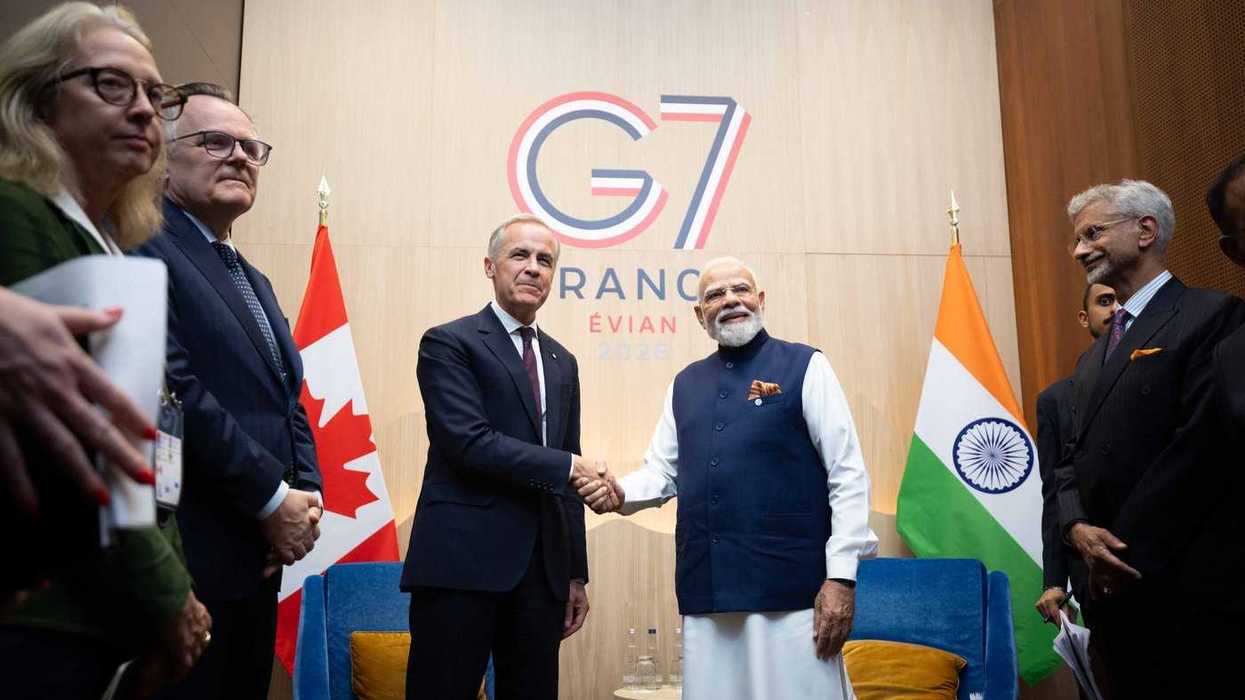
Modi's visit to Toronto and Ottawa on Dec. 11 and 12, his first bilateral trip to Canada since 2015, is built around a trade agreement and possibly a defence agreement.
Patnaik said the two countries are working together on organized crime, extortion, drug and fentanyl smuggling and counterterrorism. Their national security advisers have met, and their intelligence and police agencies are in regular contact.
Speaking at a public event in Ottawa on Nov. 17, Patnaik said the heads of CSIS and India's foreign intelligence agency, the Research and Analysis Wing, have visited each other's countries several times.
"That's not something we publicized," he said.
India has issued more than 5,000 travel documents to remove Indian nationals from Canada since Patnaik arrived in September 2025, he said. Canada Border Services Agency figures show 4,970 Indian nationals were removed from January to October of this year, more than any other nationality.
"Indians feel Canada is supporting Khalistan. Canada feels India is doing violence on Canadians," Patnaik said. "Now if you talk to each other, you realize that none of this is true."
[caption id="attachment_43614" align="alignright" width="361"] Dinesh Patnaik, India's high commissioner to Canada.[/caption]
The World Sikh Organization of Canada (WSO) sees it differently. On Nov. 17, it warned gurdwaras (temples) that people believed to be acting for the Indian government, or as go-betweens, had approached Sikh community members ahead of the Modi visit, offering to explain and defend issues such as Sikh political prisoners in India. WSO said similar outreach in past years produced no lasting results and instead caused controversy and division in the community.
"Given what Canadian law enforcement has already revealed about Indian foreign interference and transnational repression, these concerns cannot be dismissed," WSO president Danish Singh said in a statement, using the term for governments that target critics living abroad.
The federal public inquiry into foreign interference, led by Justice Marie-Josée Hogue, found in its January 2025 final report that India is "the second-most active state actor engaging in electoral foreign interference in Canada," after China. It said India works "through its state officials in Canada and through proxies," trying to bring Canada's position in line with its own, particularly on supporters of Khalistani separatism.
India rejected the report's findings.
A story first published by The Pointer and republished by New Canadian Media reported on Sikh Canadians who say Ottawa has not explained what became of its evidence of Indian government involvement.
What the public record shows, and what it doesn't
Nijjar, president of the Guru Nanak Sikh Gurdwara in Surrey, B.C., was shot dead in his vehicle as he left the temple's parking lot on June 18, 2023. That September, then-prime minister Justin Trudeau told the House of Commons that security agencies were pursuing "credible allegations of a potential link" between agents of the Indian government and the killing. India's Ministry of External Affairs called the allegations "absurd and motivated."
In October 2024, the RCMP alleged links between agents of the Indian government and homicides, extortion and other violent crime in Canada. Canada expelled six Indian diplomats, and India expelled six Canadian diplomats in response.
Four Indian nationals are charged with first-degree murder and conspiracy in Nijjar's death. Their case is before the B.C. Supreme Court. On Dec. 24, 2025, the Attorney General of Canada asked the Federal Court to keep some evidence in the case secret on national security grounds.
The request was made under Section 38 of the Canada Evidence Act, which lets the federal government ask a judge to block the release of information that could harm national security or international relations.
In July, U.S. prosecutors charged jailed gangster Lawrence Bishnoi and his associate Satinderjeet Singh, known as Goldy Brar, with ordering the killing. The indictment does not allege any role for the Indian government.
The day the charges were announced, RCMP Deputy Commissioner Lisa Moreland said "nothing has come out today to link the Indian government," adding that evidence from devices seized in the operation were still being examined.
The search for Brar has widened. On Nov. 19, the Bolo Program, a national program that publicizes police wanted notices, placed him first on its list of Canada's 25 most-wanted fugitives, with a reward of up to $250,000. Winnipeg police want him for the September 2023 killing of Sukhdool Singh Gill. In September, the FBI added him to its Ten Most Wanted list, offering up to US$1 million for his arrest.
The Canadian Security Intelligence Service's 2025 public report, released May 1, lists India among the five main perpetrators of foreign interference and espionage against Canada.
India has denied any role in Nijjar's killing.
A trade deal and a possible defence agreement
Both governments want Modi’s visit to Canada to deliver a Comprehensive Economic Partnership Agreement, or CEPA. The deal is meant "to make it easy for both countries to do business with each other," Patnaik said. "That's as simple as that."
He said negotiators expect to finish this month. "We may need one more meeting in December before we finalize," he said. Any issues left over will go to Modi and Carney, he added.
Patnaik offered the example of a Canadian company importing garments from India. "Right now they're paying about 18-per-cent tax." The deal would make that "almost zero" and cut the paperwork that asks, in his words, "Where did your buttons come from?"
The Cepa announcement would not change prices right away. Both countries would first have to change their tariff and customs laws, a process Patnaik called "legal scrubbing" that takes time. "Especially for Canada, because Canada will have to get all your provinces on board," he said.
Ikshit Sharma, founder of Toronto importer Anu Spirits, said the bigger problem for Indian whisky in Ontario is the LCBO, not federal duties. The LCBO adds a Cost of Service Differential based on country of origin, and India is in the group that is charged at the highest rate.
"Until and unless they switch India's place from others, this deal might not have any effect," Sharma said. "LCBO is not the quickest body to adapt to changes."
A defence cooperation agreement is also likely to be signed during Modi’s visit, Patnaik said at a Nov. 17 event in Ottawa co-hosted by the Centre for Strategic Statecraft and the Canadian International Council.
"One of the few things you're going to see during Prime Minister Modi's visit now would be probably a defence agreement," he told the audience.
The two countries already hold a defence dialogue, and India's chief of defence staff has visited Canada, Patnaik said. Vina Nadjibulla, the centre's co-founder and CEO who moderated the discussion, confirmed his remarks.
In the interview with NCM, Patnaik said defence investment between the two countries is "coming up as a big one," including the production of ammunition, explosives and missiles.
Global Affairs Canada did not say which Canadian ministers Modi will meet or whether an agreement will be announced. A spokesperson said by email that Carney's schedule "is announced as details become available."
Two accounts of the same relationship
At the Nov. 17 event, Patnaik said the two countries have no conflict on core strategic issues. "Yet all it took was a fringe diaspora issue to derail us," he said.
Nadjibulla, moderating the discussion, pushed back on stage. "That's a perspective from India," she said. In Canada, the issues were seen as critical "to Canada's sovereignty, to Canada's security, to values, human rights."
Jean-Christian Brilliant, director general of the South Asia division at Global Affairs Canada, told the same audience that Ottawa has not played down the dispute.
"There is no moment whereby we would have sought to minimize the nature of the issues that we were facing," he said.
The two countries have held three rounds of security talks at the national security adviser level in New Delhi in September 2025, in Ottawa in February 2026 and in New Delhi in October, according to Brilliant and government statements. Brilliant said Canada expects to say more about that work during Modi's visit.
Wesley Wark, a senior fellow at the Centre for International Governance Innovation (CIGI) in Waterloo, Ont., who studies national security and intelligence, said the hunt for Brar is "an offshoot" of Canadian and U.S. officials making clear to India that state-supported transnational repression will not be tolerated.
"Improvements in economic relations and exchanges between Canada and India rest on the end of Indian state support for such activities in Canada," Wark said in a statement provided through the CIGI.
Canadian security agencies have also shown more willingness to work with Indian counterparts on shared concerns about violent extremism, he said.
Wark called Ottawa's September 2025 listing of the Bishnoi gang as a terrorist entity mostly symbolic. "What is different is the determination to pursue criminal prosecutions."
In an emailed response from New Delhi, where she was attending meetings, Nadjibulla said the "two-track approach," with security talks running alongside diplomatic and economic re-engagement, "was necessary to break the impasse and begin repairing relations.
"However, diplomatic normalization is not the same as full reconciliation." Serious concerns about foreign interference and transnational repression remain, and rebuilding trust will take time."
For the reset to be sustainable, Nadjibulla said, "there needs to be greater communication about the progress being made on security issues, while respecting ongoing investigations and judicial processes."
Nadjibulla said the centre's India Initiative is funded entirely by Canadian philanthropy and Canadian industry, with no money from the Indian government or Indian companies.
Modi does not normally take questions from reporters when he travels abroad, Patnaik said. Instead, he said India's foreign minister, foreign secretary or high commissioner will brief the media during the visit.
Copyright 2026, New Canadian Media. All rights reserved.
Shilpashree Jagannathan, Local Journalism Initiative Reporter, New Canadian Media.