McGuinty says he can't explain Pentagon's criticism of Canada's defence spending
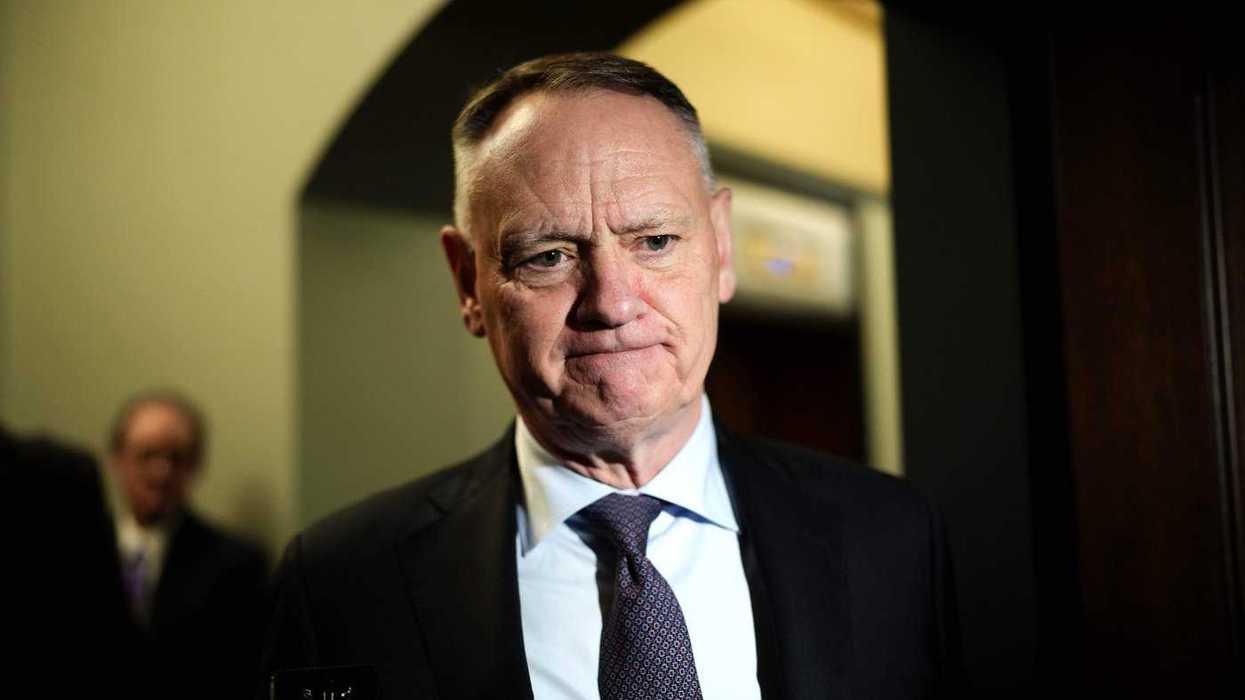
Defence Minister David McGuinty said Tuesday he can’t "divine" the thinking behind the Pentagon's recent criticism of Canada's defence spending — after the Trump administration took some symbolic steps to upend long-standing norms in North American continental security.
"The amount of co-operation that we are pursuing together under Norad has not changed. What we are doing together at NATO has not changed," McGuinty told reporters in Ottawa. "Our military-to-military co-operation has not changed."
Under U.S. Defense Secretary Pete Hegseth, the Pentagon has undermined the long-standing bilateral defence relationship as Ottawa continues to review its plans for a fleet of American F-35 fighter jets.
Hegseth last week issued a classified memo imposing restrictions on military co-operation with Canada on think-tanks and socializing.
On Monday, the Pentagon released what it called a "fact sheet" which said Canada's defence spending has limited the country's ability to contribute to the protection of North America.
The Pentagon in May also paused the Permanent Joint Board on Defense, an advisory forum for U.S.-Canada bilateral defence co-operation that was established in 1940.
A senior U.S. Department of Defense official said the memo was intended to ensure a unified objective during engagements with Canada. It does not affect military operations.
The official from U.S. President Donald Trump's administration briefed a small group of Canadian journalists Monday on background in order to speak more candidly about Canada-U.S. relations.
The official, who said the Pentagon is looking for Canada to commit to a realistic approach focused on military efficiency, cited the F-35 review.
The Liberal government has yet to reach a decision on its order of F-35 fighter jets from Lockheed Martin and the purchase has been under review for more than a year.
The official claimed the Canadian Armed Forces sees the F-35 jets as superior to the alternatives but Ottawa is focusing on a middle-power strategy and prioritizing industrial policy and parochial trade issues over defence commitments.
Canada has long faced criticism over its lagging defence spending but Trump's administration has connected it directly to larger trade issues, including the renewal of the Canada-U.S.-Mexico Agreement on trade.
Earlier this year, Canada announced it would purchase early warning planes from Sweden's Saab rather than Boeing.
Last March, Prime Minister Mark Carney said Canada had met for the first time the NATO requirement to spend the equivalent of two per cent of GDP on defence. The target was set in 2014 and Canada was among the NATO members which had never hit it.
When NATO members met last year in The Hague, they agreed to increase their defence spending to the equivalent of five per cent of GDP by 2035 — 3.5 per cent for core military and defence and 1.5 per cent for broader security and defence-adjacent investments that were loosely defined.
The U.S. official said it's good to see Canada make "modest" progress on defence spending but accused Ottawa of not having a realistic plan for the new NATO benchmark.
The U.S. official said the gap between rhetoric and reality in Ottawa is the widest among the NATO partners. They also said Canada's readiness under Norad is well below what is expected and the military organization doesn't have proper investment from Ottawa.
The Pentagon is exploring how to protect the United States in the event it cannot rely on Canada to meet its obligations, the official added.
McGuinty was pressed by reporters on whether Canada would meet the five per cent commitment. He said Canada has a path to spending the equivalent of four per cent of GDP on defence by 2030.
When asked how the U.S. reacted to Canada's four-per-cent plan, McGuinty's response was terse.
"Canada is a sovereign nation," he said. "I'll be very direct. We don't report to the United States."
The recent federal budget charted a course to meeting the spending targets by 2030 but did not look at spending beyond that year. That plan includes spending 2.6 per cent of GDP, or about $99 billion, on core military, including ammunition and soldiers' salaries.
"Canada has, for a long time, not lived up to our allies' expectations," said Jamie Tronnes of the Center for North American Prosperity and Security, a project of the Macdonald-Laurier Institute.
She added that should spur American and other allied militaries to double down on pushing Canada to increase its spending.
"A frozen relationship can only thaw with dialogue," Tronnes said in an email.
"The (Department of Defense) strategy of disengagement in public forums says more about what the secretary of the (Department of Defense) is trying to impose on his own department, which is a one-voice-speaks-for-all policy, rather than the best way to engage with allies, especially those who may not like the messenger."
This report by The Canadian Press was first published Nov. 24, 2026.
— Written by Kelly Geraldine Malone in Washington with files from Anja Karadeglija and Kyle Duggan in Ottawa
Copyright 2026, The Canadian Press. All rights reserved.