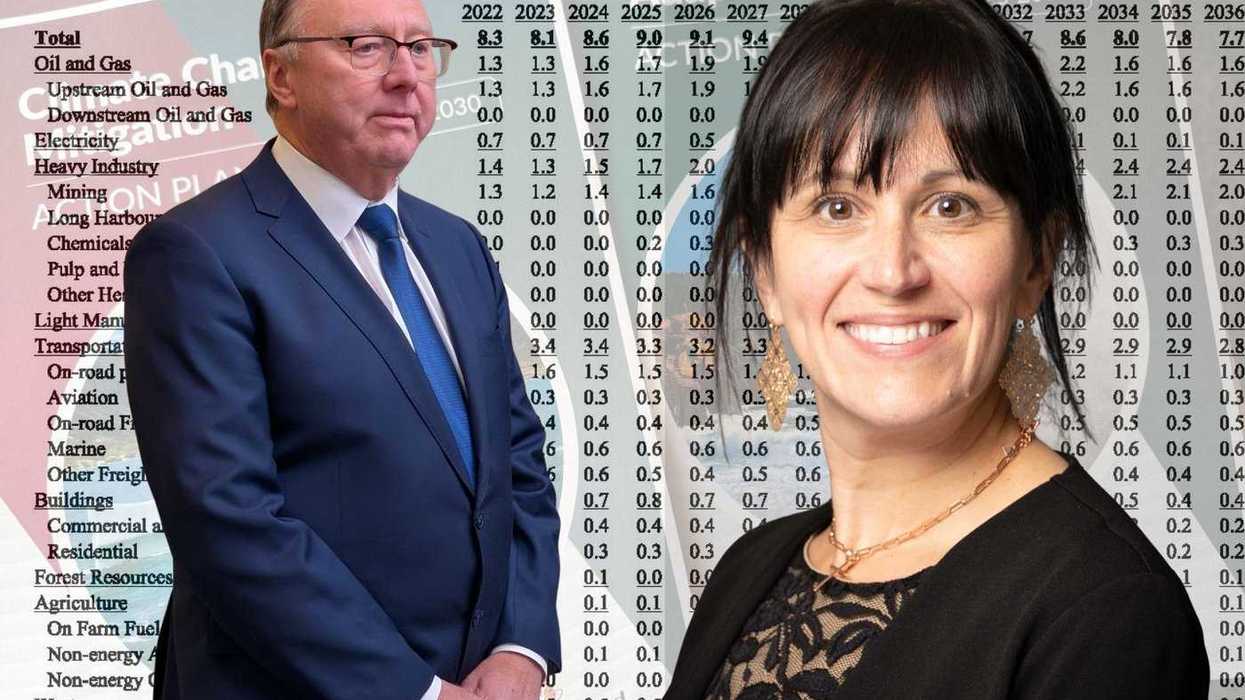
Newfoundland and Labrador will blow past its 2030 and 2040 climate targets and is at risk of failing to achieve its critical goal of achieving net-zero greenhouse gas emissions by 2050, according to internal government documents obtained by The Independent.
In a document from the Department of Environment, Conservation and Climate Change dated July 7, 2026 and obtained through an access to information request, the government forecasts Newfoundland and Labrador will be emitting 9.2 megatonnes (MT) of greenhouse gas emissions in 2030. The province’s 2030 emissions target is 7.2 MT, which represents a 30 per cent reduction from 2005 levels.
A megatonne is equivalent to one million metric tonnes of gas emissions, or roughly the equivalent of driving 217,000 passenger vehicles for one year.
Provincial NDP Climate Critic Sheilagh O’Leary says she’s “shocked and disgusted” by the projections, which she says “outline how dismissive successive governments – both PC and Liberal – have been in taking action on climate change and the refusal of the work that has to be done.”
A spokesperson from the department says the numbers disclosed in the document represent a “preliminary draft projection” that is “based on a new modelling approach being developed jointly by the Department of Environment, Conservation and Climate Change and the Department of Finance.”
On Wednesday Newfoundland and Labrador Environment Minister Andrea Barbour announced the government is set to launch a public and stakeholder engagement process to help inform the PC’s forthcoming climate strategy.
During his election campaign, Premier Tony Wakeham pledged to abandon the Liberals’ climate plan in favour of one, “with clear and achievable emission reduction targets, by sector,” the Progressive Conservatives’ platform reads.
The province’s existing climate plan, released under the former Liberal government in 2025, says achieving the 2030 target of 7.2MT, “will require continued implementation of existing programs to decarbonize passenger vehicles and residential and commercial buildings, continued investments by large industrial facilities to decarbonize their operations, and an increased focus on ‘hard-to-abate’ sectors such as marine and aviation transportation.”
It also calls Newfoundland and Labrador’s 2040 target of 4.1MT – a 60 per cent reduction from 2005 levels – “bold, but achievable.”
The province’s commitment to achieving net-zero emissions by mid-century aligns with the global consensus of what countries must do to limit warming to 1.5-2C to avert the worst impacts of global warming, which the United Nations says, already accounts for hundreds of thousands of deaths each year.
A UN report released this month, however, says our chance of limiting warming to 1.5°C “has been lost,” due to “decades of insufficient mitigation action.” It also says annual heat-related deaths attributed to climate change “reached a record-high” of more than 500,000.
O’Leary is worried Wakeham’s efforts to expand fossil fuel production in the province will mean his government’s new climate plan will be inadequate. “The concern certainly is that we have a governing party whose leader says that there’s no relation between climate change and oil and gas, and who is dedicated on expanding that industry in our province,” said the St. John’s East–Quidi Vidi MHA.
 NDP MHA Sheilagh O'Leary
Days before last fall’s provincial election, Wakeham said he didn’t believe there was a link between the oil industry and the 2025 wildfires that destroyed homes and communities in Conception Bay North.
The International Panel on Climate Change and climate scientists around the world have formed a consensus that global warming is driven by human activity, in particular the burning of fossil fuels like oil, gas and coal, which researchers say account for upward of 90 per cent of emissions.
The provincial Liberals, who also champion Newfoundland and Labrador’s offshore oil industry, aren’t as critical of the new projections as the NDP.
“It’s important to understand what has changed in these projections, what factors are contributing to the difference, and what additional measures may be needed to get the province on track to meet its target,” the party said in a written statement. “We urge the Conservative government to be clear about their updated plan to address climate change, and provide a commitment to reducing emissions over the long term.”
Though the public and stakeholder engagement process has not yet begun, the internal government documents suggest the PCs are already developing ways to ease the burden on industries.
According to Environment, Conservation and Climate Change’s August 2026 briefing binder, the department “is actively considering amendments to the industrial carbon pricing system to ensure it remains aligned with federal benchmark requirements while minimizing impacts on industry and maintaining provincial competitiveness.”
O’Leary says the Wakeham government needs to feel the urgency of the crisis. “The fact is that climate change impacts communities across our province, from St. John’s East–Quidi Vidi all the way to Northern Labrador, and we need to stop the denial and get to work."
Copyright 2026, The Independent. All rights reserved.
Justin Brake, Local Journalism Initiative Reporter, The Independent.