The word ‘kokum’ has entered the dictionary — but it’s deeper than a simple definition
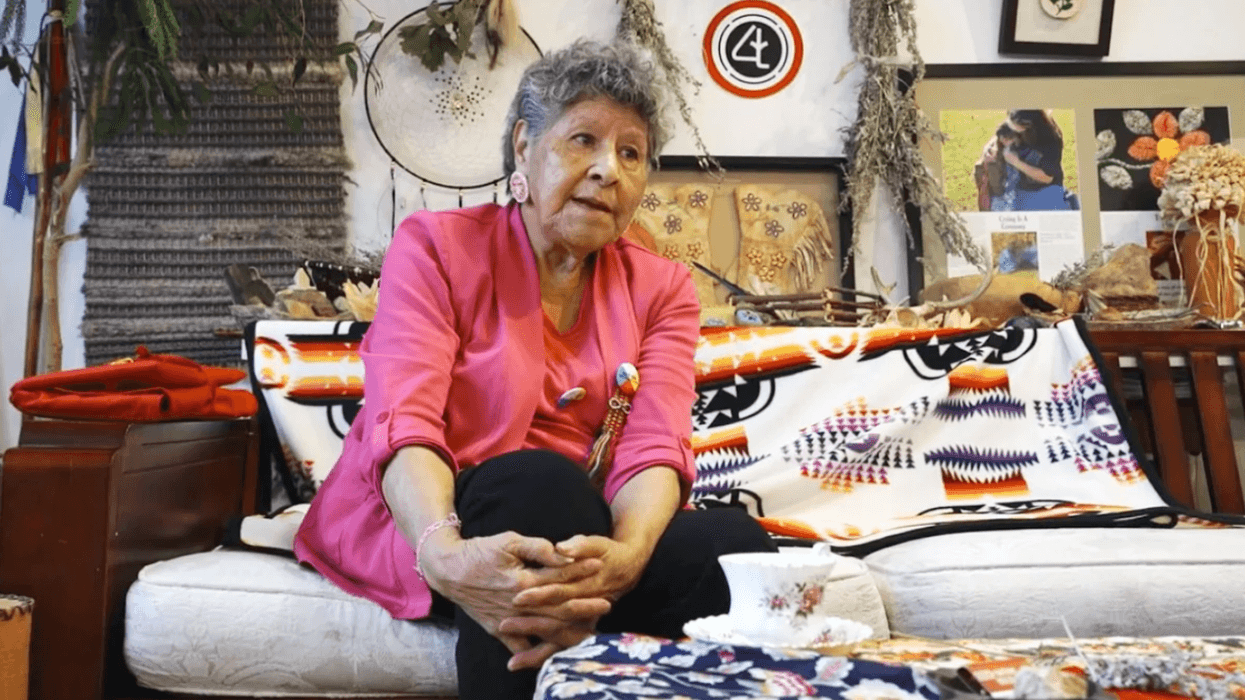
Kôhkom (grandmother) Elsie Paul was nervous about posting her first TikTok.
The young people Paul worked with at the Kohkum Kisewatisowin Society encouraged her to share her teachings online. Paul had established the society to pass on Cree language and teachings after being punished for speaking Cree at a day school in Saddle Lake.
“You could probably reach 500 people in one day,” her oskâpêw (helper), Kathy Hamelin, told her.
“Oh my,” Paul, who was 77 at the time, replied.
It was December 2021, and the COVID-19 pandemic was still keeping people apart. Hoping to reach more young people in the amiskwaciwâskahikan (Edmonton) community, Paul decided to try something new.
From her kitchen, the Cree-Métis knowledge keeper from Treaty 6 territory could share her culture with people beyond her immediate circle.
Ping! Her phone chimed.
Ping!
“I don’t know why this one keeps pinging,” said Paul.
“I bet it’s your TikTok,” Hamelin replied.
Within an hour, Paul’s first video, a 21-second clip of her dancing the Red River jig in her kitchen, had racked up 2,000 views. By the end of the day, that number had climbed to 12,000.
Paul couldn’t believe so many people had watched it.
“That many people around the world,” Hamelin laughed.
Paul soon became known as the #technokokum, with some of her videos reaching 350,000 views.
Her time on TikTok was relatively brief, ending when she retired in late 2022. But the response to her videos showed how far a Cree kinship term could travel, reaching people far beyond the communities where it originated — with comments like “thank you for being everyone’s kokum” and “I can smell the smudge and tea through the screen.”
In June 2026, kokum — an anglicized spelling of the Cree word kôhkom — entered the Oxford English Dictionary (OED).
According to the OED, it’s the first kinship term from an Indigenous language in “Canada” to be added to the dictionary.
For Danica Salazar, a lexicographer and the executive editor for “World Englishes” at Oxford Languages, the addition reflects a shift in how Indigenous Languages are represented in English.
“There’s something quite anthropological about most of our early evidence for these words,” she said in an interview with IndigiNews.
Words like muskimoot (bag or sack), shaganappi (rawhide strip, from pîsâkanâpiy) and pemmican (dried meat and berries, from pimîhkân) are all anglicized Cree words already recorded in the OED.
Those earlier entries often reflected the objects and cultural practices that outsiders encountered and documented.
“Kokum,” on the other hand, is the first example of a word rooted in the familiar relationships and everyday lives among Indigenous communities in “Canada.”
Salazar believes the addition reflects a growing influence of Indigenous communities on the English language, as their words circulate beyond the accounts of anthropologists and other outside observers.
“So that’s really interesting because you can really see the more direct influence of Indigenous languages on English,” she said, “without the third party involvement.”
But for Hamelin, the word’s inclusion raised another question: what happens to a word’s meaning once it’s recorded in English?
How a word enters the dictionary
To be considered for inclusion in the OED, a word must have an established presence in the English language
Oxford Languages, part of Oxford University Press, uses a vast digital collection of texts, known as a corpus, containing billions of words gathered from across the internet. Software helps lexicographers follow the ebb and flow of language, tracking which words are gaining momentum, how often they’re used, and by whom — whether in particular regions, communities or fields of study.
When lexicographers noticed “kokum” appearing more frequently in “Canadian” English, they flagged it for further research. They found evidence of its use dating back to 1973, when Métis writer Maria Campbell published her memoir Halfbreed, about growing up in Saskatchewan.
Hamelin remembers the impact Halfbreed had when it was first published.
“Everybody read that book,” she said. “It’s where a lot of people were introduced to that word.”
For Salazar, this first citation was particularly meaningful: rather than someone writing about an Indigenous community and the words its members use, it was a person from the community using the word herself.
Later examples traced “kokum” through newspapers and books, and eventually into social media and everyday vernacular.
But the word was also circulating in Indigenous artistic and cultural spaces. In 2019, the Cree Literacy Network shared Kokum Rap, a collaboration featuring “power-poets and power-kokums” including Campbell, Louise Bernice Halfe-Sky Dancer, Rita Bouvier, and Zoey Roy.
Salazar sees the word’s increasing visibility as part of a broader shift in the public acceptance of Indigenous languages and cultures. Words that were once discouraged, if not prohibited, are now increasingly celebrated.
“A grandmother can be on TikTok and call herself a techno kokum, and everybody thinks that’s great,” she said.
‘It’s so much deeper than just grandmother’
Although Hamelin is “thrilled” to see the word recognized by the OED, she takes issue with its spelling — “kokum” — and the dictionary’s definition of it as “a grandmother” or “one’s grandmother.”
“It’s kôhkom,” Hamelin — who is a kôhkom herself — asserted.
“’Kokum’ doesn’t mean anything. All the meaning is lost.”
But the OED records how words are adopted into English, including changes to their spelling, pronunciation and meaning. Its etymology of “kokum” also acknowledges the Cree spelling, kôhkom, which it translates as “your grandmother.”
Hamelin says even that translation doesn’t tell the whole story.
“That’s what it has come to mean,” she said.
In Cree, Hamelin explained, kinship terms change depending on whose relative someone is speaking about.
If she were talking about “your grandmother,” it’s kikôhkom, said Hamelin.
The language distinguishes between one’s own grandmother, another person’s grandmother, or the grandmother of someone being discussed.
Those distinctions are part of a much broader understanding of kinship.
She recalled a teaching the late Henry Luboucan shared with her about the origins of kôhkom. He connected the word to ohkomimâw, which Hamelin understood as meaning “leader.”
In the teaching Hamelin described, kôhkoms held the authority to question and veto family decisions made by okimâwak (chiefs), particularly those affecting the community’s political or economic life.
“It’s so much deeper than just grandmother,” she said.
You don’t have to have children of your own to become a kôhkom, either. Your siblings’ children can make you one, too. And there’s a saying. The more kôhkom’s you have, the richer you are.
“So if you have 10 kôhkoms, you’re a millionaire,” chuckled Hamelin. “People don’t understand because of the disconnection from our language and culture.”
These relationships carry responsibilities for care, guidance and passing knowledge between generations. Hamelin worries that much of this understanding has been weakened by the disruption of families and languages through the residential “school” system and the Sixties Scoop.
“A lot of people forgot how to say the words,” said Hamelin. “So they anglicize them without even knowing the full meaning.”
“If I’m talking to you about my grandmother: ninôhkom. If I’m asking you about your grandmother, I say kikôhkom. And if I’m asking you about that person’s grandmother, I’d say ôhkoma,” said Hamelin.
For Hamelin, that history is part of why she believes the OED has a responsibility to represent the word’s origins accurately, given its authority and the millions of people who rely on the dictionary as an authoritative source.
“But I’m not at all surprised,” she said of what she considers an inaccurate entry.
Salazar, however, described the OED’s role differently.
“It’s there to tell the story of the language,” she said. “We’re basically just following usage rather than dictating it. So we’re documenting it, recording it, studying it, rather than influencing it.”
Yet the question of a dictionary’s influence is difficult to separate from its own reputation. On its website, the OED describes itself as “widely regarded as the accepted authority on the English language.”
Whose history gets recorded?
Unlike many other English dictionaries, the OED is a “historical dictionary.” Its entries trace the development of words through documented examples of their use, sometimes spanning centuries.
But that written record is itself shaped by colonialism, which imposed written forms of documentation while suppressing Indigenous languages.
The OED’s earliest documented use of “kokum” therefore dates only to the 1970s, despite the word’s much longer history.
“Obviously, we cannot go back in time and listen to what people say. So it could very well be that if we could do that, we would have a much earlier date than 1973,” said Salazar.
The distinction between a word’s earliest recorded appearance in English and its history within Cree is especially important here. The dictionary’s written citations can establish when a word appeared in sources available to its researchers, while a word’s full history is often carried through oral teachings and community knowledge.
Salazar said the OED sometimes consults local language experts when researching words from other languages, but such consultations are uncommon.
“Only when information is missing,” said Salazar. “There was enough in the text for ‘kokum.’”
For “kokum,” OED etymologists drew on three online resources: the Online Cree Dictionary, the Dictionary of Moose Cree, and the East Cree Dictionary.
While the Online Cree Dictionary translates kôhkom as “your grandmother,” the Dictionary of Moose Cree lists ohkomimâw as “grandmother,” with ohkom as the stem and kôhkom meaning “your grandmother.”
Salazar acknowledged that words borrowed from historically oral languages should be traced through oral histories, not solely through written records. But she also pointed to the practical constraints of this approach, arguing that information must be recorded in some form to be accessible to researchers.
Audio recordings, she added, are relatively recent technologies in the history of languages. This reliance on recorded evidence, however, risks overlooking oral transmission itself as a knowledge system, through which language and its histories are passed down across generations.
Salazar said the OED is also hoping to introduce “moshum” — the anglicized spelling of môshom (grandfather) — in the near future.
That kinship word, like “kokum,” also appears in Halfbreed. But it doesn’t appear in literature as often as “kokum,” and so it didn’t make it into the 2026 round.
Hamelin believes the difference in their visibility may also reflect the impact of colonization on Indigenous men, including incarceration and premature death.
“The majority of our men die an early death or spend most of their lives incarcerated,” she said.
Hamelin stressed that mosômak (grandfathers) are valued just as much as kôhkomak (grandmothers).
“The mosômak deserve recognition,” she said. “I’ll look forward to seeing it in the dictionary.”
Despite her concerns about the dictionary entry, Hamelin said she doesn’t mind kôhkom becoming a more general word for grandmothers.
She recognizes that, for people separated from their languages, even an anglicized word can connect them to their families and cultures.
“It’s a way of preserving the language for people who don’t know it,” she said. “That small piece of language and culture keeps them anchored.”
Copyright 2026, IndigiNews. All rights reserved.
Amy Romer, Local Journalism Initiative Reporter, IndigiNews.