Alberta premier's office blames byelection loss on vote split; others say referendum
Alberta Premier Danielle Smith's office is blaming vote splitting among conservatives for a surprising Monday byelection defeat in what is supposed to be one of their Calgary strongholds.
However, voices from across the political spectrum took to social media Tuesday to say that if Smith’s UCP wants to point the finger of blame, it should be at themselves. Those critics say it was the upcoming referendum on quitting Canada that had voters ready to send a message.
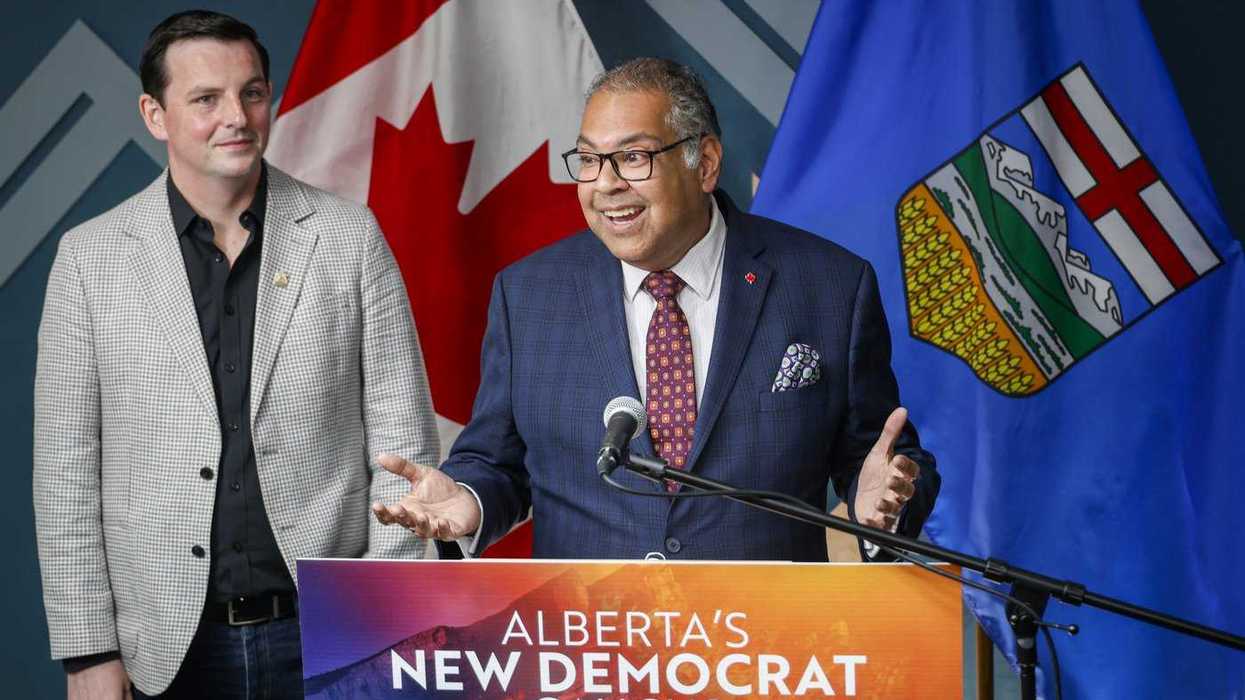
Kyle Campbell of the Opposition NDP defeated Mike Derry of the UCP in Calgary-Shaw voting Monday night.
The riding, created in 1986, has long voted conservative. The NDP had won the seat only once, in 2015, as part of the "orange wave" that brought former premier Rachel Notley into government.
Campbell collected 7,461 votes, which is 582 more than Derry. The UCP won the seat by nearly 3,400 votes in the 2023 election.
The byelection was the first to see former Smith cabinet minister Peter Guthrie field a candidate under his upstart Progressive Tory banner.
Guthrie's candidate, Kyle Joseph, finished third with 978 votes, which could have been enough to swing the vote in Derry's favour if they came from disaffected UCP voters.
Smith's office pointed to that possibility in a statement Tuesday.
“A split of the conservative vote along with a low overall turnout were the primary reason for the byelection result,” Smith's spokesperson Sam Blackett said.
“It’s more important than ever that Alberta conservatives remain united to avoid an economically ruinous NDP government."
Guthrie rejected the charge in an interview Tuesday, saying his Progressive Tory party didn't siphon votes from the UCP and that it comes down to Smith's party feeling that it is "owed" those votes.
"That's not the case. You should earn the vote," Guthrie said.
Guthrie also said support for his party is different than support for the UCP because, in his mind, Smith's party is no longer a truly conservative entity, but rather a “purely populist government.”
"We do not have a conservative government, so you're not splitting anything," said Guthrie.
While Smith's office blamed Guthrie, many conservative leaders took to social media to argue the byelection loss had more to do with the Oct. 19 referendum on whether Alberta should remain in Canada.
Former UCP premier Jason Kenney said the debate on quitting Canada is alienating conservative voters who love the country, pushing some into the arms of left-centre opponents such as the NDP.
“A vote to separate is a vote to help the NDP win the next provincial election and for the Liberal Party of Canada to win far more Alberta seats,” Kenney wrote on X.
Ken Boessenkool, a longtime conservative strategist and signatory of the famous 2001 Alberta firewall letter, said he reads the byelection result as voters being unhappy they're dealing with separatism at a time when more serious issues need addressing.
The UCP loss, he wrote on X, is “a welcome rebuke for distracting Albertans with a foolish, dangerous and undemocratic referendum.”
Michael Solberg, a former staffer to former Conservative prime minister Stephen Harper, also weighed in.
“The growing brand of rage-farming ‘conservative’ who supports separation and pushes conspiracy theories and fake narratives is UNELECTABLE anywhere," Solberg said on social media.
Cory Morgan, a conservative commentator who leads a third-party advertising outfit pushing for the province to separate from Canada, said online that the results show Smith has angered her base by "trying to play both sides of the unity issue," prompting many to stay home for the byelection.
Smith has said she had no choice but to put separation on the referendum ballot and put the contentious issue to rest. The question asks voters whether Alberta should stay in Canada or hold a second binding referendum on quitting Confederation.
Opponents say Smith has no mandate to quit Canada and that she is just doing the vote to hold at bay separatist hardliners in her party.
The NDP made the referendum a key part of the byelection campaign, urging voters to send a message to Smith that they don't want a government catering to separatists.
On Tuesday, Campbell and NDP Leader Naheed Nenshi told reporters in Calgary that when the separation vote came up at the doors with byelection voters, there was predominant support for remaining in Canada.
"People are really angry about it," Nenshi said. "We deserve a government that is unapologetically, proudly Canadian. A government that doesn't distract us with costly referendums to save their own political skin."
But Nenshi said the referendum wasn't the main issue he was hearing, and that Calgary-Shaw residents also brought up more day-to-day concerns like health care, education and affordability.
Guthrie said the separation vote was the dominant concern on the Calgary-Shaw doorsteps and that Smith's actions have given many voters the impression her UCP supports separation, despite the premier saying she wants Alberta to stay in the Confederation fold.
Calgary Mayor Jeromy Farkas also said he thought the separation issue cost Smith's government and said the result should be a "reality check" that Calgarians can't be taken for granted.
"I get that at this point in time a majority of UCP voters support separating from Canada, but that's not where the mainstream of Calgary and Alberta and Canada runs," Farkas told reporters at city hall.
"If you run a conspiracy theory peddling separatist (as a candidate), you're not going to win in Calgary."
Smith's loss in Calgary-Shaw may resonate beyond the byelection. The next provincial election is set for Oct. 18, 2027, and Calgary is considered the linchpin.
The NDP has dominated Edmonton in recent elections while the UCP takes the smaller cities and the rural areas, making Calgary a critical path to electoral success.
In the 2023 general election, won by the UCP under Smith, the NDP won 14 of the 26 seats in Calgary — a stark turnaround after the party captured just three seats in the city in 2019.
Political scientist Lori Williams called the byelection result a "significant loss" for Smith, but also said it's difficult to take firm lessons from byelections.
Williams agreed that the upcoming referendum played a role in the NDP's win, adding that the UCP candidate being endorsed by some in the independence movement could have been an additional liability.
But she also said perceptions of Smith's performance on long-standing priorities for Albertans like health care and affordability played a significant role.
"It's that sort of one-two punch that's really generated the result in this byelection," said Williams, with Mount Royal University in Calgary.
Colin Aitchison, a former UCP press secretary who now works as a managing director with public affairs firm Enterprise Canada, said he thinks the byelection shouldn't be taken as a sign of how the 2027 election could unfold.
He agreed with Smith's office that Guthrie's Progressive Tories split the conservative vote, but also said the referendum could've been a factor.
"We'll see when we have higher voter turnouts and the referendum (is) behind us what that kind of looks like."
The seat flip means the ruling UCP holds 47 of the legislature's 87 seats. The NDP has 39, and Guthrie has the lone Progressive Tory seat.
This report by The Canadian Press was first published Sept. 15, 2026.
-- With files from Lisa Johnson in Edmonton and Bill Graveland and Dayne Patterson in Calgary.
By Jack Farrell | Copyright 2026, The Canadian Press. All rights reserved.