Eby backs down, seeks joint path on Indigenous law
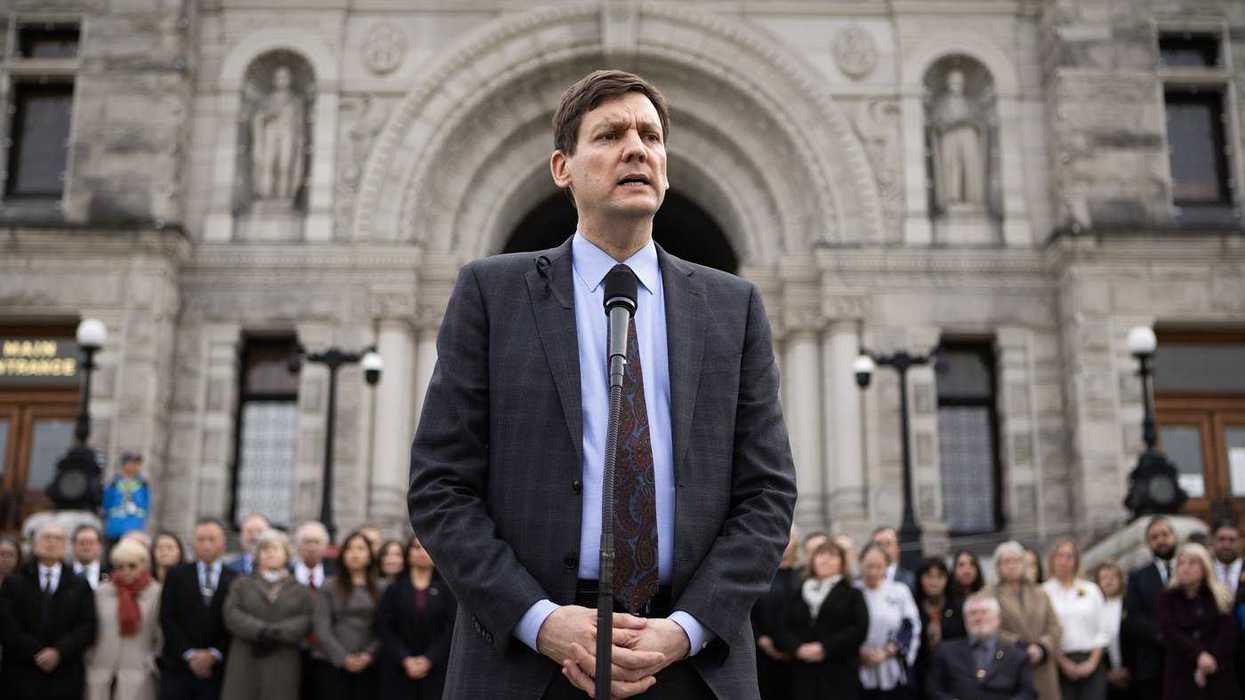
British Columbia Premier David Eby has backed down again on the pausing of key parts of the Declaration on the Rights of Indigenous Peoples Act, scrapping plans to table a suspension bill this legislative session.
The premier’s office says in a brief statement that it "can confirm that the government will not be introducing legislation on DRIPA during this session."
Instead, it says Eby will hold a press conference Monday to outline next steps.
A draft document provided by a First Nations source says the government now hopes to work with First Nations to come up with a joint approach to DRIPA, under a framework for negotiations.
Eby met with First Nations leaders late Sunday afternoon, one of whom says the suspension law was withdrawn as a result of planned protests.
The premier has said a recent court decision on B.C.'s mineral claims regime that cited DRIPA put the province at serious litigation risk, while First Nations have said the law should not be changed.
The draft government document says the goal now is to "arrive at a set of recommendations, supported by First Nations in B.C. and the Province of B.C." on how to implement DRIPA.
The document provided to The Canadian Press says there is "no commitment to either a) make amendments, or b) not make amendments to DRIPA."
It is labelled as being subject to an NDA, or non-disclosure agreement.
The document outlines how discussions between the government, First Nations and other stakeholders could take place, and says there will be a "focus on reaching a shared understanding of how legislative alignment (with DRIPA) could most effectively work, in a manner led by First Nations and government but supported by the courts."
It says the first meetings could take place within two weeks of the process being announced.
The now-scrapped plan to table the suspension bill on Monday lasted just a few hours after it emerged Sunday, and was immediately repudiated by First Nations leaders who have also opposed previous plans to amend DRIPA instead.
Attorney General Niki Sharma and Indigenous Relations Minister Spencer Chandra Herbert were also at the meeting with First Nations leaders late Sunday to discuss the latest moves on DRIPA, according to information provided by a source attending the online gathering.
A First Nations leadership source in the meeting said the government was "withdrawing the proposed (suspension) legislation because we have agreed to work together to address each others concerns.”
The source said the First Nations leaders and the government agreed "to develop a joint statement on the basic agreement to work together between now and next legislative session."
The current session ends on May 28, with sittings resuming in September.
“It’s not agreed on, but it will be the starting point I suspect," a First Nations source said of the draft document. "It’s workable.”
Sunday's developments represent the latest climbdown for Eby on DRIPA, which was intended to reflect the United Nations Declaration on the Rights of Indigenous Peoples.
But the December court ruling on mining regulations had prompted concerns about the potential sweeping impact of DRIPA on B.C.'s laws, with the court saying DRIPA should be interpreted to give "immediate legal effect" to UNDRIP.
That prompted Eby to pledge amendments to DRIPA, saying these were "non-negotiable" — a stance that infuriated First Nations leaders, resulting in the amendments proposal being dropped.
Then came a plan to suspend key parts of DRIPA for three years, which Eby said would give the Supreme Court of Canada time to rule on the government's appeal in the mining case. He said he would make the vote on the suspension a confidence vote, meaning his government with its one-vote majority would fall if it failed.
But that plan, too, was roundly condemned by First Nations, with Grand Chief Stewart Phillip saying his NDP MLA wife, Joan Phillip, did not support it.
The idea of a confidence vote was then also scrapped.
The next plan, to table the suspension bill in a non-confidence vote on Monday, had prompted the First Nations Leadership Council to tell legislators to reject it, before the proposal was also swiftly dropped Sunday afternoon.
This report by The Canadian Press was first published April 19, 2026.
By Alessia Passafiume and Wolfgang Depner | Copyright 2026, The Canadian Press. All rights reserved.