9 federal tax credits that could reduce how much you owe on your tax return this year
If you don't want to owe the government money, these tax credits could help!
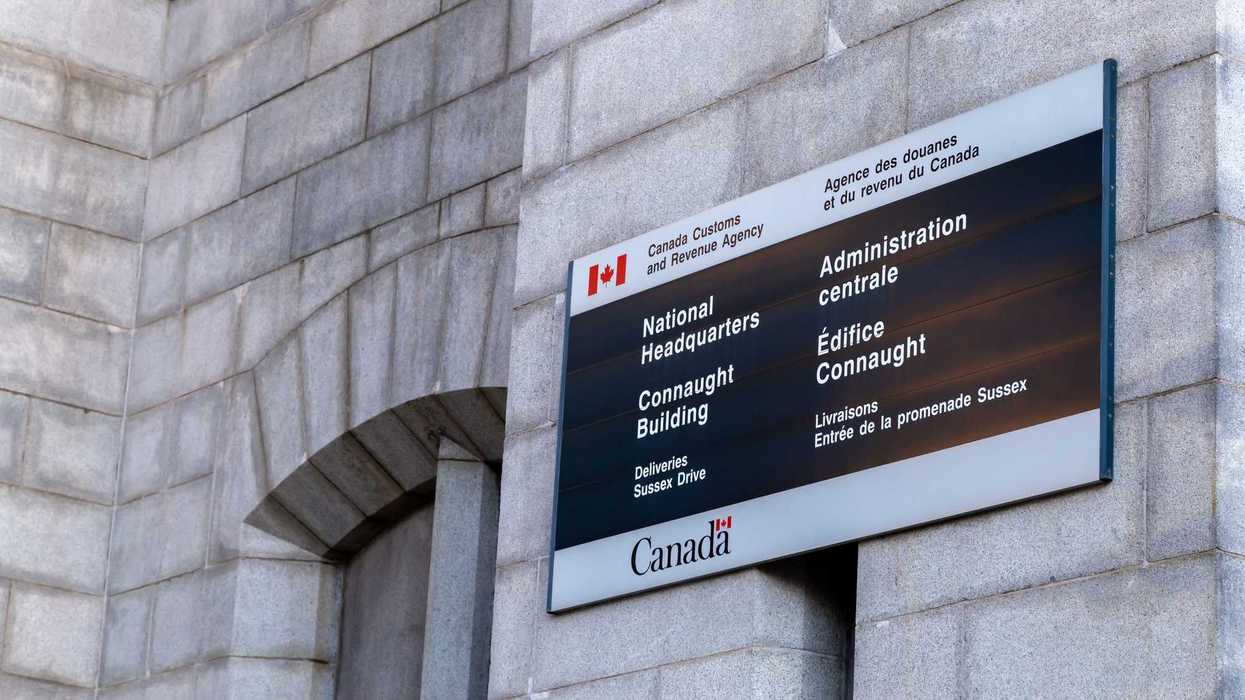
Canada Revenue Agency sign.
There are some tax credits you should know about when filing your return this year.
That's because you could reduce the amount of tax you owe the federal government by claiming these credits and deductions.
Canada Revenue Agency (CRA) has a list of all the federal non-refundable tax credits that are claimable on tax returns.
A tax expert told Narcity that these non-refundable tax credits are "essential because they directly reduce the amount of income tax you owe to the government."
So, here are a few of the non-refundable tax credits and deductions you could be eligible to claim when filing your 2025 taxes in Canada this year.
Basic personal amount
The basic personal amount is a non-refundable tax credit that lets you earn a minimum amount of income before having to pay federal income tax.
Stefanie Ricchio, a CPA and TurboTax spokesperson, told Narcity that the basic personal amount works alongside federal brackets to ensure "low-income earners pay little to no federal tax."
You can earn up to $16,129 tax-free for the 2025 tax year.
"When you file, your total tax is calculated based on your brackets, and then the basic personal amount is applied to reduce that amount," Ricchio said.
The amount you can claim depends on your net income for the year.
According to the CRA, if your net income on line 23600 of your return is:
- $177,882 or less, claim $16,129
- more than $253,414, claim $14,538
If that doesn't apply to you, then you have to use the Federal Worksheet to calculate your claim.
You have to enter the federal basic personal amount on line 30000 of your federal tax return.
On line 58040 of your provincial or territorial Form 428, you have to enter the provincial or territorial basic personal amount.
Top-up tax credit
The top-up tax credit is new, and you may be able to claim it if you're also claiming certain non-refundable tax credits that are affected by the reduction to the lowest marginal individual income tax rate from 15% to 14.5% for 2025.
Gerry Vittoratos, a tax specialist with UFile, told Narcity that this credit temporarily re-establishes the tax credit rate to 15% for taxpayers who are in the second tax bracket.
"It prevents taxpayers with large credits from losing value," Vittoratos said.
You have to complete the chart for line 34990 using your Federal Worksheet. Then, you have to enter the result on line 34990 of your federal return.
Disability tax credit
The disability tax credit is a non-refundable tax credit that helps reduce the amount of income tax people with disabilities, or their supporting family member, may have to pay.
You can apply for the credit at any time during the year or when you file your taxes.
But if you submit your application at the same time that you file your tax return, there may be a delay in your tax assessment. That's because the CRA has to review your disability tax credit application before assessing your tax return.
If you're the person with the impairment, enter the disability amount on line 31600.
If you're a supporting family member other than a spouse or common-law partner of the person with the impairment, enter the disability amount on line 31800.
If you're a spouse or common-law partner of the person with the impairment, enter the disability amount on line 32600.
Canada caregiver credit
The Canada caregiver credit is a non-refundable tax credit that helps people who support family members with a mental or physical infirmity.
For your spouse or common-law partner, you may be able to claim:
- $2,687 on line 30300
- up to $8,601 on line 30425
For eligible dependants 18 years of age and older who qualify for line 30400, you may be able to claim:
- $2,687 on line 30400
- up to $8,601 on line 30425
For eligible dependants under 18 years of age who qualify for line 30400, you may be able to claim one of the following:
- $2,687 on line 30400
- $2,687 on line 30500
You may be able to claim $2,687 on line 30500 for each of your, your spouse's or your common-law partner's children under 18 years of age at the end of the year.
For dependants 18 years of age or older, you may be able to claim up to $8,601 on line 30450 if they're not your spouse or common-law partner, or an eligible dependant claimed on line 30300 or line 30400.
You have to complete Schedule 5, Amounts for Spouse or Common-Law Partner and Dependants, to calculate your claim amounts. Then, you have to enter the results on whichever of the lines applies to you.
Home buyers' amount
The home buyers' amount is a non-refundable tax credit that helps first-time home buyers with some of the costs of purchasing a qualifying home.
It reduces the federal income tax you may owe, but you won't get a refund for this credit if you don't have any tax payable.
Generally, you can claim the home buyers' amount if you meet both of the following conditions:
- you (or your spouse or common-law partner) acquired a qualifying home
- you didn't live in another home inside or outside Canada that you (or your spouse or common-law partner) owned in the year of acquisition or in any of the four preceding years, unless you are a person with a disability
You can claim up to $10,000 for the purchase of a qualifying home in 2025.
If you're not splitting the credit with a spouse, common-law partner or an eligible person who jointly acquired the home, you enter up to $10,000 on line 31270 of your federal tax return.
Home accessibility tax credit
The home accessibility tax credit is a non-refundable tax credit to help homeowners cover the costs of renovations that make their home more accessible.
You may be eligible to claim this tax credit if you incurred eligible expenses for a qualifying renovation that improves accessibility or reduces the risk of injury in an eligible dwelling.
Generally, you can claim home accessibility expenses if you meet both of the following conditions:
- you are a qualifying individual, or an eligible individual making the claim for a qualifying individual
- you incurred eligible expenses for a qualifying renovation to an eligible dwelling
A qualifying individual can claim up to $20,000 per year in eligible expenses.
You have to complete the chart for line 31285 using your Federal Worksheet. Then, you have to enter the result on line 31285 of your federal tax return.
Interest paid on your student loans
You may be eligible to claim an amount for the interest paid on your student loans in 2025 or the preceding five years for post-secondary education if you received it under:
- the Canada Student Loans Act
- the Canada Student Financial Assistance Act
- the Apprentice Loans Act
- provincial or territorial government laws similar to the acts above
Only the student borrower legally responsible for the loan can claim this credit. If someone else, like a parent, paid the interest on your behalf, you can still claim the credit if the loan is in your name.
There is no fixed maximum limit, so when filing your taxes, you can claim the total amount of interest you paid on your qualifying student loans.
On line 31900 of your federal tax return, enter the federal amount you're eligible to claim for the interest paid on your student loans.
On line 58520 of your provincial or territorial Form 428, enter the provincial or territorial amount you're eligible to claim for the interest paid on your student loans.
Donations and gifts
If you or your spouse or common-law partner gave donations and gifts to certain institutions, you may be able to claim federal and provincial or territorial non-refundable tax credits on your tax return.
Generally, you can claim part or all of the eligible amount of your gifts, up to 75% of your net income for the year.
Qualified donees include registered charities, registered non-profit organizations, registered Canadian amateur athletic associations, registered national arts service organizations, the United Nations, and others.
On line 34900 of your return, enter the amount calculated at line 23 of Schedule 9, Donations and Gifts.
Volunteer firefighters' amount and search and rescue volunteers' amount
You can claim $6,000 for the volunteer firefighters' amount or search and rescue volunteers' amount, but not both, if you meet all of the following conditions:
- you were a volunteer firefighter or a search and rescue volunteer during the year
- you completed at least 200 hours of eligible volunteer firefighting services or eligible search and rescue volunteer services in the year
If you claim the $6,000 volunteer firefighters' amount or search and rescue volunteers' amount, add the amounts from boxes 87 and 14 of your T4 slips and enter the result on line 10100. Then, enter $6,000 on line 31220 or line 31240 of your return.
This article's cover image was used for illustrative purposes only.