Canada's premiers react to U.S. trade war with calls for unity and economic support
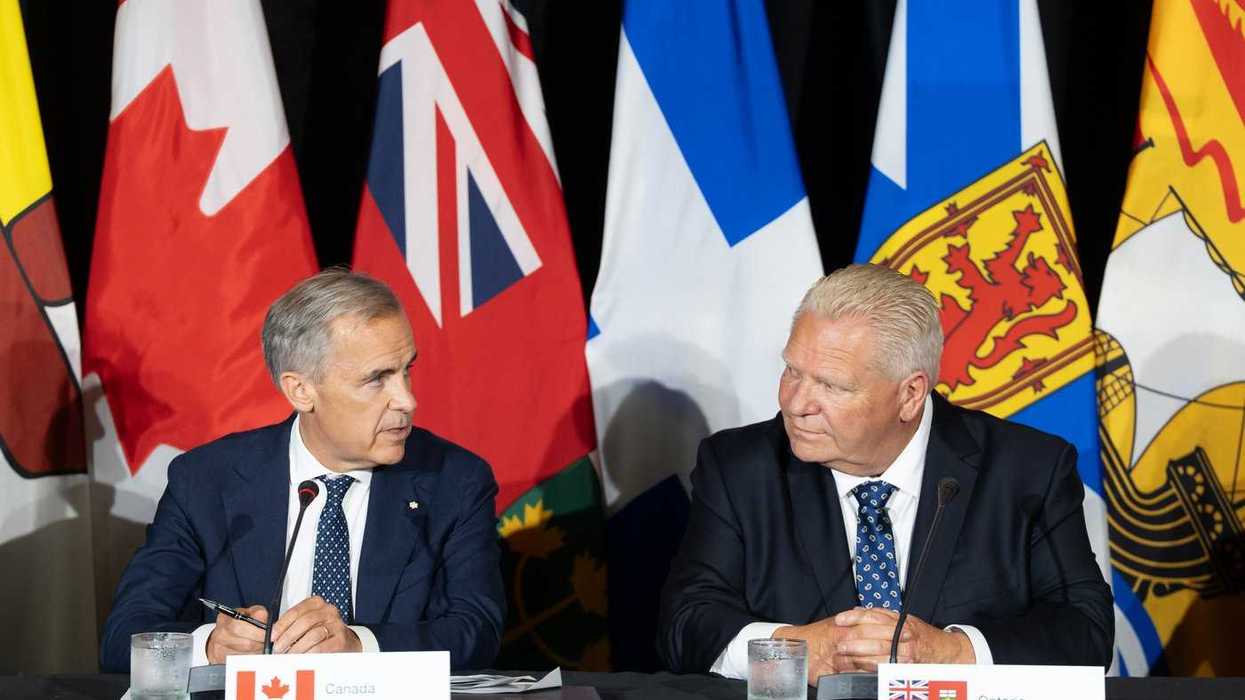
Several premiers across Canada showed a united front on Saturday after waking up to find their country in a trade war with the United States.
Manitoba Premier Wab Kinew said after a virtual meeting with premiers and Prime Minister Mark Carney that there is a strong sense of unity, and his government is behind Canada's retaliatory measures beginning next month.
"All Canadians are united in the pride that we feel for our country, and the disappointment we feel for (U.S. President) Donald Trump and his administration," Kinew told a news conference on Saturday afternoon.
"(Trump's) not in touch. He doesn't care about the American people and the cost of living."
Trump introduced new 50 per cent tariffs on billions of dollars in Canadian exports on Saturday after trade talks failed the night before.
Carney has fired back, pledging to match Washington's tariffs dollar-for-dollar beginning next month, targeting sectors such as steel, dairy, appliances, agricultural equipment, pulp and paper and electronics.
Ontario Premier Doug Ford had been silent for days about the trade talks. But on Saturday afternoon, he applauded Carney's decision to walk away from the United States' trade deal offers, saying Trump cannot be trusted.
"President Trump is the type of person that would steal your lunch money the first day, he'd steal the toque off your head the second day, and the third day he'd steal your running shoes," Ford told reporters.
He called on the country's premiers to stick together as Team Canada.
"We can't have an outlier," Ford said. "We need the group of all premiers across the country to fight like they've never fought before."
Carney said he called off talks Friday night with the U.S. because they offered a "bad deal" and were pushing terms he found unacceptable. The Americans were trying to restrict Canada's ability to make deals with other trading partners, and they tried to restrict Canada's protections for the French language, Carney told reporters on Saturday.
"It's a power play, and it becomes a question of sovereignty," he said.
When asked if Canada was in a trade war with its southern neighbour, Carney said, "Yes, that's obvious."
"You're at war when you get attacked, we got attacked," he added.
British Columbia Premier David Eby said in Vancouver that Canada was in an abusive relationship with the United States. "They cannot have a positive relationship with Canada and benefit from what is in this country, while at the same time attacking us," Eby said.
“The suggestion that Canada would not trade with other countries or reduce our trade with other countries because the Americans tell us to, would reduce us to the economic equivalent of the 51st state."
Quebec Premier Christine Fréchette said the new 50 per cent tariffs will affect $7.7 billion of goods from her province.
"To that we can add the tariffs that are already in place on aluminum, on steel, lumber, softwood, copper," she told reporters. "Quebec actually is the most impacted by these tariffs since the beginning of this trade war."
She announced a suite of programs for businesses to help offset the tariffs' financial hits and said she'd ask Carney for more help. Fréchette also urged Quebecers to buy local products.
Susan Holt, premier of New Brunswick, also encouraged people to support local businesses and seek out products made close to home.
"Some New Brunswick businesses have now been hit with an unjustified tariff that will hurt our economy, workers and families," she said in a statement. "Now, more than ever, we need to double down on buying local and supporting New Brunswick businesses and workers.”
Alberta Premier Danielle Smith said she was disappointed trade talks collapsed and that people should not cheer for Canada’s retaliatory measures.
“We shouldn't be cheering if our farmers have to pay 50 per cent more for all the equipment that they need to produce our food. That's not a success for us. It’s something we should be lamenting," Smith told a call-in radio show that aired in Alberta on Saturday.
She said she hoped negotiators would soon resume talks.
Other premiers weighed in with statements on social media, encouraging their counterparts to stay together and applauding Carney for standing up to Trump.
"It’s clear that we cannot trust or rely on the United States as we once did. This reality must make us more determined than ever to make Nova Scotia and Canada stronger," wrote Tim Houston, premier of Nova Scotia.
Newfoundland and Labrador Premier Tony Wakeham and Saskatchewan Premier Scott Moe said Carney has their full support.
Prince Edward Island Premier Rob Lantz said the Team Canada approach has been working.
"We need that same strength and unity now," he said.
The new U.S. tariffs target $28 billion in Canadian goods ranging from hockey sticks and honey to essential oils and dairy products. U.S. Trade Representative Jamieson Greer said Friday that the U.S. and Canada had "declined" to finalize a tentative agreement, and laid the blame entirely on Canada.
Carney said more details on retaliatory measures, as well as supports for affected sectors, will be announced in coming days.
The counter tariffs are set to come into force on Sept. 8, the day after Labour Day.
This report by The Canadian Press was first published Aug. 22, 2026.
Copyright 2026, The Canadian Press. All rights reserved.