DULF Wins Constitutional Challenge, Judge Applauds Their Work
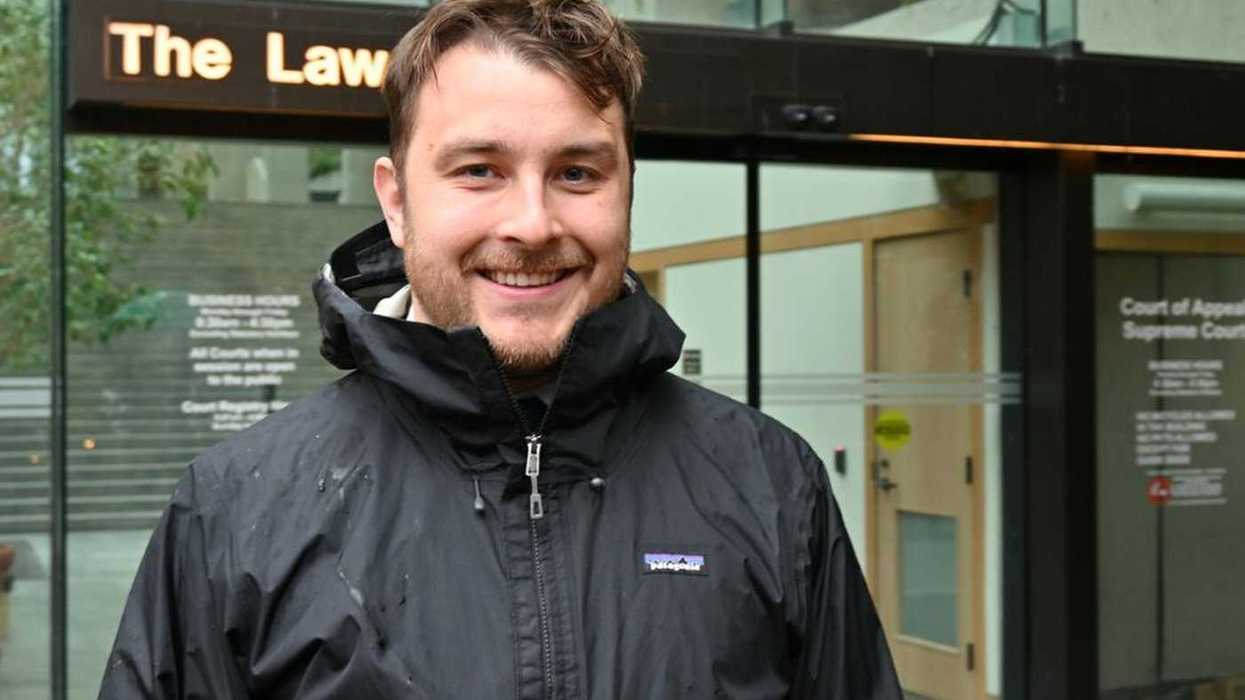
Drug User Liberation Front co-founders Eris Nyx and Jeremy Kalicum will not face jail time, Justice Catherine Murray ruled this morning.
Nyx, Kalicum and their lawyers have been appearing before Murray in BC Supreme Court for almost a year, first facing trafficking charges and later in a constitutional challenge.
Their ultimate goal has been to push for a novel response to the ongoing public health emergency caused by the unregulated toxic drug supply.
Through the Drug User Liberation Front Nyx and Kalicum had provided tested methamphetamine, cocaine and heroin to DULF members at cost. The idea was to allow people with substance use disorders to understand the makeup of the drugs they were taking to avoid overdose and death.
“You selflessly put yourselves to the side for this cause and that’s something most people wouldn’t do. For that I applaud you. You should be very proud of yourselves,” Murray said, directly addressing the pair in court as she delivered her judgment.
Murray has declared Section 5(2) of the Controlled Drugs and Substances Act unconstitutional and given Ottawa six months to bring the legislation in line with the Charter of Rights and Freedoms.
As a result of this finding, Nyx and Kalicum’s trafficking convictions have been stayed.
If Ottawa doesn’t fix the legislation within the six-month timeframe Murray has mandated, it will no longer be in force.
It’s likely the government will apply for more time to fix the legislation, said Tim Dickson, one of DULF’s lawyers, after the judgment was delivered.
Dickson said today’s judgment was a “vindication” of what DULF was doing.
“The court has declared the prohibition on possession for the purposes of trafficking to be unconstitutional because it violates the Charter rights of individuals who need non-medicalized safer supply to reduce the terrible risks of this toxic drug criss we are suffering under,” Dickson said.
Why DULF was in court
Nyx and Kalicum argued that the law that convicted them both of three counts of trafficking methamphetamine, cocaine and heroin was unconstitutional.
Because the pair had been selling drugs to compassion club members to reduce harms and fatalities caused by the unregulated drug supply, DULF’s lawyers Tim Dickson, Stephanie Dickson and Kaelan Unrau contended that shutting down the club violated Section 7 and Section 15 of its members’ Charter rights.
Murray delivered a judgment today that aligned with this argument.
Murray agreed that a non-medicalized safer supply program is urgently needed to save lives and found that DULF had been reducing the harms associated with the toxic drug crisis while having no negative impact on the community or public safety.
She also agreed there was no way for a compassion club or non-medical safer supply program to source legal drugs and no legally and practically available safety valves in the Controlled Drugs and Substances Act to support such a program.
She also said Section 5(2) of the Controlled Drugs and Substances Act was unconstitutional because it prevented a non-medicalized safer supply program from operating during the ongoing toxic drug crisis.
This infringed on DULF compassion club members’ rights to life, liberty and security of the person and their right to be treated equally under the law, which are guaranteed under Sections 7 and 15 of the Charter of Rights and Freedoms.
“It’s people like you who make a difference,” Murray told Nyx and Kalicum. “And you just did. So go out and do great things. I have no doubt that you will.”
Starting the Drug User Liberation Front
Nyx and Kalicum met in 2020 and bonded over a shared vision for the future, where no one died after taking unregulated drugs.
As of June the unregulated, toxic drug supply has killed at least 19,906 British Columbians since January 2014, according to the latest data from the BC Coroners Service.
Nyx and Kalicum wanted people who use drugs to be able to access drugs that had some safety protocols.
If people knew what they were taking they wouldn’t have to overdose, Nyx told the court.
The pair began buying and testing drugs, and then giving away tested, labelled drugs for free at rallies.
They applied for a Section 56 exemption to the Controlled Drugs and Substances Act from Health Canada, asking for permission to buy and sell methamphetamine, cocaine and heroin through a compassion club.
They were denied. They decided to open a compassion club anyway.
At the start of the trial, Nyx told the court she has responded to more than 100 overdoses.
“This is a calamity beyond words. This is a horror beyond words. This is a travesty,” Nyx said. “This is gutting my community and killing everyone I know.”
The compassion club welcomed 47 members with previous drug use experience. Members could buy pure, tested drugs at cost.
There was a limit to how much a member could buy in a week.
DULF partnered with Vancouver Coastal Health Authority, which provided funding for DULF to test its drugs, and permission to store, test and package the drugs.
Vancouver Coastal Health Authority also provided DULF with office space in the Downtown Eastside, which it used for storage and a storefront for compassion club members.
But this partnership did not cover the selling or distribution of drugs.
Vancouver Police raided DULF’s office space and arrested Nyx and Kalicum on Oct. 25, 2023. Nyx and Kalicum were both found guilty of three counts of trafficking on Nov. 7.
Launching a constitutional challenge
Two and a half weeks later, DULF launched a constitutional challenge.
DULF’s lawyers argued government action violated Section 7 of the Charter of Rights and Freedoms, which prohibits the state from depriving people of their rights to life, liberty and security of the person, and Section 15, which says all people must be treated equally and have equal protection and benefit from the law.
This case boiled down to the Section 56 exemption DULF had requested from Health Canada.
The federal health minister can grant exemptions under Section 56 of the Controlled Drugs and Substances Act to allow people to violate the legislation in extraordinary cases.
DULF lawyers argued exemptions were not practically available. They said that meant the Controlled Drugs and Substances Act violates Charter rights. Crown counsel disagreed and argued the safety valve was available.
In her judgment Murray agreed with DULF’s lawyers, saying there was no practical way a non-medicalized safer supply program could get a Section 56 exemption. Ottawa will now have to figure out a way to make sure such a safety valve exists in practice.
The Crown has 30 days to appeal Murray’s decision.
Like ‘a gun always at the back of your head’
Throughout the charter challenge DULF lawyers called 14 witnesses to help explain why DULF chose to open an unsanctioned compassion club.
The compassion club ran what is known as a non-medical safer supply model, where interacting with a doctor is not required to access drugs.
This model is recognized by B.C. experts as a solution to the crisis’s catastrophic death toll.
The BC Centre on Substance Use, Vancouver Coastal Health, Fraser Health and the BC Centre for Disease Control took five years to try and figure out a way to develop a non-medical model, but in the end weren’t able to find a legal way.
Other experts, including Provincial Health Officer Dr. Bonnie Henry, and experts for two death review panels convened by the province’s chief coroner, have called on the province to explore a non-medical safer supply model. So far the province has declined to do so.
Instead the province offers a medical model of safer supply, where a patient gets a prescription from a doctor to use pharmaceutical drugs. This model is extremely limited and only a fraction of the people who could benefit from it can access it.
TJ Felix, who is Secwe̓pemc and uses they/them pronouns, testified about why the services B.C. currently offers to respond to the unregulated toxic drug crisis didn’t work for them.
Using drugs from the unregulated market feels like “a gun always at the back of your head,” but withdrawal from opioids feels “like every nerve ending exploding. It’s like you’re being dragged through a bed of nails,” they said. “It’s indescribable, horrific and painful. You’d do anything you could to avoid it.”
DULF offered stability because members didn’t have to worry about withdrawal or the danger of the unregulated supply, Felix told the court.
Felix said sometimes they would share drugs they had bought from DULF with loved ones.
After seeing a loved one fatally overdose “many times,” Felix said they’d do anything to try and separate their loved ones from the unregulated drug supply.
Giving drugs to someone other than the person they were prescribed or sold to is known as “diversion.”
Politicians critical of safer supply, such as MLA Elenore Sturko, say the risk of diversion outweighs the benefits offered by the program.
But diversion from safer supply programs is minimal at best, testified Lisa Lapointe, who worked as B.C.’s chief coroner for 13 years.
Only three per cent of the Dilaudid dispensed in B.C. in 2024 was for the safer supply program, with the other 97 per cent dispensed for reasons unrelated to safer supply, such as for pain management, Lapointe said.
Patients prescribed Dilaudid for pain do not have to take their medication in front of a pharmacist or provide urine tests to their doctor.
It’s also not clear if Dilaudid pills seized in police drug raids are actually diverted pharmaceuticals or if they’re unregulated knockoffs, Lapointe said.
In 2023 the Vancouver Police Department said Dilaudid made up 0.3 per cent of all drugs seized that year.
DULF is also awaiting the decision in a judicial review where they asked a judge to review Health Canada’s decision to deny them permission to buy, test and distribute unregulated drugs in the name of harm reduction.
Copyright 2026, The Tyee. All rights reserved.
Michelle Gamage, Local Journalism Initiative Reporter, The Tyee.