Quebec premier criticizes Wab Kinew for describing Bill 21 as 'legislated racism'
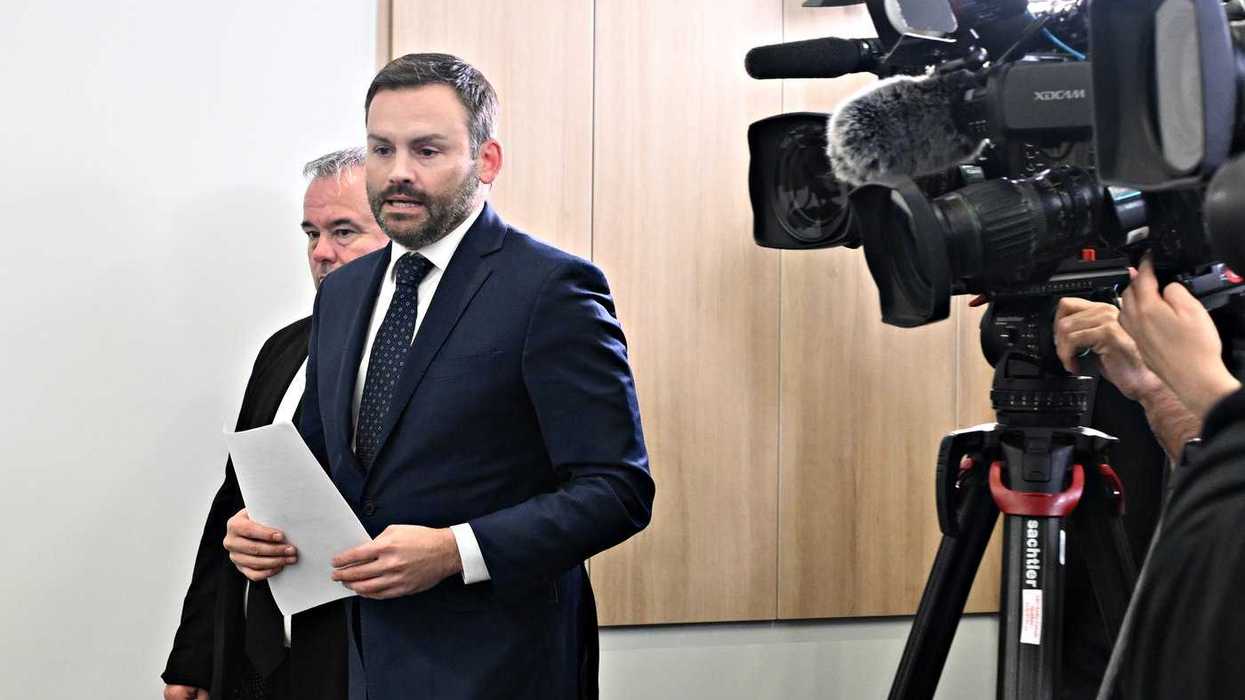
Quebec Premier Paul St-Pierre Plamondon is asking his Manitoba counterpart to retract comments that suggested the French-speaking province had adopted a racist law.
St-Pierre Plamondon posted the criticism on social media, one day after Manitoba Premier Wab Kinew reacted to a Supreme Court decision that largely upheld a Quebec's secularism law known as Bill 21.
"I vigorously denounce the comments by the Manitoba premier suggesting that Bill 21 consists of 'legislative racism,'" St-Pierre Plamondon said on social media on Saturday. "Mr. Kinew should be ashamed of his disrespectful and intolerant comments toward Quebec. I ask him to retract them."
Bill 21 was adopted by Quebec's national assembly in 2019. It prohibits public servants in positions of authority from wearing religious symbols.
The law pre-emptively invoked a section of the Constitution known as the notwithstanding clause, which allows legislatures to override some Charter rights. As a result, the law applies to a number of professions, including school teachers, police officers and prosecutors, restricting what they are allowed to wear, while on the job.
The Supreme Court upheld most of the law, ruling that the Quebec legislature made valid use of the notwithstanding clause. The court overturned the part of the law that applied to members of the legislature, noting that this violated democratic rights.
In a dissenting opinion, three Supreme Court justices, Michelle O’Bonsawin, Andromache Karakatsanis and Sheilah L. Martin wrote that the entire law should have been overturned for violating gender equality, since the notwithstanding clause cannot be used to override this right.
But the majority on the top court disagreed.
O’Bonsawin and Karakatsanis also wrote that “there can be no serious question that Bill 21 violates freedom of religion.”
“It treats visible religious minorities as less worthy of full participation in Quebec society, influences their life choices and mobility, and creates professional barriers for them by preventing qualified individuals from being hired, promoted or transferred within public sector workplaces,” they wrote.
Kinew had said he was glad the ruling noted rights had been violated, even though the court upheld the law.
“The Canada that I want to live in should have an RCMP officer free to wear a turban," Kinew told reporters on Friday, responding to the ruling. "It should have a school teacher, if she chooses to wear a hijab, to be able to do so."
Kinew noted that Manitoba had argued that the courts should be allowed to make non-binding declarations — an argument accepted by the top court. He added that non-binding declarations in court rulings can give citizens a tool to use in an election to campaign about laws adopted by a government that violated rights.
"A Hutterite woman should be able to wear a head covering. You should be able to wear a cross, if you so choose, and yes, your premier should be able to have long hair," he said. "These are all cultural symbols that would be banned by Bill 21, which I think is legislative racism. But me as a Canadian, my work will not be done until racism is stamped out everywhere.”
In their dissenting opinion from Friday's ruling, O’Bonsawin, Karakatsanis and Martin also noted that Bill 21 has a disproportionate effect on Muslim women.
“The attorney general of Quebec chose not to address whether any breaches related to Bill 21 could be justified in a free and democratic society,” they wrote.
But St-Pierre Plamondon said the ruling confirms Quebec secularism is valid and shows how the province is distinct on this issue.
This report by The Canadian Press was first published Nov. 28, 2026.
By Mike De Souza | Copyright 2026, The Canadian Press. All rights reserved.