Refugee advocates in court to challenge U.S.-Canada Safe Third Country Agreement
Hearings began this week at the Federal Court in Toronto in a legal challenge to the constitutionality of the Safe Third Country Agreement (STCA). The agreement is between Canada and the United States and requires migrants seeking asylum to do so in the first “safe” country they reach.
The plaintiffs in the case are Amnesty International Canada; the Canadian Council for Refugees; and the Canadian Council of Churches, along with two families who claimed asylum in Canada. In this new challenge, they are collectively asking the court to end the designation of the U.S. as a safe country because it no longer reflects the conditions underlying the agreement, which was first implemented in 2004.
Many refugee claims presented at a Canadian land port of entry from the U.S. are ineligible to be considered in Canada, and asylum seekers are returned to the U.S. In the court filings, the plaintiffs affirm that the STCA “is an instrument of legal exclusion” and disproportionately affects visible minorities, women, children and LGBTQ+ people.
“Canada has continued to deem the U.S. as a safe country, and every day is sending back refugees, including children, women who fled violence, and members of the LGBTQ+ community to U.S. border offices on the basis that they will be treated fairly,” said Julia Sande, a lawyer specializing in privacy and migrant rights at Amnesty International Canada.
“They are detained in horrific conditions.”
The petition mentions that Canada sent 4,323 asylum seekers back to the U.S. between January 2025 and March 2026.
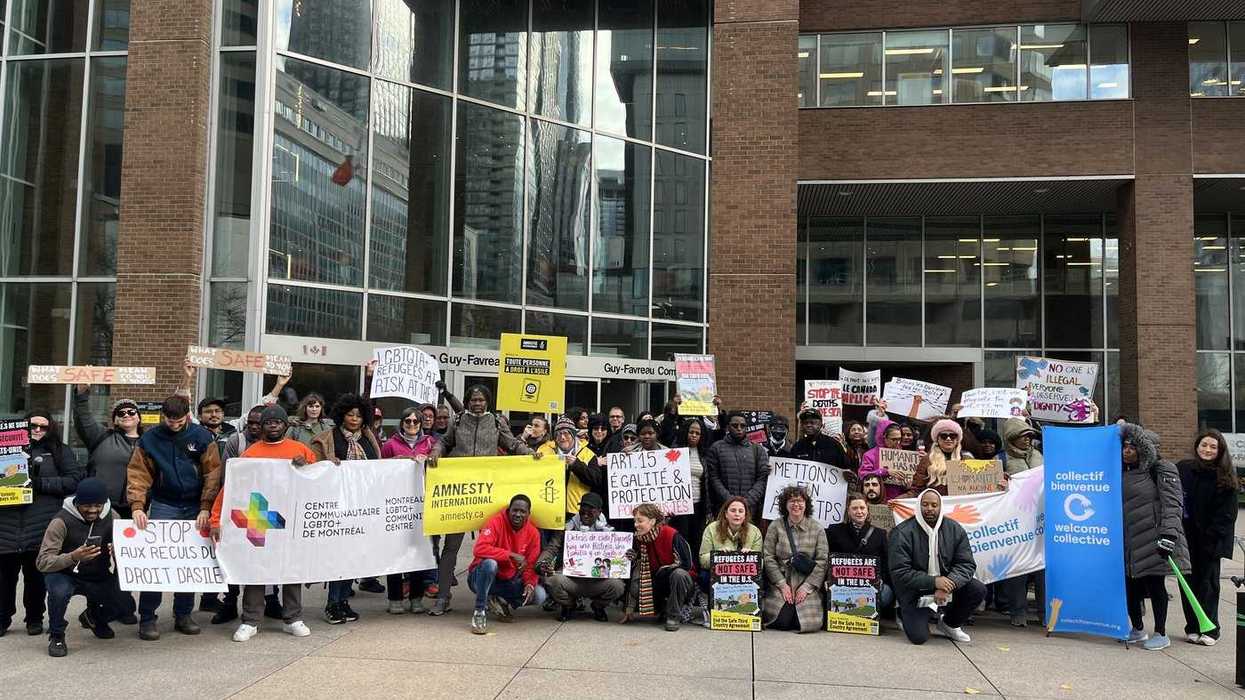
On Nov. 9, the day the hearings began, groups advocating for asylum seekers’ rights held rallies in Toronto and Montreal to support the constitutional challenge.
“We all gathered to speak out and shed more light on the issue, because I think few Canadians are aware that Canada continues to consider the United States a safe country,” said Flore Morel, advocacy coordinator of the Welcome Collective, a non-profit organization in Montreal that helps newcomers and refugees.
In earlier stages of the legal challenge, the Supreme Court of Canada considered that the STCA violated Section 7 of the Canadian Charter of Rights and Freedoms, which refers to life, liberty, and security, because of U.S. immigration detention practices.
In 2023, the Court issued a ruling stating that it wasn’t in a position to make a decision on whether the STCA was in breach of Section 15 of the Charter, which relates to the guarantee of equality rights to every individual in Canada. The Court also ruled that the issue should be determined at the Federal Court level. The plaintiffs in this challenge aim to show how the STCA doesn’t apply equally to everyone.
The impact on LGBTQ+ migrants
The current hostile climate in the U.S. has pushed trans people to seek refuge either within the country — in states that offer strong legal safeguards and rights — or outside of it. Like other asylum seekers, members of the LGBTQ+ community who are returned from Canada to the U.S. are likely to be detained.
But according to the court filings, LGBTQ+ immigrants are in a more vulnerable position since they are 97 times more likely to be sexually assaulted than other detainees.
“(The STCA) disproportionately affects people from the so-called global south, who might not be able to afford a visa or a plane ticket to Canada to try to seek safety, because the only way to Canada would be by sea or by going through the U.S.,” said Celeste Trianon, a transfeminine jurist (an expert in law) and activist based in Montreal who advocates for the rights of trans people.
In her eyes, the constitutional challenge is even more relevant now due to the current immigration policies in the U.S. To Trianon, practices such as deporting immigrants to third countries put LGBTQ+ people who seek asylum at higher risk.
“What if you are being sent to a country where being queer is actually criminalized or even punishable by death? For example, in Uganda, which is a country that punishes so-called aggravated homosexuality with a death penalty,” she said.
According to the court filing, the U.S. Immigration and Customs Enforcement (ICE) “has stopped publishing detention data concerning transgender detainees and removed its Transgender Care Memorandum,” which was a guide relating to the respectful treatment and custodial care of transgender individuals in immigration detention.
A shifting landscape for refugee protection
The current immigration policies in the U.S., added to the implementation of Bill C-12 in March 2026, have created a different landscape than the one that existed when the Supreme Court of Canada made previous rulings. At that time, the court was still in a position to trust the U.S. to meet basic human rights protections under the Immigration and Refugee Protection Act.
“Looking across the border now, it’s a lot harder to get to that conclusion,” said Catherine Dauvergne, a University of B.C. law professor who specializes in immigration and refugee law.
The STCA is designed to “keep the border orderly while continuing to offer protection to people who need it,” Immigration, Refugees and Citizenship Canada (IRCC) told New Canadian Media.
IRCC said the “designation as a Safe Third Country is continually assessed, in accordance with our obligations under the Immigration and Refugee Protection Act, to determine whether the conditions underpinning it continue to be met.”
Dauvergne argues that protection in the U.S. for asylum seekers is more difficult now than when the constitutional challenge process started in 2020.
“Even during the first Trump administration, although he had said many things that were hostile to refugees and other people in vulnerable positions, President Trump had not systematically altered the mechanisms to obtain asylum in the U.S.,” she said.
Dauvergne said Canada’s immigration system isn’t functioning well, and the adoption of Bill C-12 made refugee protection in Canada weaker. She said this challenge to the STCA puts pressure on the government to find ways to make the system function, especially since the consequences of getting rid of the agreement would result in having to process more asylum claims.
“More than ever before, I think the pressure is on Canada to do the right thing and not worry about what the United States is doing because we can’t predict (the outcome) of this,” she said.
After three days of hearings in the Federal Court in Toronto, the next hearing date is scheduled for Dec. 16.
Copyright 2026, New Canadian Media. All rights reserved.
Natalia Rivero, Local Journalism Initiative Reporter, New Canadian Media.