New book aims to ‘push back and defend survivors’ against denialism
Outside a Winnipeg bookstore, about 25 volunteers in orange shirts formed a welcoming line as sage smoke rose from an abalone shell.
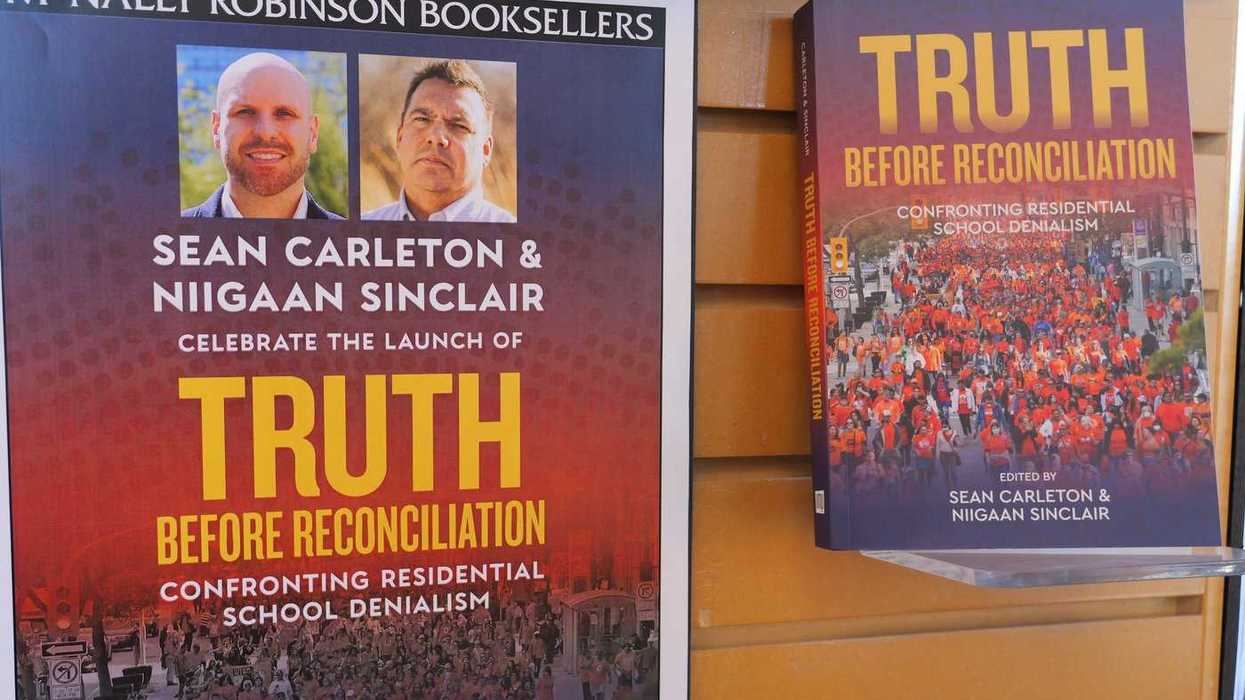
Inside McNally Robinson Booksellers, more than 300 people gathered for the launch of Truth Before Reconciliation: Confronting Residential School Denialism. Outside, the volunteers helped provide security as organizers anticipated denialists might try to disrupt the event on September 17.
“We want to make sure that it’s safe for the survivors,” said Emma Tardiff, one of the volunteers. “I really care about my community.”
Published by University of Manitoba Press ahead of National Day for Truth and Reconciliation, the collection grew from an effort by scholars and authors to confront the denial and downplaying of what survivors experienced.
The book consists of 13 chapters that include survivor interviews, expert analysis and examination of the denialism movement. Contributors include historians, educators, survivors, archivists and archaeologists, alongside the book’s two co-editors, Sean Carlton and Niigaan Sinclair.
Drawing on survivors’ lived experiences, historical evidence, and peer-reviewed scholarship, it examines the origins, methods, and consequences of denialism, challenges its claims, and highlights sources denialists ignore or misrepresent.
“We felt like we needed to collectively pool our expertise to push back and defend survivors, defend truth, and help us not get distracted in this hard work of Truth and Reconciliation,” said Carleton, a settler historian and associate professor of history and Indigenous studies at the University of Manitoba.
“Through the peer-reviewing process, everybody pulled together; it was a true, collective team effort.”
Carleton noted that academic publishing takes time, particularly for an edited collection. People had repeatedly asked him to do the book, he told the audience.
“Someone needed to do it, and we figured, ‘why not us?’” he said.
“This book is a collective statement in defence of survivors and survivor truth.”
Confronting 150 years of misinformation
People in “Canada” have been subjected to 150 years of misinformation about Indigenous Peoples and the residential school system, co-editor Sinclair told the audience. Indigenous Peoples, meanwhile, have lived with the institutions’ effects and hold first-hand knowledge of what happened.
Sinclair, an Anishinaabe writer from St. Peter’s/Little Peguis, is a Winnipeg Free Press columnist and a professor of Indigenous studies at the University of Manitoba. His father, the late senator Murray Sinclair, chaired the Truth and Reconciliation Commission (TRC).
Sinclair pointed to decades of research documenting the residential school system, including the commission’s work.
“There is a contingent of Canadians who are still full of doubt, easily — perhaps — confused or manipulated by information that would be hearsay or cherry-picked facts, or by individuals that perhaps are nefarious and trying to sow division, trying to create conflict,” he said.
“Denialism isn’t the denial of the schools themselves; it’s the denial or the downplaying of the atrocities that happened in those schools.”
Michelle Good, a member of Red Pheasant Cree Nation and a former lawyer who has represented survivors, joined the co-editors for a panel discussion during the launch. She spoke about malnutrition and conditions in the institutions that left children vulnerable to disease.
For Good, the evidence also comes from years of listening to survivors and from her own family.
“I represented survivors from many different schools across the country, and the similarity of stories that came from these folks just makes it so entirely undeniable,” she said. “Not to mention my own mom, who was locked up in one of those awful places for far too long.”
How the media lends denialism legitimacy
Carleton drew a connection between the tactics used to minimize residential “school” harms and those used by Holocaust deniers.
“They are basically copying and pasting Holocaust denialism,” he said.
He described how those arguments focus on disputing the number of deaths to downplay what happened.
“But they continue to do it anyway because it makes them money, it gets them a platform, it promotes their brand, and it’s really harmful, hurtful stuff,” he said.
The speakers criticized mainstream media outlets for giving unverified and unsupported denialist claims equal space and airtime.
“I also see denialism slowly creeping into some mainstream news sources,” Carleton said. “They’re asking questions that they shouldn’t be asking because we already know the truth.”
Sinclair reflected on his appearances as a broadcast commentator over the past 10 to 15 years.
“I learned about a year in that the other side was simply racism; when you debate racism, you give racism not only legitimacy, but now suddenly racism gets this platform of equal time with me, and I realize, ‘holy smokes, like that’s how the media works.’”
He said he had worked for decades to become a knowledgeable speaker on these issues, while people advancing racist arguments were given equal footing in debates.
“I didn’t do the due diligence of asking who would be on the show with me,” Sinclair said.
“Now, I’m encouraged that there is less of that, predominantly because we have Indigenous Peoples in newsrooms.”
“We don’t need to platform bigots and give them an opportunity,” Carleton added. “If you’re talking with somebody and somebody says gravity doesn’t exist, then the conversation is really over.”
Defending the myth of a gentler ‘Canada’
Sinclair connected residential “school” denialism to political nostalgia.
“This is the ‘Make Canada Great Again’ movement,” he said.
Good, meanwhile, challenged the national self-image that makes some people reluctant to acknowledge the country’s violence against Indigenous Peoples.
“Canadians for so long have become so accustomed to seeing themselves as the global Boy Scouts, ‘we’re the good guys,’ ‘we’re the kinder, gentler nation,’” she said. “I think that it creates a cognitive dissonance in some people.”
She challenged the notion that “the Americans were so violent, and Canada was so sweet” towards Indigenous Peoples. In her view, differences in the scale of military violence reflected capacity rather than gentler intentions.
“My research has shown me that the only reason there weren’t military campaigns against Indigenous people in Canada was that we didn’t have a military, we didn’t have an organized military of sufficient size to take on smaller kinds of campaigns, so don’t for a minute, think that we were sweeter,” Good said.
“Denialism is a backlash to the progress of reconciliation,” Carleton added. “They’re losing, and so this is like in other movements, a backlash to the gains that have been made and trying to derail our progress. It’s trying to keep us exhausted.”
Carleton described receiving comments whenever he wears an orange shirt and the pressure that creates to stop showing support.
“It’s trying to slow that momentum,” he said.
He said that denialists are a “very loud and small group” who are “getting desperate.”
“One of the things about denialism is it is a lonely road,” he said.
Making the case for criminalization
Good urged people who doubt survivors’ accounts to confront the evidence.
“It is okay to have doubts. It’s okay to say, ‘Oh it couldn’t have been that bad,’” she said. “But figure it out. Get to the facts.”
In the book’s ninth chapter, “Residential School Denialism is a Crime,” Good takes that call for accountability into the legal realm.
“Regardless of whether it is specifically articulated in the Criminal Code, residential school denialism meets the criteria for criminalization and is no less a crime than Holocaust denialism and should be recognized as such,” she wrote.
The Criminal Code already provides a precedent. In 2022, Bill C-19 added subsection 319(2.1), titled “Wilful promotion of antisemitism.” It makes it an offence to communicate statements, other than in private conversation, that wilfully promote antisemitism by “condoning, denying or downplaying the Holocaust.”
Good argues that residential “school” denialism deserves the same seriousness and explicit recognition in criminal law.
In her chapter, Good writes about Winnipeg Centre MP Leah Gazan’s proposal to criminalize residential “school” denialism. Gazan introduced Bill C-254 in October 2025. It would create an offence of wilfully promoting hatred against Indigenous Peoples by condoning, denying, downplaying or justifying the residential school system, or misrepresenting facts about it, through statements communicated outside private conversation.
The bill has completed first reading but has not become law.
The neglect behind many children’s deaths
“I hate calling residential schools, schools,” Good said, offering another description for the institutions, “deconstruction centres.”
She spoke about children suffering from malnutrition and the conditions that allowed disease to spread through the institutions.
“Tuberculosis. This is one of the things that the denialists seize on quite intensely. They say, ‘you know, it wasn’t the schools that killed these kids; it was TB.’”
In her chapter, Good describes the neglect that exposed children to infection.
“Children were not screened when they were first brought into the school to determine if they were sick or not. Ill children were not segregated from healthy children,” she wrote.
Those dangers were documented more than a century ago. In his 1907 report for the Department of Indian Affairs, chief medical officer Peter Henderson Bryce examined tuberculosis in residential schools in Manitoba and the Northwest Territories.
His findings documented overcrowded dormitories, inadequate ventilation and infectious children sharing space with other children.
“We have created a situation so dangerous to health,” he wrote.
Bryce’s recommendations went largely unheeded. Duncan Campbell Scott, who became deputy superintendent general of Indian Affairs in 1913, later obstructed Bryce’s efforts to address the health crisis.
In 1920, Scott told a parliamentary committee examining amendments to the Indian Act that he wanted to “get rid of the Indian problem,” explicitly describing the government’s goal of assimilating First Nations people.
During the panel, Good described Bryce as a “hero” for exposing the truth.
A year after the campus confrontation
The book launch came nearly a year after Indigenous activists and residential “school” survivors confronted denialists led by Frances Widdowson outside the University of Winnipeg on Sept. 26, 2025.
Campus security escorted Widdowson from the grounds and issued her a five-year ban from the property. She later alleged that members of the Indigenous community had assaulted her.
Winnipeg police confirmed in an email to IndigiNews that the investigation remains ongoing.
At the book launch this month, volunteers stationed outside had photos of Widdowson and several people known to be her supporters.
Before the event began, a man described as a residential “school” denialist entered the store. IndigiNews witnessed Winnipeg police asking him to leave.
“It’s their house, their rules,” an officer said.
Police escorted him outside, where he joined Widdowson in a designated protest space in the parking lot.
“Different intentions have been stated on social media… we don’t know what one might do,” Emma Tardiff said. “Our goal is just to make sure that any extra layer of security we can give to the voices of Survivors, of these authors that are telling their stories, is what we’re doing.”
IndigiNews overheard her mother, Denise Tardiff, instructing volunteers to avoid engaging with Widdowson and her supporters.
“They use that footage, and they twist it, and then the other crazies out there send money; this is how they can fly around the country,” Denise said, referring to recordings of interactions with Indigenous activists.
Widdowson has publicly solicited donations to fund her media projects and travel. A May 2025 fundraiser for a documentary titled “Grave Error” sought money for editing and trips to four “B.C.” cities.
“It’s not worth anybody’s energy to engage with the denialists,” Denise said. “We just want everybody to feel safe and okay and concentrate on the good work that’s being done.”
Before the launch, the University of Winnipeg posted a reminder that police would be called to enforce its barring notice if Widdowson returned to campus.
During a Facebook livestream from outside McNally Robinson, Widdowson recounted a separate encounter when she returned to the University of Winnipeg on September 17, 2026. She said she had refused to leave after security staff told her she was barred, prompting them to call police. According to her account, 11 security staff and eight police officers attended, and she received a $672 ticket, under the Petty Trespass Act.
Outside the bookstore, Widdowson told her livestream: “So far it doesn’t look like anything’s going to be happening.”
“Okay people, nothing’s happening, we’re going to watch the (book launch) livestream,” she said before ending her broadcast.
A volunteer stationed outside confirmed to IndigiNews that Widdowson left before the launch ended.
A starting point for reconciliation
For Good, accepting what happened in residential “schools” is the starting point for reconciliation.
“We need to just accept it. It happened, which brings us closer to truth before reconciliation. And if we’re standing on the same ground in the same truth, then we’re at the starting line,” she said. “Then we’re at the beginning of being able to reconcile and to embrace and accept each other, regardless of this horrible history.”
Sinclair added: “We will never get to reconciliation if we’re still debating truth.”
Carelton said the contributors wanted their research to serve survivors. All royalties from the book will be donated to the Indian Residential School Survivors Society in perpetuity.
“To be perfectly honest, we hope that this book can be a sledgehammer to the denialist movement, and we can get on with the other hard work of building good relationships,” he said.
Copyright 2026, IndigiNews. All rights reserved.
Crystal Greene, Local Journalism Initiative Reporter, IndigiNews.