Construction of Bell Canada's AI data centre in Saskatchewan scaling up
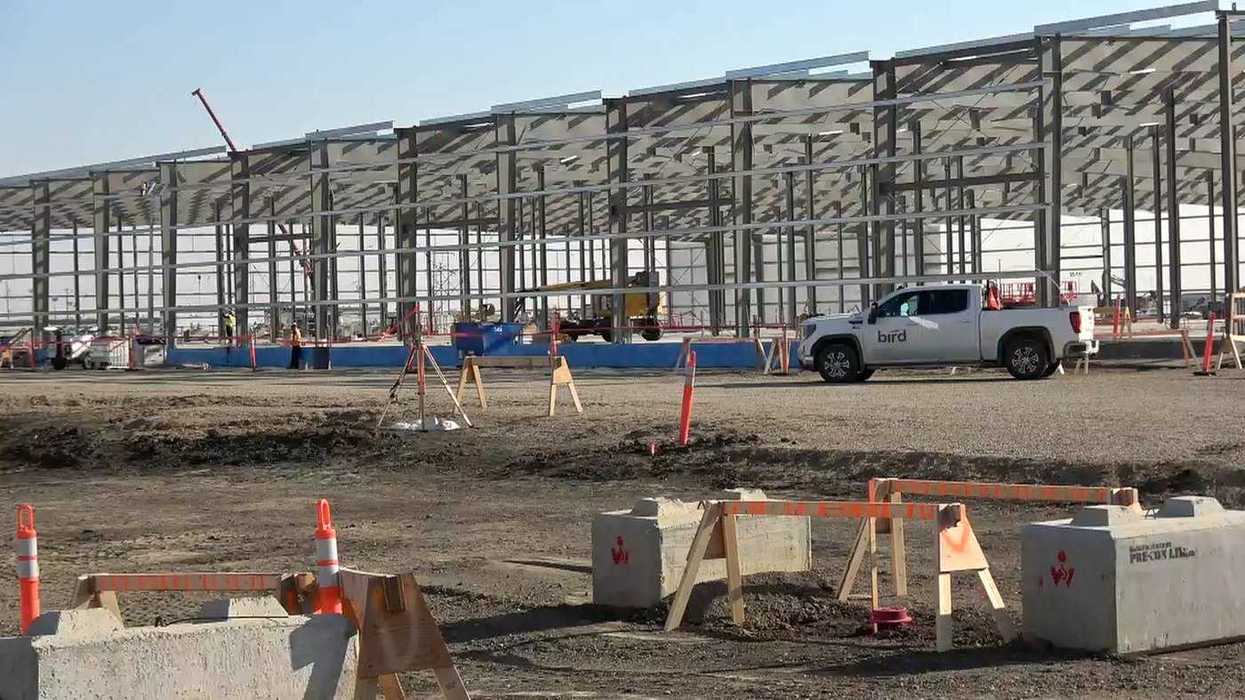
Saskatchewan’s Crown investments minister stood Thursday in front of a skeleton of steel beams to tout progress on an artificial intelligence mega facility, while the Opposition again called on the province to consult first, then build.
"We have just an amazing thing going on here behind us," Jeremy Harrison told reporters at the site, southeast of Regina.
"Literally millions of pounds of steel."
Harrison and Bell Canada held a news conference at the company's 65-hectare site. Behind them, construction crews moved heavy equipment.
Framing is done for three of four data halls. Paneling for one wall is also nearing completion.
Surrounding the structures are dozens of trailers, stacks of steel pipes and piles of dirt. Security cameras keep an electronic eye on comings and goings.
Harrison said there are 500 workers on the site at any given time.
The $1.7-billion, 300-megawatt centre is to be one of the country's largest data facilities.
John Watson, group president with Bell, told reporters the first two halls are set to start operating in the first half of next year. Its anchor tenants are CoreWeave and Cerebras.
Bell also has its sights set on expansion. It plans to quadruple the size to 1.2 gigawatts, which would cost $50 billion and require a dedicated natural gas plant.
Watson said there are no timelines on when the expansion would happen.
"It needs to be probably twice as large as this one," he said. "It will be in proximity to here."
Bell and the province are promising the expansion would produce bigger economic benefits.
Harrison said it could support 500 permanent jobs at the site, plus up to 3,000 off site and community jobs.
Bell would also move its AI fabric headquarters to Regina, he said, which would add 100 management jobs to the city.
Regina Mayor Chad Bachynski said the project would make the province a hub for innovation and growth.
"These are the kinds of jobs that will help us retain talented young people (and) attract new workers and families," he said.
Bell has said it plans on partnering with the University of Regina for research, including the possibility of capturing the facility's heat for greenhouses.
The centre has met with public pushback.
There have been protests this past year, with critics saying they worry about how the megaproject will affect the environment and electricity grid. They've also taken issue with what they say is a lack of public consultation, as the project was quickly approved.
Asked if the province should hold town hall meetings about the centre, Harrison said people already support it.
"Elected representatives are here speaking on behalf of their constituents, which I think reflects the broad support that exists out there," he said.
The Opposition NDP has called on the Saskatchewan Party government to impose a moratorium on large-scale centres, arguing robust consultation isn't happening.
Sally Housser, the NDP's energy critic, told reporters at a separate news conference that the province should be holding town hall meetings.
"I think that is the most basic thing, particularly around the areas that are most affected," she said. "People have genuine concerns about how this is going to affect their power bills, how this is going to affect the area they live in."
Watson has said the data centre won't use groundwater but rather a closed-loop system, where a fluid continuously runs through it for cooling. Bell also said the facility won't cause power rates to increase.
This report by The Canadian Press was first published Oct. 1, 2026.
By Jeremy Simes | Copyright 2026, The Canadian Press. All rights reserved.