The relationship with Quebec premier remains, above all, “professional,” says Carney
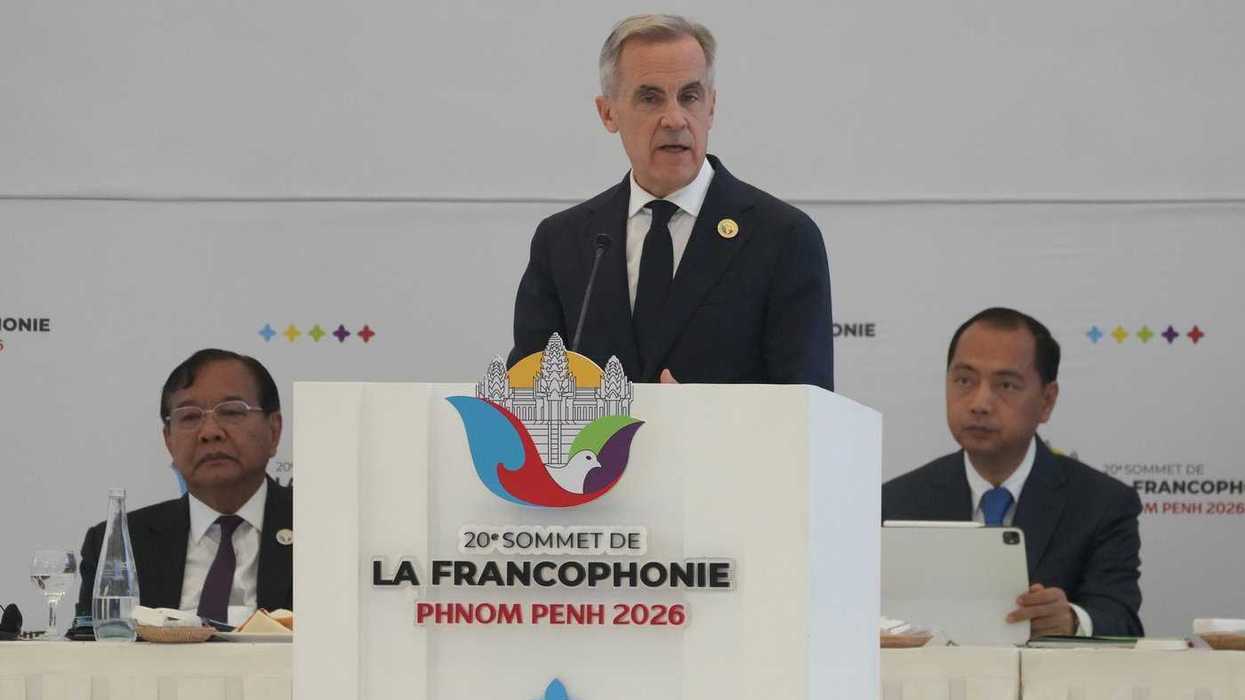
Prime Minister Mark Carney downplayed suggestions of a budding “bromance” with Quebec Premier Paul St-Pierre Plamondon, describing their relationship as friendly but professional.
The two leaders struck a cordial tone during their first meeting since the Parti Québécois formed government following last month’s provincial election, finding common ground on homelessness and economic co-operation. But differences remained over Quebec’s role in trade negotiations with the United States and its representation on the world stage.
"We will continue in a professional way — friendly but not necessarily a bromance. I have a wife," Carney quipped in French at a news conference Monday in Phnom Penh, Cambodia.
His comments contrasted with the enthusiasm expressed by St-Pierre Plamondon, who described Sunday’s meeting on the sidelines of the Francophonie summit as “very pleasant and funny.”
“We certainly share a sense of humour,” the sovereigntist premier said in a statement published Sunday following the meeting.
St-Pierre Plamondon said the two leaders had found common ground on several issues, exchanged personal phone numbers and agreed to meet again in the coming weeks.
Carney said the two leaders had plenty of work ahead of them, pointing to homelessness and major infrastructure projects, including Contrecœur and Churchill Falls.
Carney's meeting with St-Pierre Plamondon in Cambodia came after a few weeks of friction between the two men since the Quebec premier's victory in the Oct. 5 provincial election.
They initially could not agree over the location of their meeting. While Carney offered to meet in Montreal or the Ottawa-Gatineau region, St-Pierre Plamondon had argued that the meeting should take place in Quebec City.
The Quebec premier also declined to attend Canada's October summit with the European Union in Montreal saying the federal government had denied him an opportunity to deliver an official speech.
But both leaders appeared to be more collaborative after meeting in Cambodia.
On homelessness, St-Pierre Plamondon said in his statement that Carney had agreed to let Quebec choose projects and co-ordinate funding through a summit the province is organizing.
The Quebec premier also welcomed Carney’s support for an economic gathering Quebec plans to host in 2027, bringing together economy and foreign trade ministers from French-speaking countries, along with businesses.
St-Pierre Plamondon described the initiative as an opportunity to diversify Quebec’s economy and strengthen economic ties within the Francophonie.
But the two leaders appeared to have different views on Quebec’s role in negotiations with the United States.
St-Pierre Plamondon wants Quebec to have a greater say in trade discussions, while Carney maintained that international agreements are negotiated by the federal government.
"I understand stakeholders making their views known to those in the United States, and it's important to get those views across," Carney said. "International agreements are negotiated between federal governments."
Carney said Quebec could communicate with American counterparts and reiterated his commitment to sharing information with the province, as Ottawa does with other provincial governments.
The prime minister also rejected the idea of Quebec obtaining additional independent seats in international organizations.
He pointed to Quebec’s existing status within the International Organisation of La Francophonie, where the province participates as a full member.
Quebec has also had official representation within Canada’s Permanent Delegation to UNESCO since 2006, allowing it to participate in discussions on culture and education, areas under provincial jurisdiction.
“Canada has an enormous impact on the world stage,” Carney said in French, pointing to its participation in the Francophonie, Commonwealth, G20 and G7, as well as its relations with the European Union.
“We advance objectives for all Canadians,” he added.
This report by The Canadian Press was first published Nov. 16, 2026.
By Caroline Plante | Copyright 2026, The Canadian Press. All rights reserved.