Harper says Canada had 'no choice' but to walk away from U.S. trade talks
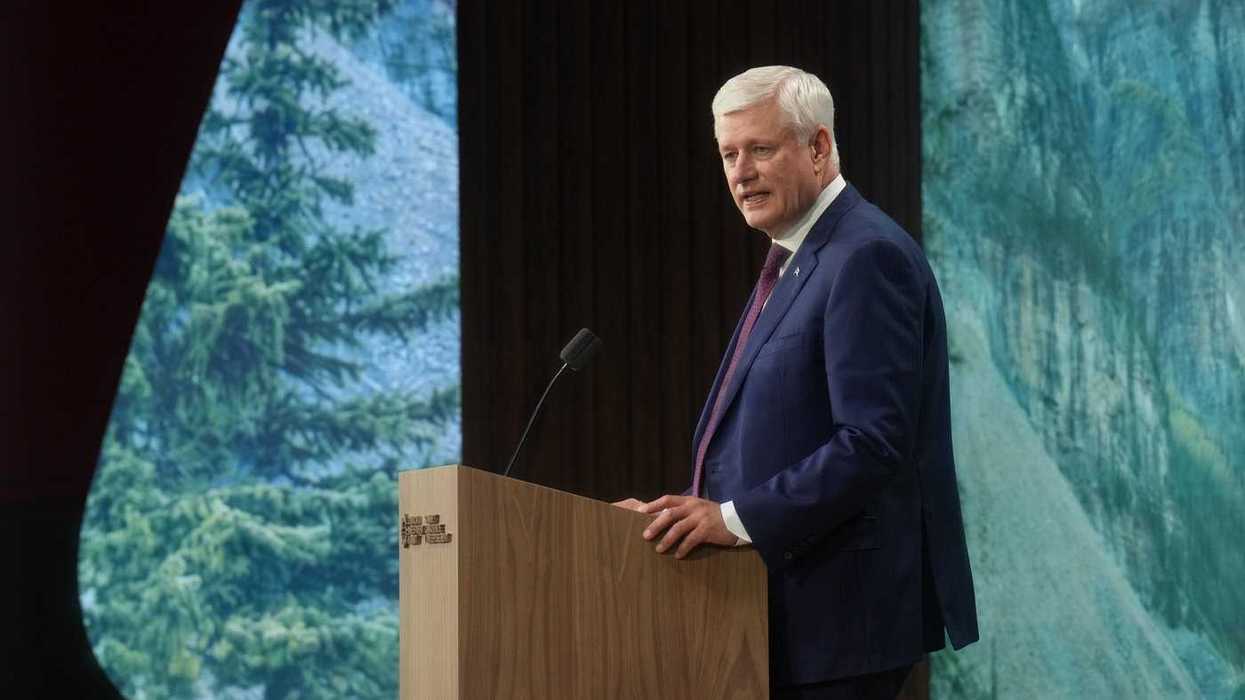
Former prime minister Stephen Harper says the federal government had "no choice" but to walk away from trade talks with the United States.
Delivering closing remarks at Canada's first-ever national investment summit Tuesday, Harper said the move was necessary and that Canada needs to reduce its reliance on the United States.
"It is clear that the current U.S. administration views our level of economic integration as incompatible with our separate sovereignty. Thus, to maintain that sovereignty, we must pursue diminished reliance upon the United States," he said.
"There will be significant costs to this effort, but those are costs that I hope and believe Canadians are able and prepared to accept."
Harper said he sees the breakdown in trade talks as "sad" but necessary.
"I believe that in this necessity, our country will also discover and is discovering opportunity," he said.
A last-ditch effort to reach a new trade deal with the United States collapsed in August. After Prime Minister Mark Carney suspended the talks and summoned his negotiators back to Ottawa, he accused the Americans of introducing unacceptable demands at the last minute.
That decision led to new 50 per cent U.S. tariffs on billions of dollars in Canadian exports. Ottawa has replied with retaliatory tariffs on American products.
Hundreds of executives and global asset managers were in Toronto for this week's investment summit — part of the Carney government's efforts to hit an ambitious goal of attracting $1 trillion in new investment over the next five years.
Harper said Canada can't let U.S. President Donald Trump's administration hollow out its industrial capacity.
He said Canada has come "nowhere close" to realizing its true potential and its natural resources are its "special comparative advantage."
"Canada cannot simply blame external factors or make other excuses to explain away the difficulties that we face," he said.
"Today, more than ever, Canada must become more internally competitive, more externally connected and more truly sovereign than it has been."
In his speech, Harper congratulated the federal government on the measures it has taken to fast-track major project approvals, especially for projects in the energy sector.
"These changes are welcome and they are very important. However, more does need to be done," he said. "The burdens and restrictions that do not exist elsewhere simply must be removed in Canada.
"If we do not do these things as a country, the Americans will continue to be our sole customers, and they will not lack the urgency that we have lacked here in Canada."
Conservative Leader Pierre Poilievre told reporters at a news conference in Vancouver Tuesday that he was happy Carney was holding an investment summit but said "where are the results?"
"We've had now 18 months of speeches, summits and symbolic signing ceremonies and what have Canadians got? More expensive food, gas and housing."
The Prime Minister's Office said Tuesday the investment summit "laid the foundation for enormous new investment and strategic partnerships, while accelerating existing negotiations – resulting in nearly $500 billion in new investment commitments to Canada."
It said Canada’s leading pension funds, insurers and institutional investors committed nearly $100 billion in new capital to Canadian assets. Canada’s top banks, it said, committed nearly $325 billion in new financing for Canadian businesses and infrastructure.
Premier Scott Moe and Bell Canada CEO Mirko Bibic announced an expansion of Bell’s AI data centre project in Saskatchewan.
Manitoba said it will waive the provincial sales tax on major capital spending for the Port of Churchill as it tries to attract international investment.
Asked about his reaction to Harper’s involvement in the investment summit, Poilievre said "Conservatives are always willing to put Canada first."
This report by The Canadian Press was first published Sept. 15, 2026.
— With files from Catherine Morrison in Ottawa
By Craig Lord | Copyright 2026, The Canadian Press. All rights reserved.