A new winter forecast calls for a 'dramatic' season of blizzards, snow and icy weather in Canada
Some parts of the country will have a colder and snowier winter.
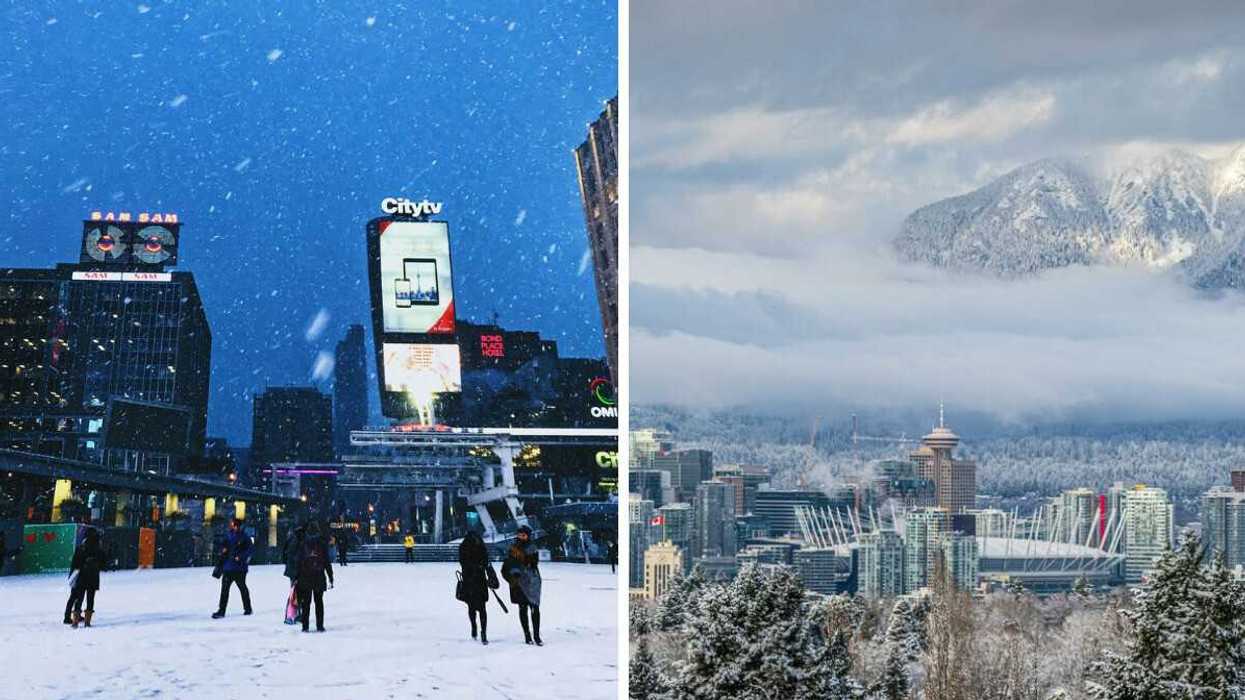
People in Toronto during a snowfall. Right: Vancouver skyline in the winter.
There's a new winter forecast out now for every province in this country.
It revealed that Canada's weather will be "dramatic" throughout the season, with blizzards, frigid Arctic air, lake-effect snow, freezing rain, and more.
Recently, the Farmer's Almanac released the Canadian winter weather forecast for 2026 and 2027.
This winter is expected to be a season of "dramatic contrasts" across the country, including rain, wind and mountain snow in B.C., blizzards in the Prairies, frequent lake-effect snow in Ontario, colder and snowier conditions in Quebec, and rain-snow mixes from coastal storms in Atlantic Canada.
So, here's what you need to know about what the season will be like in each province, according to this new winter forecast.
BC
Vancouver, Victoria, and the Lower Mainland are forecast to have repeated periods of rain, gusty winds, and occasional intense storms this winter. But there will be thaws in those parts of the province throughout the season because of mild Pacific air.
Repeated storms will bring "significant mountain snowfall" to parts of B.C., including Whistler. So, the Farmer's Almanac has warned that travel through mountain passes could be difficult during the strongest storms.
In Kamloops, Prince George, Kelowna and other parts of the interior, valleys are forecast to alternate between snow, mixed precipitation, and occasional thaws, while higher elevations stay "more wintry."
Alberta, Saskatchewan and Manitoba
Alberta, Saskatchewan, and Manitoba are forecast to get surges of Arctic cold, "dangerous" wind chills, blowing snow, and even blizzards this winter.
Edmonton and Calgary will have "abrupt" temperature changes as milder Pacific air meets colder Arctic air.
But parts of Saskatchewan and Manitoba might not get breaks from the cold once Arctic high pressure settles over the region. Winnipeg is expected to have "dangerous" wind chills during each surge of cold Arctic air.
Also, the Farmer's Almanac said fast-moving clippers are forecast to bring sudden bursts of snow and wind across the Prairies during the winter season.
Ontario
According to the Farmer's Almanac, cold northwest winds will blow over the relatively warmer waters of the Great Lakes in southern Ontario. So, "intense" lake-effect snow is expected across the region, and localized heavy snowfall in places east and southeast of the lakes.
Storms from the southwest will bring widespread snow, sleet, freezing rain, or rain to the region throughout the winter. Toronto, Hamilton, London, Windsor and Ottawa could get all of that precipitation in one storm while another is mostly snow.
There will be frequent freeze-thaw cycles in southern Ontario, along with ice storm risks from Kingston to Ottawa.
Places in northern Ontario, like Timmins, Kapuskasing, Cochrane and Moosonee, are forecast to have a more consistent cold and snowy winter season.
Quebec
Southern parts of Quebec are forecast to get periodic thaws and mixed precipitation. Montreal and places in the St. Lawrence Valley could be on the rain-snow line during some major storms, while places closer to the border with Ontario could be at risk for freezing rain and ice storms.
In northern, central, and eastern parts of the province, the precipitation won't be as mixed this winter. That means those areas are forecast to get mostly snow.
According to the Farmer's Almanac, coastal storms moving north could bring heavy snow, gusty winds, and nor'easter conditions to Quebec during the winter season.
New Brunswick, Nova Scotia, PEI and Newfoundland & Labrador
New Brunswick, Nova Scotia, P.E.I., and Newfoundland are forecast to get a mix of snow, sleet, freezing rain and rain this winter, sometimes all within the same storm.
Interior parts of New Brunswick and places at higher elevations across the region will mostly get snow, while coastal areas in Nova Scotia and P.E.I. will get more mixed precipitation and rain.
Newfoundland is expected to have "dramatic" weather contrasts, while Labrador is consistently cold and snowy, with frequent storms, blowing snow, and prolonged stretches of "bitter cold."
This article's cover image was used for illustrative purposes only.