It's Still Northern Lights Season In Canada & Here's The Best Way To Spot The Aurora
The winter season offers the best chances to see the natural phenomenon.
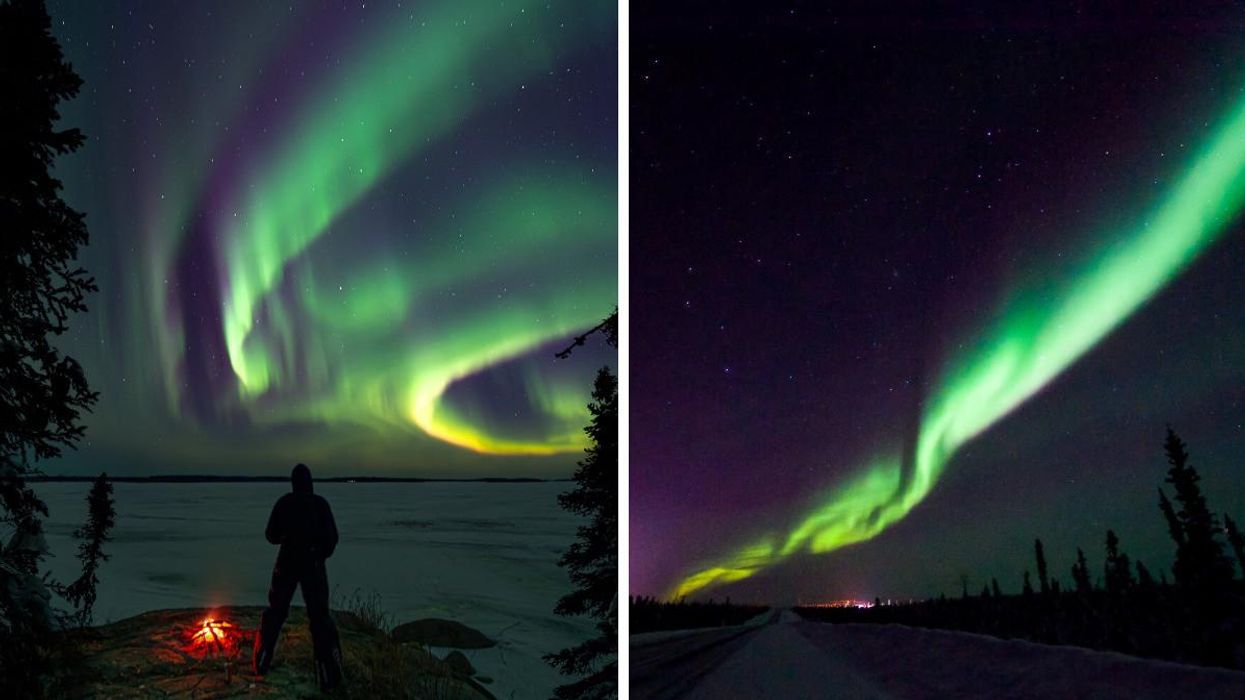
A person standing by a campfire, looking at northern lights. Right: Northern lights over a road.
If you want to catch a glimpse of northern lights in Canada, now's the best season to see them and the Canadian Space Agency has tips on how to make the most of it!
The northern lights, aka the aurora borealis, happen when charged particles collide with gases in Earth's upper atmosphere which then produce tiny flashes that fill the sky with light.
According to Destination Canada, it's possible to see the northern lights almost anywhere in Canada during all four seasons.
However, the northern parts of the country are the best places to see them since that's where they are the most active.
Also, the wintertime from December to March is typically the best season to view the aurora borealis because there are more hours of darkness each night, and thus a better chance for clear skies.
The more active the sun is, the more brilliant the northern lights will appear here on Earth, and the further south they'll be visible.
So, while being closer to Earth's magnetic north pole betters your chances of being able to see them, they can also be seen in more southern parts of Canada during periods of strong solar activity.
The Canadian Space Agency has a bunch of viewing tips for the northern lights throughout Canada, including where to go, where to look, and when to try and catch a glimpse.
Generally, they appear in the sky a few hours after sunset when the sky is clear and then typically become more intense around midnight.
You don't need any special equipment to spot the aurora, but you do need to choose a location free of light pollution.
Bright city lights can make it more difficult to see the northern lights, and make low-intensity ones invisible.
Another thing that the Canadian Space Agency said to do is to check the aurora borealis forecast to find out what the chances of the northern lights being visible near you are.
You should also check the local weather forecast before leaving because clouds, precipitation, and even a full moon can make it difficult to see the aurora.
When you've found a spot and know that the northern lights will be visible, it's important to look all around you because they can appear anywhere in the sky not just to the north.
Happy viewing!
- The Northern Lights Put On A Stunning Show In Canada That ... ›
- 13 Places To See The Northern Lights In Canada No Matter Where You Live ›
- The Best Place To See The Northern Lights In The World Is Apparently Right Here In Canada - Narcity ›
- The Northern Lights Will Put On An Epic Storm Across Almost All Of BC & Alberta Tonight - Narcity ›