Northern lights could be seen alongside the total lunar eclipse in parts of Canada tonight
Watch the moon turn red and the sky turn green!
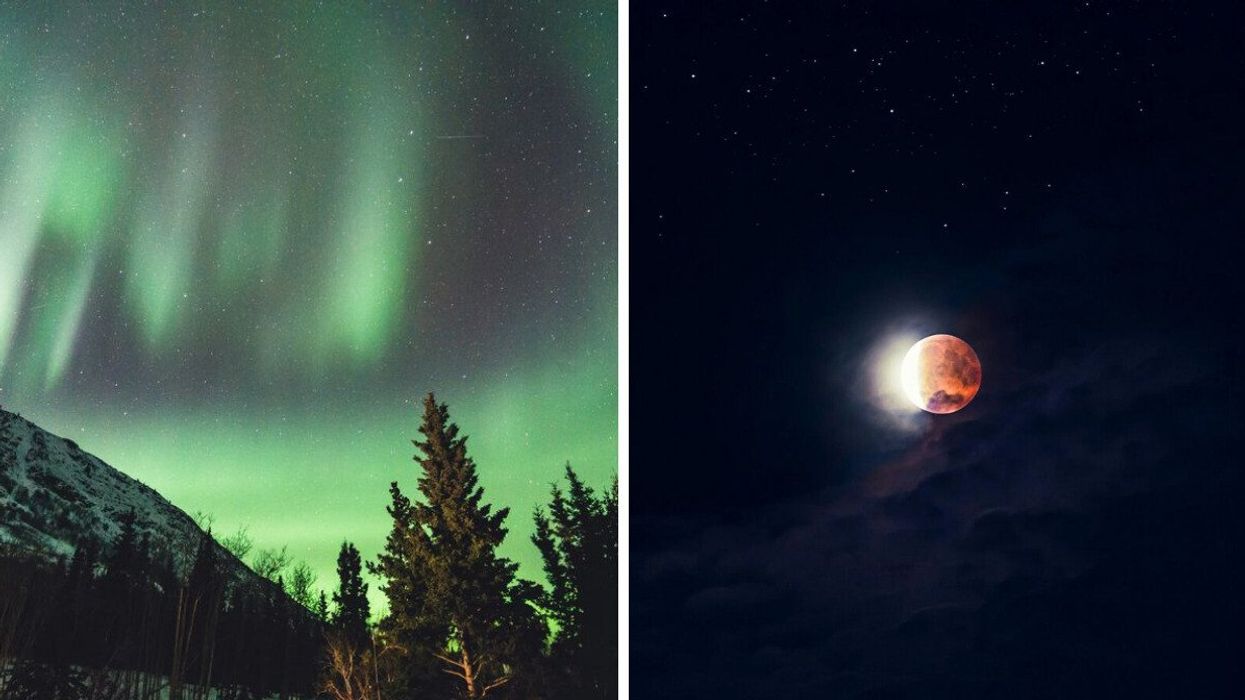
Northern lights in Canada. Right: Total lunar eclipse.
The northern lights could be visible alongside the total lunar eclipse in some parts of Canada.
So, here's what you need to know about spotting the blood moon and the aurora tonight.
NOAA's northern lights forecast for Thursday, March 13 revealed that the aurora could be seen in quite a few places across Canada.
It also included a view line showing how far south the northern lights might be seen near the northern horizon.
You could see the aurora in Edmonton, Banff, Calgary, Lethbridge, Regina, Saskatoon, Winnipeg, Brandon, Churchill, Thunder Bay, Moosonee, and more cities.
The northern lights could be seen on the northern horizon in Vancouver, Kelowna, Sudbury, Timmins, Quebec City, Saguenay, Gaspé, Corner Brook and more places that are along the view line.
According to the Canadian Space Agency, the northern lights typically appear a few hours after sunset and become more intense around midnight.
Find a place with little to no light pollution and then look all around you because auroras can appear anywhere in the sky.
But if you're somewhere along the NOAA view line, the northern lights will only be visible near the northern horizon.
The lunar eclipse that's happening overnight from March 13 to March 14 is visible from everywhere in Canada.
When the eclipse reaches totality, the moon turns red, which is why total lunar eclipses are also called blood moons.
Here are the times for the eclipse phases in Canada on March 13 and March 14, 2025:
- penumbral eclipse starts at 8:57 p.m. PT, 11:57 p.m. ET and 12:57 a.m. AT
- partial eclipse starts at 10:09 p.m. PT, 1:09 a.m. ET and 2:09 a.m. AT
- total eclipse starts at 11:25 p.m. PT, 2:25 a.m. ET and 3:25 a.m. AT
- maximum eclipse at 11:59 p.m. PT, 2:59 a.m. ET and 3:59 a.m. AT
- total eclipse ends at 12:31 a.m. PT, 3:31 a.m. ET and 4:31 a.m. AT
- partial eclipse ends at 1:47 a.m. PT, 4:47 a.m. ET and 5:47 a.m. AT
- penumbral eclipse ends at 3 a.m. PT, 6 a.m. ET and 7 a.m. AT
You can view a total lunar eclipse with the naked eye.
No special equipment like telescopes, binoculars or eclipse glasses is needed.
So, not only can you see the moon turn red but you also have the chance to see the aurora light up the sky with green hues tonight!