Saskatchewan producers play key role in new Canada-China canola, peas deal
A Saskatchewan producers organization has played a key role in calming trade disputes between Canada and China, opening the way to a new deal with hopefully more to come.
According to an announcement from the Agricultural Producers Association of Saskatchewan (APAS), “Canada and China have agreed to extend favourable market access arrangements for Canadian canola meal and peas through the end of 2028, providing greater certainty for Saskatchewan producers, processors and exporters.
“The update was shared directly with APAS by the embassy of the People’s Republic of China in Canada following a recent meeting between APAS representatives and Chinese embassy officials to discuss market access issues affecting Saskatchewan agriculture. The announcement is a positive signal for Saskatchewan’s export-orientated agriculture sector and underscores the value of maintaining an open dialogue on trade.”
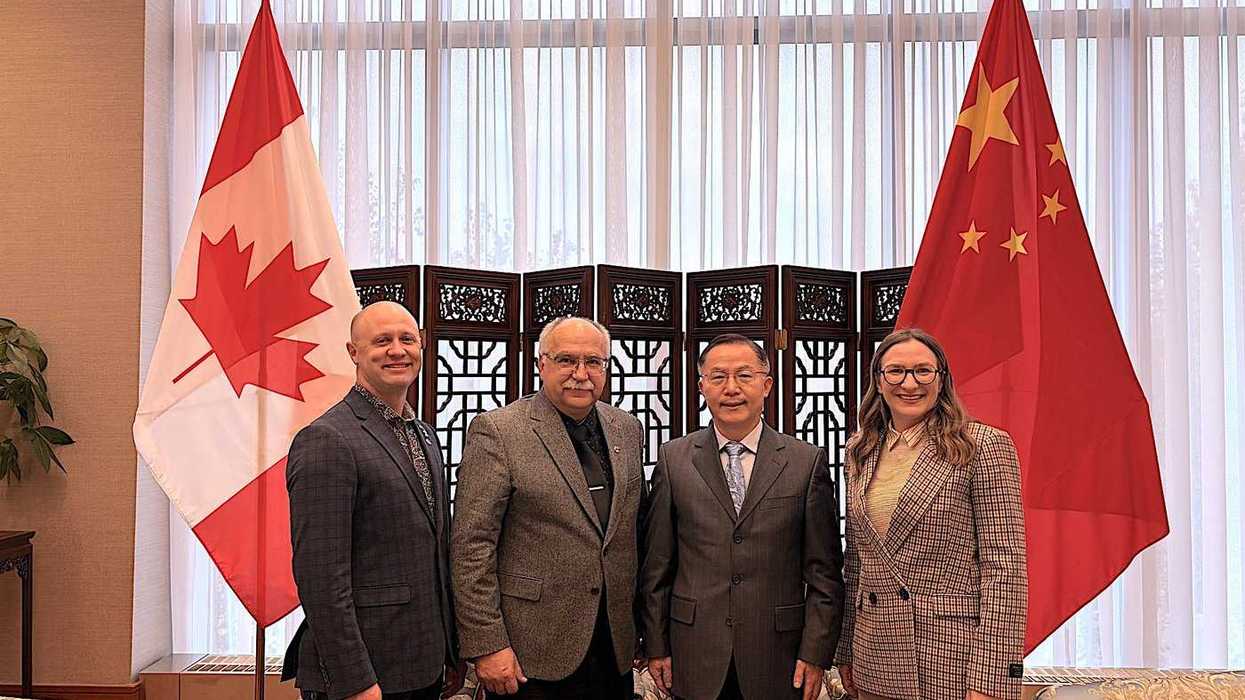
It’s no surprise that the Chinese embassy directly contacted APAS, as the Saskatchewan producers organization personally met with Embassy of the People’s Republic of China in Canada Minister-Counsellor Economic and Commercial Affairs Xu Qingjun, as related by APAS President Bill Prybylski in a phone call with Your West Central Voice Nov. 4. Xu is responsible for all trade relations between China and Canada.
“Very cordial,” said Prybylski of the most recent meeting with Chinese officials held at the Chinese embassy in Ottawa. “Very pleased he was willing to talk to us.” Prybylski stated the purpose of the face-to-face meeting was to discuss the effect of tariffs on the agricultural sector, and producers especially. Prybylski observed APAS has met with Chinese officials three times over the past six years.
Prybylski noted that the fact Xu spoke to APAS face-to-face signals improving relations between Canada and China.
Prybylski stated that foreign trade is very important to Saskatchewan producers: the province holds 50 per cent of arable land in Canada and upwards of 80 per cent of the province’s agricultural product is exported. “It’s very important that we can maintain those relationships,” said the president.
Prybylski, himself a farmer in the Willowbrook area, observed that hiccups such as tariffs, labour disruptions or supply chain issues involving products like canola meal and peas affect a Saskatchewan producer’s bottom line.
He added that deals like the one announced give producers certainty when planning for next spring. “With all the uncertainty we have to deal with it’s good to know there are some things we can negotiate with some security and certainty going forward,” said Prybylski.
He added that meeting with Chinese officials in their embassy was a memorable experience but APAS is willing to do what it takes to benefit its members.
APAS noted in their announcement some trade issues remain to be ironed out between the two nations. “While APAS welcomes this positive step forward, significant trade barriers remain. Canadian canola seed continues to face a combined tariff of 14.9 per cent, despite a substantial reduction earlier this year, while canola oil remains subject to an additional 100 per cent tariff,” stated APAS. “These barriers continue to affect Saskatchewan’s canola sector, reinforcing the need for further progress toward comprehensive and predictable market access.”
Prybylski echoed those comments, noting canola meal and peas were only two of several issues. “Great news, but we still have work to do,” he added.
Copyright 2026, Your West Central Voice. All rights reserved.
Stu Salkeld, Local Journalism Initiative Reporter, Your West Central Voice.