John Tory says he has no intention of making a political comeback
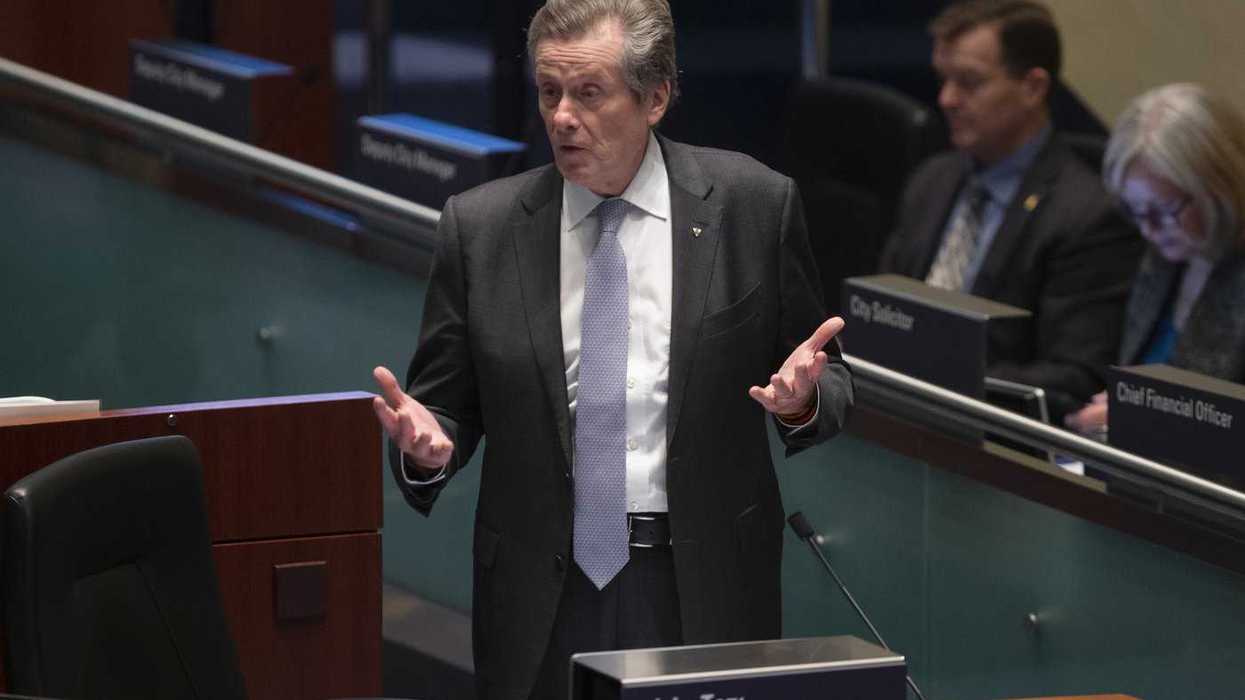
John Tory has run Canada's largest city, led the Progressive Conservative Party of Ontario and been a political strategist and adviser throughout his decades-long career.
But three years after resigning as Toronto's mayor, Tory says he has no intention of making a political comeback — ever.
Though Tory, 72, no longer has political ambitions, that will not stop him from commentating on politics as a fixture on Toronto's CP24 news channel, where he appeared as an analyst on the night of Olivia Chow's re-election last month.
Asked his thoughts on Chow's resounding victory, Tory said: "She is well-liked, and that is a significant step in politics.”
"I think, secondly, she had the advantage, which I had twice, of incumbency."
Chow is staring down an estimated $1.1 billion shortfall in the city's 2027 budget. The Ontario government has refused to extend an agreement through which it provided $1.2 billion in operating cash to Toronto in the past three years.
“I think she's still going to have a very significant financial problem,” Tory said as he criticized the funding model for municipalities relying heavily on property taxes.
"They get these envelopes from the province saying 'you have some new responsibilities, congratulations,'" he said. "And then when you look inside the envelope to see if there's a cheque accompanying the letter, there isn't one, and it's just not sustainable over time.”
In February 2023, Tory resigned just months into his third term after admitting to an “inappropriate relationship” with a former staffer, after details were first published by the Toronto Star. Allies urged him to stay in the city's top job. Even a public-opinion poll at the time was evenly split: 45 per cent of Torontonians surveyed said they wanted Tory to continue as mayor while 43 per cent wanted him to quit.
Tory said he doesn’t regret resigning as it was the “honourable” move to make.
“I miss the job, you know, because it was very challenging and very interesting … I tried my best and I certainly tried to always have the city's best interests at heart,” he said.
“But I think I did the right thing in that situation … I tried to do something that respected the office I held, respected the system I was a part of, and also protect my family and people close to me from being damaged by what happened.”
Since then, Tory has volunteered with several charities in the city he led for over eight years. He is chair of the Toronto International Film Festival board of directors and he has taken on a new role as the chair of the board of directors at WoodGreen Foundation, the charitable arm of WoodGreen Community Services, which provides social services to alleviate poverty and help the city’s vulnerable residents.
Tory has history with the WoodGreen from his time as mayor. When he sponsored a Syrian refugee family over a decade ago, WoodGreen helped them settle smoothly in the city.
"I thought it was the gold standard and it is the gold standard in terms of a sort of broad reaching social service organization that's making a difference in the city,” he said.
“I just thought that I could help take them, you know, perhaps, to the next level…with the team to raise more money.”
The federal government recently announced an investment of close to $30 billion in its budget to end homelessness across Canada over the next decade.
The effectiveness of that "substantial" financial commitment will depend on several factors, Tory said.
Ottawa needs to provide funding to the provinces and cities with conditions that it should be strictly spent to build supportive and affordable housing and help those struggling with mental health and addiction, he said.
He said a close partnership between all levels of government is also key for an investment of this magnitude to achieve its intended results.
He said programs that are financed by Ottawa and offered by Canada Mortgage and Housing Corporation require financial guarantees for non-profits to access the money, which is impossible "because they don't have the money sitting anywhere or the financial capacity."
“We're not able to take full advantage of it if we don't adjust those policies," he said, adding that resources being made available are "perhaps unconsciously excluding non-profits."
WoodGreen’s data shows it is currently managing close to 1,850 affordable units across 39 properties, making the charity the largest non-municipal provider of such housing in Toronto.
Tory said he particularly admires what WoodGreen does to help seniors and homeless mothers, and that in his new role, he is trying to raise funds and work with different levels of government and the private sector to help the non-profit “scale up” its programs and operations.
Homelessness and a housing shortage have been decades-old problems in Toronto.
Average rent in the city has tripled since 1990, according to data from the Canada Mortgage and Housing Corporation. Over the course of Tory's time in office, from December 2014 to February 2023, average rents in Toronto increased by over 40 per cent.
Advocates, however, say incomes and government social assistance have increased at a far slower pace, creating an affordability crisis. They have often criticized decision makers at all government levels, including Tory's administration, for doing too little to bridge that gap between housing cost and income.
The former mayor defended his record saying he doesn't think the "responsibility should be put at the feet of any mayor for conditions that cause rents to go up."
He said Toronto had a shortage of affordable housing for “some considerable period of time,” and the problem got worse in recent years due to several factors including the influx of newcomers, the increase of both construction costs and interest rates, and the global COVID-19 pandemic.
"I'm not trying to make excuses as much as to say we did make progress in some areas,” he said, adding that hundreds of supporting housing units were built during his time as mayor as part of the Rapid Housing Initiative, a program that was launched in co-operation between Toronto, Ontario and the federal governments.
“Do I wish it was more? Of course, but there were a number of things that contributed to that progress being less than we all would have wanted.”
This report by The Canadian Press was first published Nov. 28, 2026.
By Sharif Hassan | Copyright 2026, The Canadian Press. All rights reserved.