ABC Wants More Involuntary Care. No, Say Vancouver Liberals
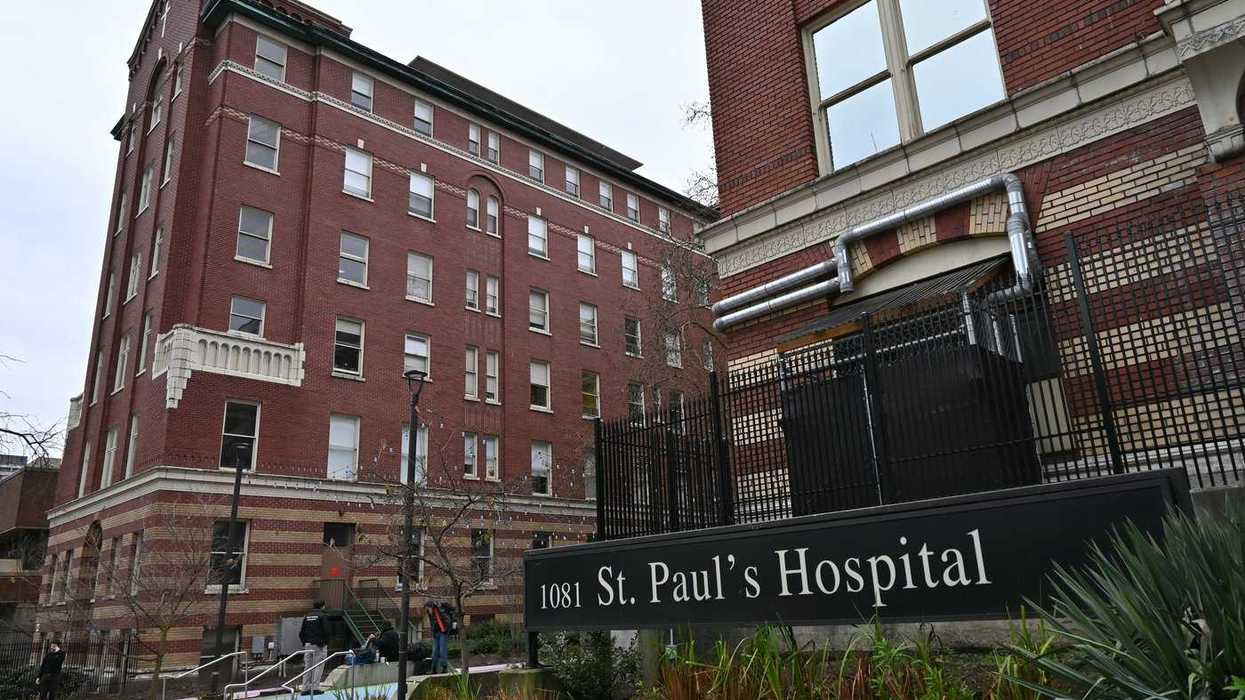
Vancouver Liberals mayoral candidate Kareem Allam is asking Vancouverites to vote no on Oct. 17 when asked if they want to convert the old St. Paul’s Hospital into an involuntary care facility.
The plebiscite, which will appear on the municipal election ballot, will centre on whether the city should ask the province to “convert portions of the old St. Paul’s Hospital, or another similar site, into a secure medical facility that provides acute voluntary and 100-plus involuntary care beds for individuals posing a serious risk to themselves or others due to severe substance use and mental health disorders.”
Allam told The Tyee the facility would amount to a “mental health prison” and is asking Vancouverites to vote no for three main reasons.
First, because it’s non-binding, so putting it on the ballot was a waste of money, he said.
Adding two plebiscite questions to the ballot will cost the city about $500,000, an ABC Vancouver spokesperson told The Tyee. ABC has the majority of seats on city council and voted to put the plebiscite on the ballot.
Second, Allam said, opening a facility such as this falls under provincial, not municipal, jurisdiction, and putting people who use drugs in an involuntary care facility would be illegal.
And third, because it would cost an enormous amount of money to renovate the building so it could offer involuntary care, which he said would be better spent revitalizing the neighbourhood.
When the province sold St. Paul’s Hospital to Concord Pacific in 2020 for nearly $1 billion, the idea was that a new development would revitalize the edge of Davie Village and the edge of the downtown business district, Allam said.
Putting in a “prison” would be a missed opportunity for the neighbourhood and would offer a “bailout” to the developer now that the market has bottomed out, he added.
ABC Coun. Lisa Dominato said she is “shocked” to hear Allam call the site a potential bailout.
“The whole focus of this is about getting the services we need,” she said, adding Vancouverites can clearly see people’s needs are not being met around the city.
Dominato said she has been “consistently hearing for the course of this term” that the public is concerned about street disorder and people who are “clearly suffering and severely unwell.”
“From my perspective, that gives us a clear mandate to be seeking help from the province and advocating for the necessary resources,” she told The Tyee.
When asked why a plebiscite is needed, Dominato said a yes vote would provide a “clear endorsement” to take to the province to advocate for more health-care resources.
While health care falls under provincial jurisdiction, Dominato said there’s still a role to play for municipalities in advocating for more resources. She said this advocacy would be similar to when mayors decry local emergency department closures.
St. Paul’s Hospital seemed like a “natural” location to propose for the facility because it is a medical facility that is about to be emptied, and “there’s willing partners there with the owners of the property,” she said.
She added she is not aware of any other site that is being considered for the hypothetical new facility at this time.
During the last municipal election, ABC said it would hire 100 cops and 100 nurses if elected. One year after the election, 100 cops had been hired but only 9.5 full-time equivalent nursing positions had been filled, mainly because health care falls outside of the city’s jurisdiction.
Dominato said that over the last four years the city has been working closely with Vancouver Coastal Health to integrate mental health professionals into dispatch and police response. Last year these programs diverted 2,500 people towards health services instead of police response, she said.
The rules of involuntary care
For someone to qualify for involuntary detention, they must be in a mental state of impairment that makes them unable to interact with the environment or to seek care, thereby putting themselves or others at risk, or be at risk of deteriorating if they leave care, according to B.C.’s Mental Health Act.
If someone meets these criteria and is detained, they still have the right to say what treatment they receive.
The Mental Health Act does not apply to someone simply because they use drugs, Dr. Daniel Vigo, B.C.’s chief scientific adviser for psychiatry, toxic drugs and concurrent disorders, previously told The Tyee.
Someone who is in psychosis because of their drug use could be held, but only until they came out of psychosis, he said. The patient would then be given the option to remain in voluntary care or be free to leave, even if it meant they would do drugs again, Vigo said.
Therefore, it would not be legal to detain someone in an involuntary care facility “due to severe substance use” as the plebiscite question suggests, Allam said.
The Tyee asked Dominato how the proposed 100 involuntary care beds would help people who use drugs, given how the Mental Health Act does not apply to people who use drugs.
“I’m not a medical expert, a practitioner or a lawyer,” Dominato said.
“The system does address these issues when someone poses a harm to themselves or harm to others,” she added.
When asked if ABC consulted with a lawyer or mental health practitioner about the phrasing of the plebiscite, Dominato said she could not “speak to the crafting of the question.”
Dominato also said she did not know that people held involuntarily under the Mental Health Act have the right to decline treatment they do not want.
Renovating the old St. Paul’s
Converting the old St. Paul’s Hospital into an involuntary care facility would likely cost “hundreds of millions” and comes with several major hurdles, Allam said.
The building is old, is not seismically sound, has asbestos in the walls and is not set up to offer patients individualized care in their own room, he said.
The site would also need to be rezoned because it is currently designated as a treatment facility, which, according to the city’s bylaws, is different from a detention facility, The Tyee previously reported.
A city can advocate for the services it needs and then it is up to the province to provide funding for capital and operating expenses, Dominato said.
A six-pillar approach
The current provincial goal is to get someone into a detox bed within 48 hours of them saying they want to try treatment, but the province currently falls “dramatically short” of being able to offer that, or does not have treatment beds available once someone gets through detox, Allam said.
This is leading to a “tremendous” number of people who want to access voluntary treatment but can’t, he added. Allam said he would advocate for the province to open more voluntary treatment services.
Allam said his party is proposing the city revamp its four-pillar drug strategy, which focuses on prevention, treatment, harm reduction and enforcement to address substance use.
The four-pillar approach was introduced in 2001. It needs an overhaul because the city has been focusing only on enforcement and harm reduction, Allam said. If elected, he said, he would introduce a new six-pillar approach, adding the pillars of housing and youth mental health, within his first 100 days in office.
The Vancouver Liberals are also proposing to build a meth response program for the city and to end homeless encampments by offering everyone stable housing and the supports they need.
Allam said he would reverse the ABC party’s freeze on building supportive housing.
The freeze has set supportive-housing projects back by a generation because the pipeline of projects in the works was given a hard stop, he said.
That’s significant because people who need supportive housing often have complex health needs that require hospital care, he said, adding that the city has several hospitals and not nearly enough supportive housing.
Dominato said ABC has been calling for an action plan to convert single-room occupancy units to apartment units with individual bathrooms, kitchens and living spaces.
However, “we need to recognize that housing alone is not a solution to certain issues,” she said, adding that providing supports to help people access treatment and recovery is also needed.
ABC’s website says its platform will address public safety and street disorder by banning drug use in public spaces; giving police tools to seize drugs; advocating for 100-plus involuntary care beds in Vancouver; mandating that provincial drug consumption sites be located away from schools and parks; and requiring public housing providers to implement a “good neighbour agreement.”
It is currently illegal under the Controlled Drugs and Substances Act to possess any amount of unregulated drugs in B.C. or anywhere else in Canada. B.C. ran a decriminalization pilot project that allowed people to carry small amounts of drugs, but that pilot project ended Jan. 31, 2026.
The police already have the authority to seize illegal drugs.
Eight of the nine overdose prevention sites in Vancouver are located in the Downtown Eastside, with the ninth at Commercial Drive and Broadway. The province opens these sites where there is already a high rate of overdose and overdose fatalities, which is why it was trying to open a site at 900 Helmcken St., in the neighbourhood with the second-highest overdose fatality rate in the region.
Under ABC, Vancouver’s homeless count has increased by 12 per cent and overdose prevention sites have been shut down or prevented from opening, which creates barriers to people stabilizing their lives, Allam said. Stability through housing and employment can often be people’s first step towards treatment, he added.
The proposed involuntary care facility wouldn’t reduce the city’s homeless count because only a “very, very small fraction” of the 2,715 Vancouverites who are currently unhoused would qualify for involuntary care, Allam said.
Copyright 2026, The Tyee. All rights reserved.
Michelle Gamage, Local Journalism Initiative Reporter, The Tyee.