Online Shopping Is Getting More Expensive & You Can Partly Blame Vancouver, Say Experts
Who knew?!
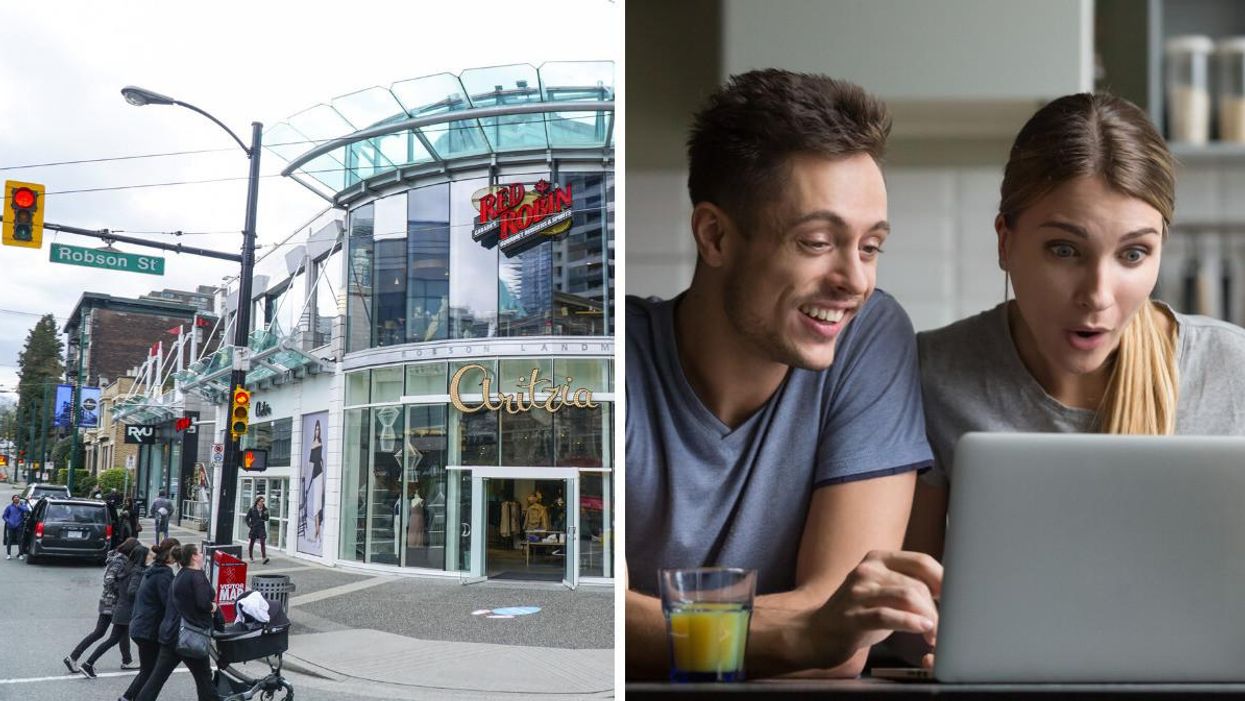
People shopping on Robson Street in Vancouver. Right: A couple doing online shopping.
Greater Vancouver’s municipalities are painstakingly slow to approve industrial developments, for which there’s great demand and low availability, causing rental rates to surge and forcing e-commerce companies to recover costs from consumers who buy products online.
“It is incredibly hard to get new product onto the market. We’re seeing a lot of barriers to entry municipally and provincially,” said Josh Gaglardi, Principal of Orion Construction.
“Lower Mainland industrial land has an extreme scarcity problem. Once you find a property and work through intense due diligence requirements, it’s increasingly harder to go through municipal and provincial approvals. If it wasn’t hard enough to satisfy one of the key factors, coupled with strong industrial demand and the lack of greenfield options, you have a municipal approvals process that is slowing everything down.”
In addition to transportation costs increasing, COVID-19-induced supply chain bottlenecks have made goods more expensive. Then, of course, there’s inflation reaching 5.7% in February.
But rent alone has been enough to wreak havoc on e-commerce companies’ overheads, says Sean Bagan, Vice President of Industrial at Colliers. A year ago, leases were signed for $16-18 per sq. ft but now they’re $20-23 per sq. ft, which has contributed to the price of online goods rising.”
“They have to increase the cost of their products now,” Bagan said. “I have seen it as a consumer. We don’t see their balance sheets or their income lines, but yes, products have grown in terms of their cost to the end user and that, in my opinion, is a reflection of not just real estate costs but all costs for companies to operate. And that’s not just an issue in Vancouver, it’s happening everywhere.”
Gaglardi says the situation has become so dire that the Metro Vancouver and Fraser Valley regions need to prioritize employment lands, possibly through ratification. He notes that Metro Vancouver approved 300 acres of developable land in South Surrey—the latter municipality is still in the approvals process, though—but it won’t even make a dent satisfying demand.
Approvals previously required 51% of relevant municipal officials’ votes, but now two-thirds are needed. Additionally, more stringent environmental regulations have been introduced from cutting greenhouse gas emissions to establishing the Agricultural Land Reserve (ALR), which prioritizes designated provincial lands for farming above other uses, and while it only comprises 5% of British Columbia’s land mass, part of these protected lands are in the land-locked Lower Mainland.
Moreover, construction costs have surged as a result of supply chain issues, which Gaglardi estimates is in the order of 20-25%, and that’s in conjunction with land scarcity putting upward pressure on land prices.
“It has always been bad but with the dwindling supply of land and the remaining sites requiring more complex approval processes, the situation is just getting worse. It’s more challenging,” he said.
Locations Are Hard to Come By
Bagan says the No. 1 issue his clients, which range from e-commerce firms to distribution and manufacturing companies, have is finding adequate space. They will typically look for industrial units that are 20-25% larger than their immediate needs because supply chain headaches mean a product might not be available for just-in-time delivery, spurring the need for just-in-case inventory.
“The industrial market has become so extremely competitive, where there are multiple bids on any property whether it’s on- or off-market, and it’s pushed market values up,” Bagan said. “For most tenants, every month rates still seem to be increasing. Tenants expect a certain lease rate but they sign the lease at a higher price than what they had expected throughout the negotiation process.”
One reason locations are so crucial is that, beset though they may be by several cost-increasing variables, finding adequate labour is proving difficult, but the easier the locations are to travel to, the higher their employee retention becomes.
“It’s extremely difficult and expensive to find labour right now, so they need to be attractive to their employees, whether it’s being close to transit or main transportation arteries,” Bagan said.
Making Do
If a tenant wanted to move out of their 100,000 sq. ft unit, they would have nowhere to go, hence why those listings are seldom available, Bagan says. He maintains that municipalities’ slow permitting and obstinacy freeing ALR land are major problems in the Greater Vancouver Area’s industrial market, but for developers who squeak through and deliver product, creativity is imperative.
“Permit timing anywhere in Vancouver is extremely slow, so the solutions are significantly decreasing some of that permit timing and getting access to some of that land in the ALR,” he said.
“E-commerce companies in our market find it difficult to expand and they’re trying to figure out how to use existing space more efficiently, whether it’s through more modern racking systems or densifying their racking. Industrial developers can’t build larger warehouses, so they build higher ceilings from 26’ to 36-40’. We can’t create more land but what we’re starting to see is developers get creative with how they build their developments. We’re seeing more multi-level industrial builds that are 2,000-5,000 sq. ft in some municipal areas with large ramps for trailers to climb levels.”
The post How Vancouver’s Industrial Land Scarcity Makes Online Shopping More Expensive appeared first on STOREYS.