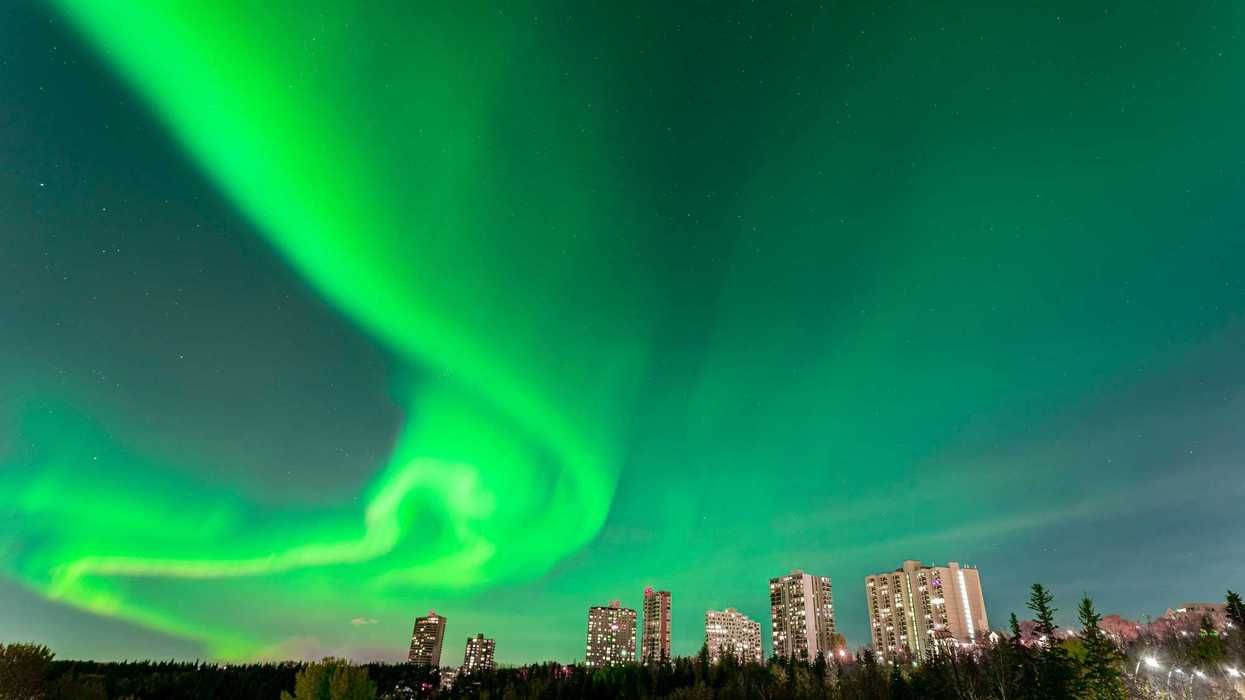
You could see the northern lights from almost everywhere in Canada tonight, including southern Ontario.
Some places are expected to get a "more intense" aurora, so here's what you need to know.
A northern lights forecast from NOAA said geomagnetic storms are likely, which means the aurora could shine over most of Canada on Friday, January 16 and into the overnight hours on Saturday, January 17.
The aurora is expected to be "more intense" in places like Prince George, Edmonton, Jasper, Calgary, Banff, Saskatoon, Regina, Churchill, and Winnipeg.
You could also see the northern lights in Victoria, Vancouver, Kelowna, Lethbridge, Thunder Bay, Moosonee, Timmins, Quebec City, Saguenay, Labrador City, Happy Valley-Goose Bay and the surrounding areas.
NOAA's forecast has a view line that shows how far south the aurora could be seen on the northern horizon.
Toronto, the GTA, and most of southern Ontario, including Ottawa, are within the view line for Friday night.
The northern lights could also be visible along the northern horizon in Montreal, Sherbrooke, Trois-Rivières, Saint John, Moncton, Fredericton, Charlottetown and nearby areas.
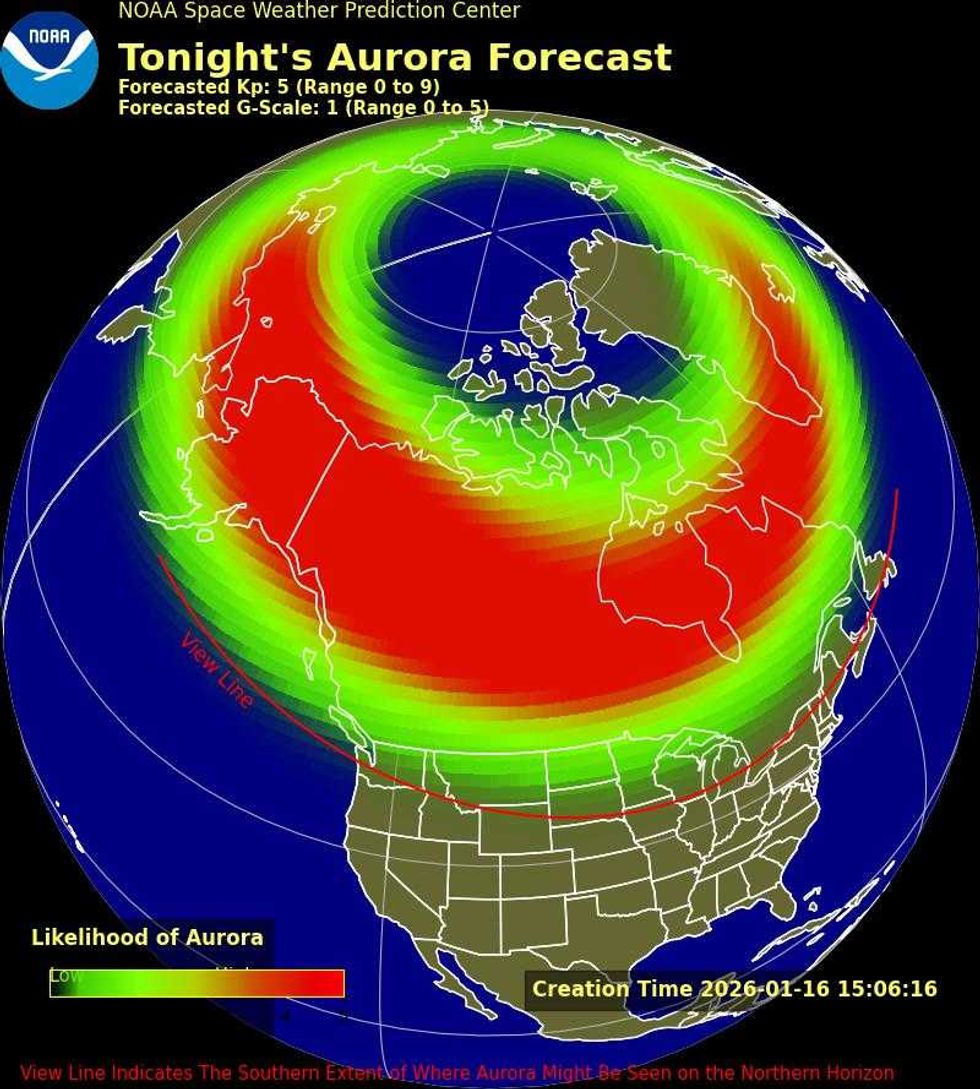 Northern lights forecast map for January 16, 2026.NOAA
In this forecast map from NOAA, the brightness and location of the aurora are shown as a green oval.
The aurora is expected to be "more intense" where the green oval is red.
You can see the northern lights directly overhead in places within the oval, but the aurora can be observed from 1,000 kilometres away when it's bright, according to NOAA.
There are aurora viewing tips from the Canadian Space Agency to help you see the northern lights.
Usually, the northern lights appear a few hours after sunset and become more intense around midnight.
You should find a place with little or no light pollution, according to the Canadian Space Agency.
If a less intense aurora is forecast, city lights can block your view.
Then, when you're in a dark location, you're being told to look all around because the northern lights can appear anywhere in the sky.
But if you're in a place that's near the view line in NOAA's forecast, the northern lights will be visible toward the northern horizon.
You don't need a telescope or binoculars to see the northern lights.
Good luck!
This article's cover image was used for illustrative purposes only.