A Canadian Fisherman Caught The Weirdest Fish Ever & It Was Lurking 800 m Deep (PHOTO)
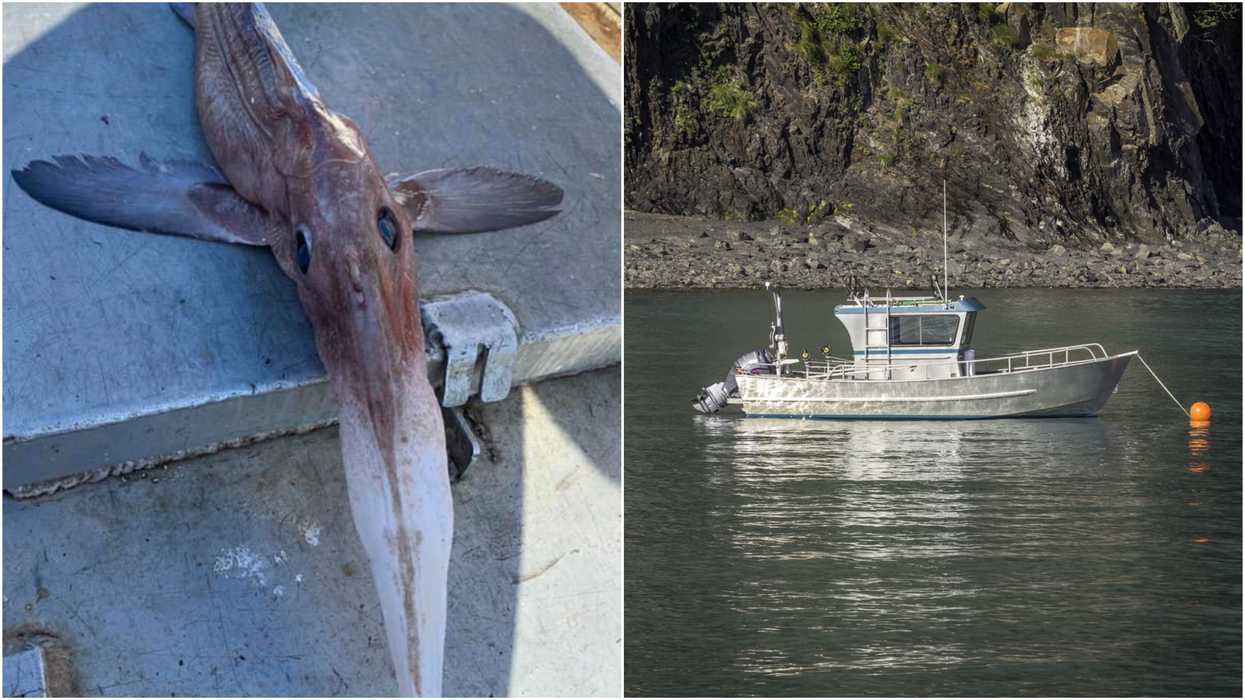
If you’ve ever wondered what lurks 800 metres underneath the sea, you’re about to find out. A Canadian fisherman caught a pretty terrifying creature last week, while he was fishing for turbot in Newfoundland and Labrador. The fish is so stange looking, the man initially thought he'd caught a platypus!
Garry Goodyear, from Templeman, N.L., was fishing on the Grand Banks last week when his nets brought up an extremely unusual discovery.
With the nets at 800 metres deep, Goodyear was expecting to find turbot. Instead, he caught a creature that was almost one metre long.
Editor's Choice: Canada's Set To Suffer Through An Extra Cold & Snowy Winter This Year (VIDEO)
The fisherman told CBC News that he saw the huge fish and said, “Good God! What in the heck was that?"
Noting that he’d never seen anything like it before, Goodyear explained that he initially thought they’d caught a platypus.
"It looked like he had wings, and his nose was, it was almost like rubber. I guess it was like cartilage," he said.
None of the people on board were able to identify the dead critter, so Goodyear turned to Facebook for answers.
"What a weird looking fish we pulled from the depths on our turbot trip. Does anybody know what it is?" he asked.
He eventually learned that he’d pulled out a long-nosed chimaera, a cartilaginous fish that has venom in its spine.
"We didn't know it had a spine with venom in it. It was just another fish to us ... and we were handling that with bare hands," Goodyear added.
Since the fisherman's original post, the image has been widely shared across social media.
Responding to a reposted photo of the strange creature, one Newfoundland local mused, "Only 5% of the ocean has been studied......... god knows what else is down there."
Experts told CBC News that the fish likely died while being pulled up by the fishing net, a common fate for deepwater species.
While chimaeras can sometimes be found as deep as 3,000 metres below the surface, they can also be spotted at around 200 metres.
This means you’re very unlikely to bump into one while paddling in the ocean, thankfully!
*The article's right cover image is for illustrative purposes only.