Alberta separatists gain partial court win, referendum petition to be verified
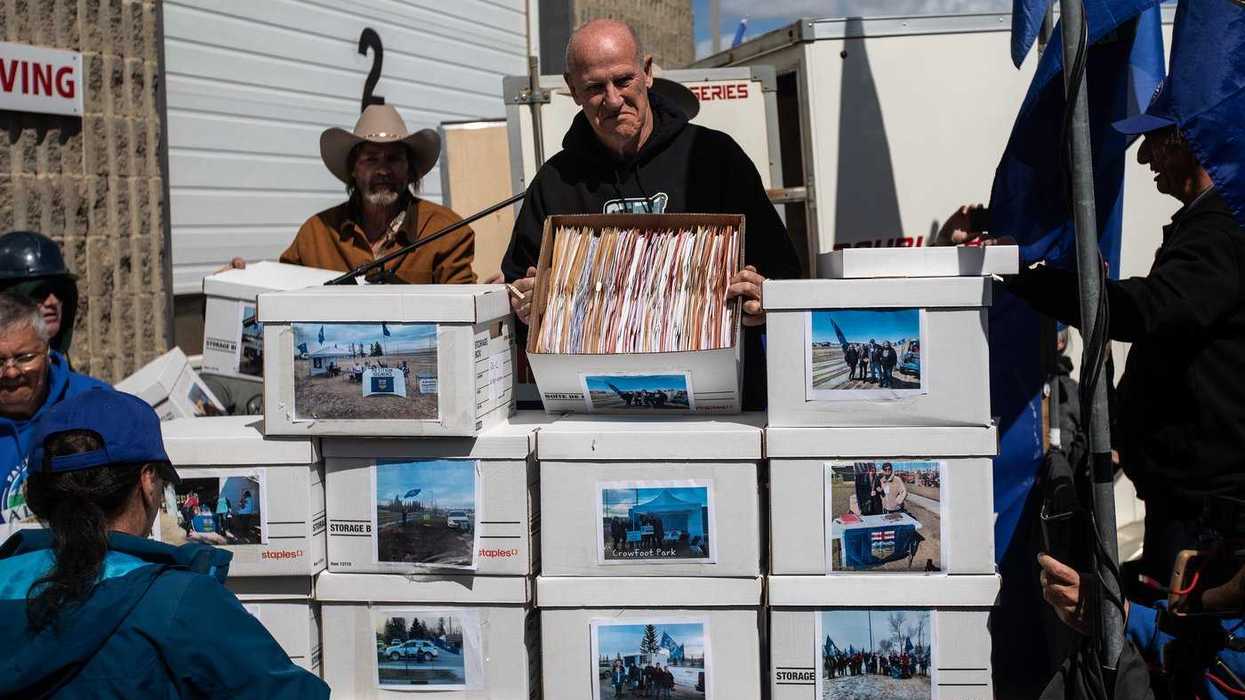
The group behind a petition for a separation referendum in Alberta has won a partial victory in court.
An Alberta Court of Appeal judge ruled on Monday that the signatures on the petition can be counted and verified and that the results can be shared publicly.
Justice Alice Woolley, in a written decision, said not verifying the signatures now could create more problems later on should things change with larger issues that have yet to be decided in court.
"People who signed the petition may move or die. They may change addresses or phone numbers. Trust and confidence in the security and integrity of the collected sheets will begin to erode (if they're not verified now),” Woolley wrote.
Woolley’s decision is the latest development in a long-running court fight over a referendum petition launched by a group named Stay Free Alberta.
The battle began last year when Stay Free Alberta was given permission by Elections Alberta to start collecting names, prompting a legal challenge by a group of First Nations to get the process stopped on the grounds they had not been consulted on an issue that affects treaty rights.
In early May, Stay Free Alberta submitted to Elections Alberta what the group said was nearly 302,000 names calling on Premier Danielle Smith’s government to consider a referendum on having Alberta quit Canada and become an independent state.
It was far more than the minimum 178,000 required under provincial law.
But just two weeks later, that petition was quashed by a judge who ruled it should not have been issued under provincial law and that Smith's government neglected its duty to consult First Nations.
Both the province and Stay Free Alberta are appealing that ruling.
Monday’s decision to allow the names to be verified is the first step in the appeal process and comes after Stay Free Alberta's application for a stay order was heard earlier this month. Woolley had said during the hearing that she had concerns with multiple parts of the May decision.
She also noted there are already questions about the integrity of the petition, referencing how Elections Alberta has committed to a special verification process after a copy of the province's official voter list had been improperly obtained by a separatist group.
Woolley did not grant the separatists everything they sought, as her ruling Monday only granted a partial stay of the decision to throw out the petition.
She wrote that even if the petition is found to have more than the minimum required number of signatures, it still cannot be sent to the province for consideration.
However, Albertans will still be voting on the future of the province's place in Canada.
After the petition had been thrown out, Smith announced that Albertans will vote Oct. 19 on whether they want to remain in Canada or start the process to hold a second, binding vote on leaving Confederation. Albertans will also vote on nine other government sponsored questions related to immigration and constitutional reform.
Smith said the question her government came up with was in response to the ruling and the fact that two competing petitions on either side of the separatist debate had generated hundreds of thousands of signatures.
Woolley wrote that while the question put forward by Smith's government isn't what Stay Free Alberta is seeking, she thinks it's a clear sign the group's campaign didn't go unnoticed.
“If a majority chooses to commence the legal process to hold a binding referendum on whether Alberta should separate from Canada, a question akin to (Stay Free Alberta's) may well be put to voters."
Jeff Rath, a lawyer for Stay Free Alberta, said Monday he was pleased with Woolley's decision.
"We think it's a great day in Alberta for democracy," he said in an interview.
Rath has been a fierce critic of Smith for putting a "question to have a question" to voters rather than a binding separation vote, and he said he thinks having the signatures verified will put pressure on Smith to act.
He said a majority of members of Smith's United Conservative Party want to see Alberta go its own way, and said Smith is "constantly thwarting" her own supporters by taking the federalist side.
"It's time for Danielle Smith to do the right thing: either give us our question or resign," Rath said.
A spokesperson for Justice Minister Mickey Amery said Woolley's decision was a "positive development" while the government waits for its appeal to be heard.
"In the interim, Alberta’s government will continue with the current referendum question,” said Amery's press secretary Heather Jenkins.
Athabasca Chipewyan First Nation, one of the nations that challenged the petition in court, said it respects Woolley's decision, and will continue to fight to make sure last month's ruling isn't overturned.
"The separatists are still trying to force their issue onto the ballot, but Albertans have an opportunity (on Oct. 19) to shut this down for good,” the nation said through its lawyers in a statement.
Provincial law requires Elections Alberta to verify referendum petition signatures within 21 days. A spokesperson for the agency said it was reviewing Woolley's decision.
This report by The Canadian Press was first published June 29, 2026.
By Jack Farrell | Copyright 2026, The Canadian Press. All rights reserved.