Alberta's contentious new riding boundary maps tabled in the legislature
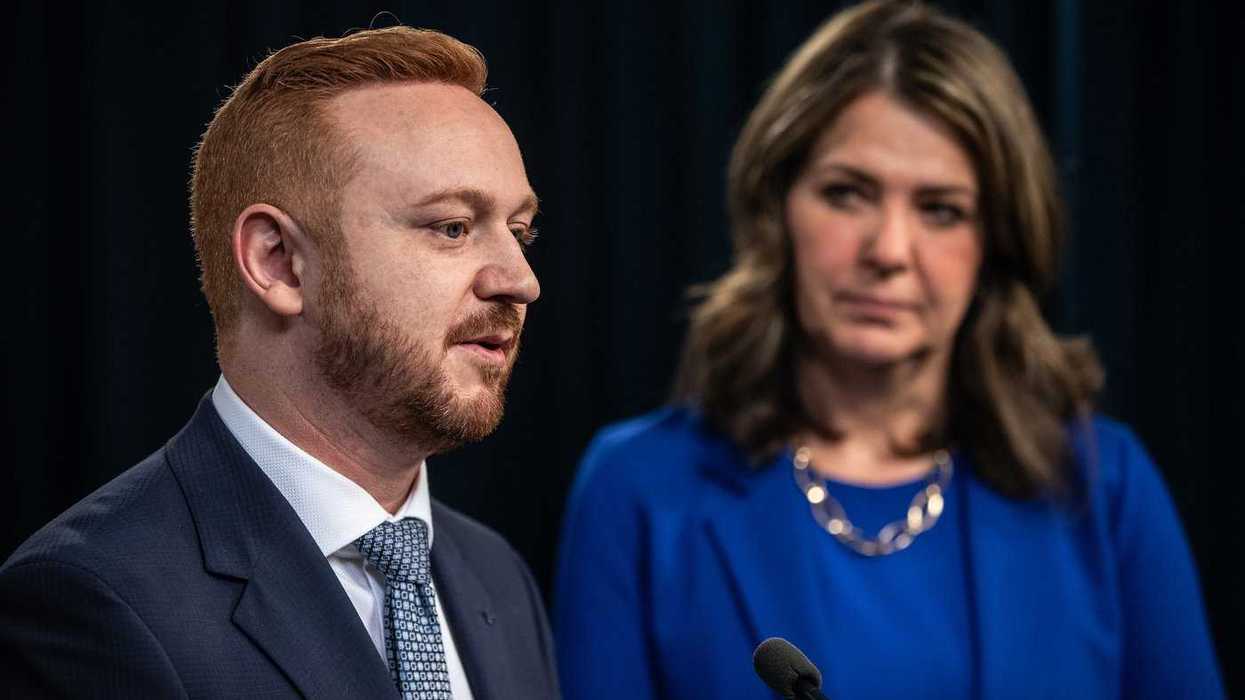
Alberta's hotly debated proposals for new riding boundaries were released to the public Monday as the Opposition NDP renewed its call for the government to change course.
NDP Leader Naheed Nenshi told reporters after the report was tabled that he believes the proposals are illegal and unconstitutional.
He has said they plan to challenge the proposals in court. He has charged that Premier Danielle Smith’s United Conservatives are aiming to use their legislative majority to rig the new boundaries to give themselves an unfair advantage in next year’s election.
"If they have the nerve to cheat to win, I'll say two things: we're going to win anyway, and their legacy will be that they lost even after cheating," Nenshi said.
The proposals will go to a debate in the legislature, expected later this week.
Justice Minister Mickey Amery said in a statement Monday UCP caucus "will discuss the report and have more to say later."
Amery told reporters earlier Monday that it was his expectation new riding maps would be adopted by law before the end of the month.
The controversy comes down to proposed changes in battleground election districts in Lethbridge and Calgary.
The proposals come from an advisory panel that, like the bipartisan commission previously tasked with redrawing the province's riding maps, was split among party lines.
The panel's majority faction was made up of the two UCP appointees — including former federal Conservative cabinet minister Monte Solberg — and a retired judge appointed by a UCP-dominated legislature committee.
The majority has proposed splitting Lethbridge's two current ridings into four, with one riding being strictly urban while the other three districts become what's known as hybrid ridings. These districts include some city neighbourhoods and stretch far into the surrounding rural area.
The UCP and the NDP each currently hold one Lethbridge seat, while the UCP holds the two rural districts that surround the city.
The NDP has accused the UCP of trying to gerrymander the ridings in their favour by boosting the power and influence of the rural vote, which is the bedrock support of the governing United Conservatives.
Gerrymandering, which is common in the United States, sees electoral districts drawn up not for reasons of shared geography and priorities but by voting patterns in order to assist one political party.
The panel's majority, in the report released Monday, denies any ill intentions.
"This is not hybridization for an improper purpose," the majority wrote of its Lethbridge proposals.
They wrote that there's a real need for regional representation in southern Alberta because of how the agricultural and food processing industries unite residents and because Lethbridge serves as a service and entertainment hub for the region.
"For many rural residents, Lethbridge is their city in every practical sense," the majority wrote.
"Lethbridge is not there solely for its resident population. It is also there for the people of southern Alberta."
In Calgary, the panel's majority has proposed two hybrid ridings in the city's northwest, near where the NDP and UCP battled in a number of tight races in the 2023 election.
The two new hybrids are on top of the four that the previous commission's majority had proposed and that the panel has largely kept intact.
The new ridings being proposed both take existing urban ridings and add rural neighbourhoods on the city's outskirts.
The panel has also taken one of the previously proposed hybrid ridings and changed it to include the southern portion of the estate community of Springbank. The northern part of the estate area is included in one of the two new hybrid ridings.
In their report, the panel's majority argues that Springbank is very much a part of Calgary's social fabric. They cite the fact that residents largely work in the city and the area is home to a golf course affiliated with a downtown athletic club.
The report is riven with disputes between the minority NDP appointees to the panel and the UCP-appointed majority and chair. Not only do they disagree on their conclusions but also on what their mandate was supposed to be.
The chair, retired judge Brian O'Ferrall, accused the NDP appointees of wasting time by crying foul throughout the process.
"The minority's opinion can be summarized quite simply. Our proposals are constitutional; yours are not. Our proposals are non-partisan; yours are not," he wrote.
"The panel's proposals are not unprecedented and they do not exceed the panel's mandate.”
O'Ferrall, who conceded that he "failed miserably" in getting the panel to "confine itself to the merits" of the exercise, nevertheless encouraged the members of the legislature to analyze the majority's proposals through a non-partisan lens.
Meanwhile, the clock is ticking.
Last week, Alberta's top elections official, Gordon McClure, warned the legislature that as it is he won’t have enough time to adopt new riding maps ahead of next year's election, scheduled for Oct. 18, 2027.
He had suggested last week that the election either be postponed or be done with the current maps still in place, but the proposal was quickly dismissed by Amery. The minister said he expects Elections Alberta to get the job done in the time allotted.
The boundary redrawing process has been mired in controversy since the premier rejected the main recommendations of a public boundaries commission early this year when the commission came back with a split report.
Bucking political norms, Smith's government voted it down in the legislature and restarted the redrawing process with a new advisory panel.
That new panel was given new marching orders based on some recommendations from the previous commission's chair — including expanding the number of ridings to 91 from 87 to preserve two rural ridings that had been set to be dissolved.
The panel's majority report Monday does maintain those two ridings, although with adjusted boundaries. It also sees Calgary gain two seats more than it currently has while one additional seat is added in Edmonton.
This report by The Canadian Press was first published Nov. 2, 2026.
By Lisa Johnson and Jack Farrell | Copyright 2026, The Canadian Press. All rights reserved.