Experts Say Canada's Interest Rate Could Increase 3 Times This Year & Here's What That Means
This could really affect you.👇
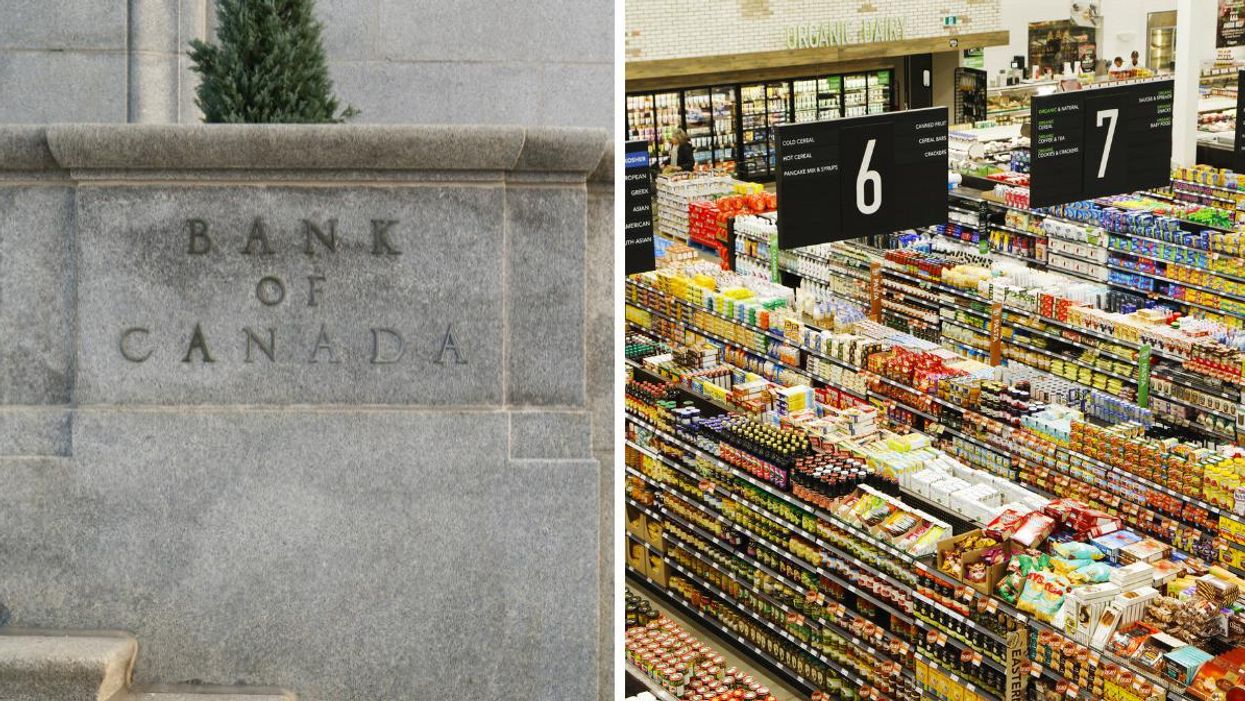
The Bank of Canada Headquarters. Right: A grocery store in Toronto.
Financial analysts are predicting three increases in Canada's interest rate this year, which could have some major effects on the economy and the average Canadian.
As reported by Storeys, financial analysts are calling for an increase of 50 base points — with 1 base point equalling 0.01 of a percentage point — three times over the coming months.
What this means is that we could see an interest rate increase from the current 0.50% to around 2% by the time July rolls around.
After that, they are expecting it to go down to a 0.25% per rate announcement, which could mean an interest rate of around 3% to 3.25% by March 2023.
So, what does this mean for you? Well, it could lead to a few different things for the average Canadian wallet.
The first is one of the reasons that the Bank of Canada has recently raised the interest rate, to combat inflation. By raising the interest rate, the Bank of Canada is making it more expensive for banks and other financial institutions to borrow money. This causes companies to spend less and save more. Which in turn incentivises them to more gradually increase prices, or even lower them, slowing inflation.
And, lower inflation rates mean less money out of your pocket for essentials like groceries, gas and more.
However, a higher interest rate has the same effect on the average consumer. The cost of taking out a loan of any kind, from a mortgage, to a student loan, to a car loan, increases for all Canadians as well. This is because the Bank of Canada is not only trying to get big financial institutions to slow down, it also wants individuals to spend less and save more. Which also contributes to a slowdown of the economy and inflation.
So, a higher interest rate is double-edged. It could have a positive effect on the rising inflation rate, which in February was at a 31 year high, but it also means that loans for everyone, from banks to regular folks, would be more expensive.
This article's cover image was used for illustrative purposes only.
- 27 Ways To Save Money On Groceries, Gas, Property & More If You ... ›
- Canada's Inflation Rate Is at A 30-Year High & Here's What That ... ›
- Canada's Interest Rate Is Increasing & Here's What That Means For ... ›
- Canada's Interest Rate Just Went Up Again & Here's How It's Going To Impact Mortgages - Narcity ›
- Inflation In Canada Has Gone Up Once Again & Gas Costs Almost 40% More Than In 2021 - Narcity ›
- Ontario's House Prices Are Actually Expected To Drop Next Year & Here's Why - Narcity ›
- There Are Fewer People Buying Homes In Toronto & Here's What's Happening - Narcity ›
- Canada's Interest Rate Just Jumped By A Whopping 1% & Here's Why Everyone's Saying 'WTF' - Narcity ›