Human rights panel accuses Canada of genocide against Indigenous population
An international panel of human rights experts has accused Canada of committing genocide against its Indigenous population after a week of hearings in Montreal.
The Permanent Peoples' Tribunal was mandated to look at missing and disappeared children and unmarked graves at Canada’s residential school sites, as well as the forced sterilization of Indigenous women, through the lens of international law.
The panel of seven judges said Canada historically adopted a series of policies that they deemed were crimes against humanity with genocidal intent, including the residential schools, which were in operation for over 150 years. The last residential school closed in 1996.
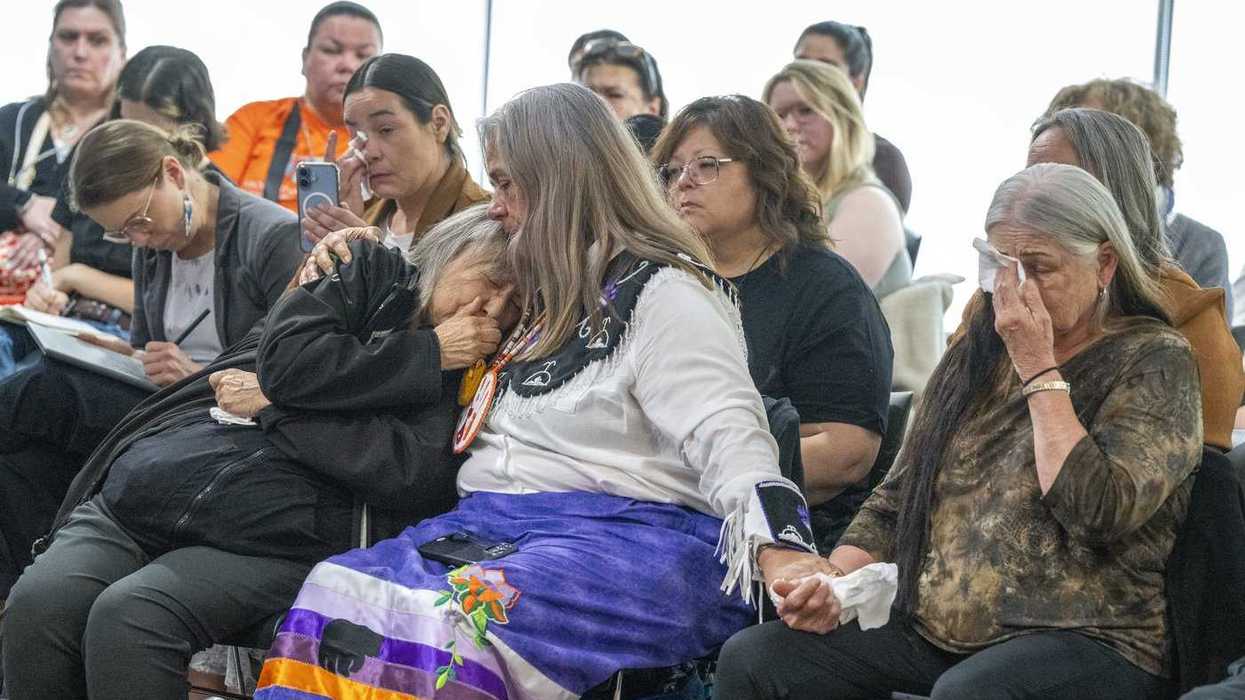
Survivors at the hearings held onto each other and wiped away tears as three tribunal members read out the decision.
Roberta Hill, a survivor who testified, said she welcomed the judgment, and she hopes it will lead to answers and better reconciliation efforts.
“It’s all we’ve ever asked for: just tell the truth about how this country came to be,” Hill said. “Survivors have been standing up for a long, long time trying to get people to understand and listen to us.”
During the trial, survivors of the residential school system recounted being subject to nutritional and medical experiments, including being underfed and malnourished, and to forced labour. Children were made to live in cold, unsanitary and crowded conditions, leaving them vulnerable to infection.
Witnesses gave harrowing accounts of sexual and physical abuse, including being beat or put into solitary confinement for speaking their language or helping other children.
While reading out the panel’s decision, Permanent Peoples' Tribunal judge Frances Webber cited the testimony of one survivor, Audrey Hill, who said, “They didn’t care, that was the thing.” She had also described days spent locked in a dark closet alone with no food or water.
Webber said between 4,000 and 6,000 children are known to have died or disappeared while in the residential school system. Dr. Scott Hamilton, a witness in the hearings, said the numbers are likely to be underestimated as many deaths were not recorded. Of the recorded deaths, almost half were caused by tuberculosis.
Witnesses spoke of infected babies left to die alone in tents in the freezing cold.
Parents were often never notified of their child’s death, Webber said.
The panel also heard testimonies from women who were forcefully sterilized. They said they faced racism from medical professionals who told them they were unfit to be mothers and lied to them about the irreversible nature of the procedures.
“There’s no difficulty for us to accept that … forced disappearances, torture, sexual violence, enslavement, persecution, and other inhumane omissions such as failure to provide safe and healthy living conditions systematically to Indigenous children, women and families constitute crimes against humanity,” said Webber, reading the panel’s judgment.
She added the goal of these acts was to seize Indigenous lands, territories and resources.
The international opinion court was created in 1979 to investigate crimes against humanity and human rights violations. The hearing on Missing Children and Unmarked Graves was the 57th case the tribunal has overseen.
The government of Canada did not participate in the court of opinion’s hearings.
Pascal Laplante, a spokesperson for Crown-Indigenous Relations and Northern Affairs Canada, said “residential schools are a shameful part of Canada’s colonial history whose painful legacy continues to be felt across the country today.”
Laplante added that the government “will continue working with Indigenous partners to support education, commemoration and community-led healing initiatives for survivors, families and future generations.”
The Permanent Peoples' Tribunal says Canada has failed to meet its responsibilities laid out by the United Nations Declaration on the Rights of Indigenous Peoples and the Truth and Reconciliation Commission in 2015. Tribunal judge Valmaine Toki said Canada bears legal, moral and political responsibility for its “systemic policy of assimilation, dispossession and destruction.”
She said Canada’s policies affected successive generations of Indigenous families, causing long-lasting trauma and psychological harm caused by the destruction of culture and language.
Toki said Canada is doing “just enough” to say it is improving its relationship with Indigenous Peoples but has failed to investigate the crimes against residential school survivors. She said the government continues to harm Indigenous communities through forced sterilizations, child protection services that are not culturally adapted and failing to provide clean drinking water to some communities.
“We welcome the preliminary statement, particularly the finding of the continuing genocide,” said Christa Big Canoe, a prosecutor and director of the Aboriginal Legal Services. “We have nothing but hope moving forward.”
The tribunal said it has sent its findings and recommendations to the government of Canada and will hand down its full judgment on Sept. 30 for the National Day for Truth and Reconciliation.
This report by The Canadian Press was first published May 29, 2026.
By Erika Morris | Copyright 2026, The Canadian Press. All rights reserved.