Tick Season Is Set To Be Worse in Parts Of Canada This Year & Here's How To Avoid Them
Be careful when hitting this woods this summer!
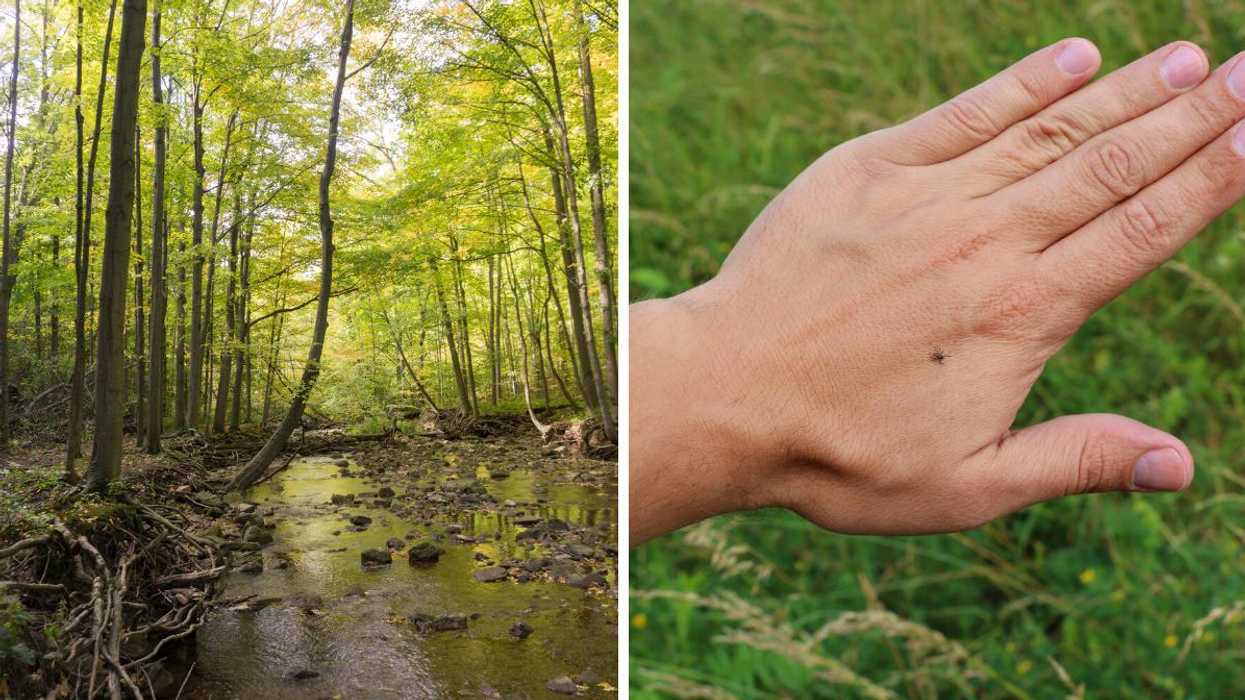
A stream in the Ontario woods. Right: A hand with a small tick on it.
Experts are saying that 2022 will be a bad year for ticks in Canada with more of them than ever expected to be carrying Lyme disease.
And if that sounds scary, don't worry, because there are plenty of ways to stay safe when you get out into the backcountry this summer.
According to Global News, parts of Canada are likely to see an increased amount of ticks this year due to more mild and short winters.
This escalation in ticks numbers is likely going to be the case every year from now on due to climate change, according to Dr. Vett Lloyd — the director of the Lloyd Tick Lab at Mount Allison University.
Health Canada says Lyme disease is transmitted to humans typically via a bacteria, carried by the juvenile form of the blacklegged tick. Symptoms include fever, fatigue, headache, a bull's eye-shaped skin rash, aching muscles and joints, and more.
More serious cases can cause joint pain, an irregular heartbeat or even nervous system disorders.
There is no known cure or vaccine for the disease, but antibiotic treatments can lead to successful recovery if administered early enough.
Right now, the place with the highest tick-to-human ratio is Nova Scotia, followed by Ontario, but the little insects can be found from coast to coast.
Luckily, protection against tick bites is relatively easy. The Government of Canada has several tips on preventing bites and, therefore, potential Lyme disease infection.
If you're going out into the woods, walk on cleared paths and be sure to tuck your shirt into your pants and your pants into your socks — to limit places for the bug to crawl into.
You should also wear light-coloured clothing — for easy detection of the black insects — closed-toe shoes and carry a bug spray with either DEET or Icaridin.
When you get home, it's good to do a full-body check of yourself, children and your pets.
It's also recommended to shower or bathe ASAP, as well as pop your clothes in the dryer for about ten minutes.
If you do find that you are bitten, carefully remove the insect, and any parts leftover, with a set of tweezers and then wash the area with soap and water or an alcohol-based sanitizer.
After that, stay on the lookout for Lyme disease symptoms.
Luckily the disease can be treated if caught early, so staying on the lookout is key.
Stay safe when out hiking this summer, Canada!