Senator Says Canada Has Lost 'Moral Ground' & Should Make Things Easier For Newcomers
She also called for the media’s active role in addressing Islamophobia.
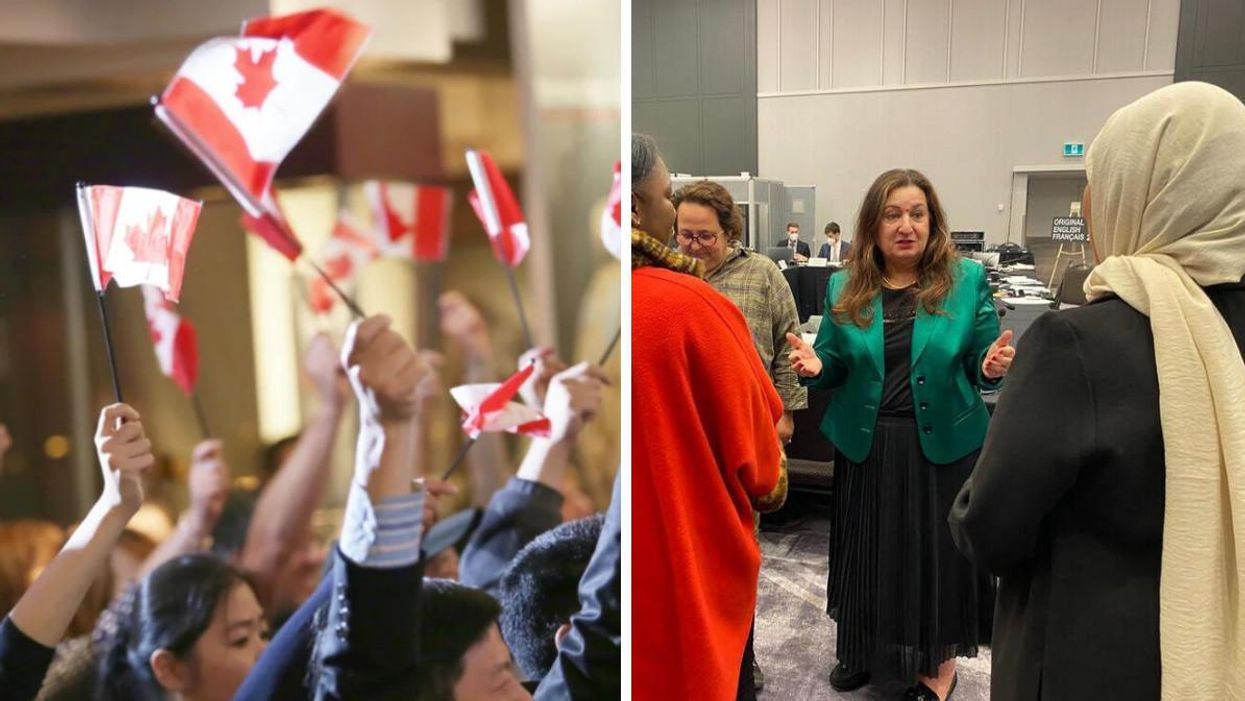
Canadian flags. Right: Senator Salma Ataullahjan with panellists.
Canada has witnessed the highest number of hate-motivated mass killings of Muslims among G-7 countries in the last five years – and it’s "eroding" the country’s global image, according to Senator Salma Ataullahjan.
"When you move to Canada, especially those who are Muslim, are going to find it a bit hard," she exclusively told Narcity on Wednesday.
Ataullahjan, who sits with the Conservative caucus, is currently in Toronto, chairing the Senate Standing Committee on Human Rights, which is studying Islamophobia in Canada.
The two-day discussions are aimed at giving a platform to the members of local Muslim communities – and for sharing their testimonies on the subject of anti-Muslim hate in the city.
But while the existence of Islam in Canada dates back to the first census in 1871, hate crimes against its million-plus current Muslim population have only intensified in recent decades, according to Ataullahjan.
"We keep saying that Canada needs new immigrants, but then we don't make that process [of transition] easier for them. It's a difficult ask – but if we're bringing them and they are uprooting themselves, then we owe it to them for making the transition a bit smoother," she said.
Muslim Women At Risk
The subject of hatred against "visibly Muslim women" was raised by multiple panellists in their testimonies. A 2018 qualitative study by University of Toronto researcher Sidrah Ahmad found that one in three incidents have gone unreported, still more than a third of Islamophobic hate crimes have targeted Muslim women.
"We had some very powerful panellists in Toronto today. But the ones that really stood out for me personally, as a woman, were the two female teachers (educators Rizwana Kaderdina and Rabia Khokhar)," said Senator Ataullahjan.
"They spoke so beautifully and eloquently of the challenges facing young women who wear the hijab – the challenges about how they are viewed within society, and even with the people that they work with."
Various panellists then cited the example of Quebec’s Laicity of the State Act, also known as Law 21, as a systemic measure which disproportionately affects Muslims by ramping up prejudices and misconceptions about headscarf-clad women in popular culture.
They suggested that it’s not only affected students, who are unable to get access to education but potential teachers that are rejected from jobs for their choice of head covering.
Media As Gatekeeper
The role of media in addressing Canada’s increasing Islamophobia was scrutinized by a number of panellists as well.
"When you go into some of the smaller towns, the perception of being a Muslim is what they see portrayed in media. And we have heard this criticism that the media has played a negative role. They will point out a Muslim terrorist, but they will not identify other terrorists by their religious identity," said Ataullahjan.
And while she was cautious about not calling for censoring the media's freedom of speech, she highlighted the need to report responsibly and consciously avoid hate-mongering on the basis of religion.
"When a Muslim commits a terror act, we [the Muslims] do condemn it. But that onus is not on other communities when somebody from their community commits an act of terror," she added while quoting that less than a percentage of total terrorist acts in Canada are committed by Muslims.
Mental health director and a member of the Muslim Medical Association of Canada, Dr. Arfeen Malick, also pointed out the dehumanization and resulting surveillance of Muslims in her panel remarks.
Unlike white people who commit crimes, brown people are seldom viewed as individuals – but as a product of their community, quickly described as terrorists by large sections of the media, research has found.
In the post-9/11 world, studies have established that over half of Canada doesn't trust Muslims. No less than 46 percent of Canadians also believed that the discrimination Muslims faced was their own fault.
Possible Measures
Another panellist and GTA-based educator, Omar Zia, put forth a possible course of action in order to remedy the "otherness" regarding Muslims in mainstream culture. The hiring of more Muslim teachers; the key role of parents in helping the youth develop information literacy and a critical eye towards the media; and an acknowledgment of the impact of Islamophobia on the victims’ mental health were discussed.
Two more sets of panel discussions are slated for Thursday, which will see further educators, lawyers, police personnel and religious leaders put forth the social problems of Toronto’s Muslim communities.
Senators David M. Arnot, Victor Oh and Amina Gerba will continue to be in attendance for the committee, after participating in Wednesday’s discussions.
The committee has been travelling across the country, including recent panels in Edmonton and Quebec City, before submitting the results of their study by the end of 2022.
What senators hear from locals could form the basis of recommendations for measures that can be implemented to make Canada a more welcoming place.
"We (Canada) were known for our stance on human rights, we were known for our stance on standing up for vulnerable people. Unfortunately, I think we've lost a little bit of the moral ground on that," Senator Ataullahjan, who migrated to Canada from Pakistan in the early '80s, told us.
"I'm being very blunt and very truthful because I, myself, am an immigrant to this country. We need to look at maneuvering immigrants, we need to support them better," she concluded.
- Immigrating To Canada Can Be Pretty Expensive & Here Are The Fees You Need To Be Mindful Of - Narcity ›
- Immigrating To Canada Can Be Expensive & Here Are The Fees You Need To Be Mindful Of - Narcity ›
- TikToker Explains Why Iran Protests Aren't Just About The Hijab But Women’s Freedom Of Choice - Narcity ›
- A 2022 Human Rights Report Has Called Out Canada For Multiple Violations - Narcity ›