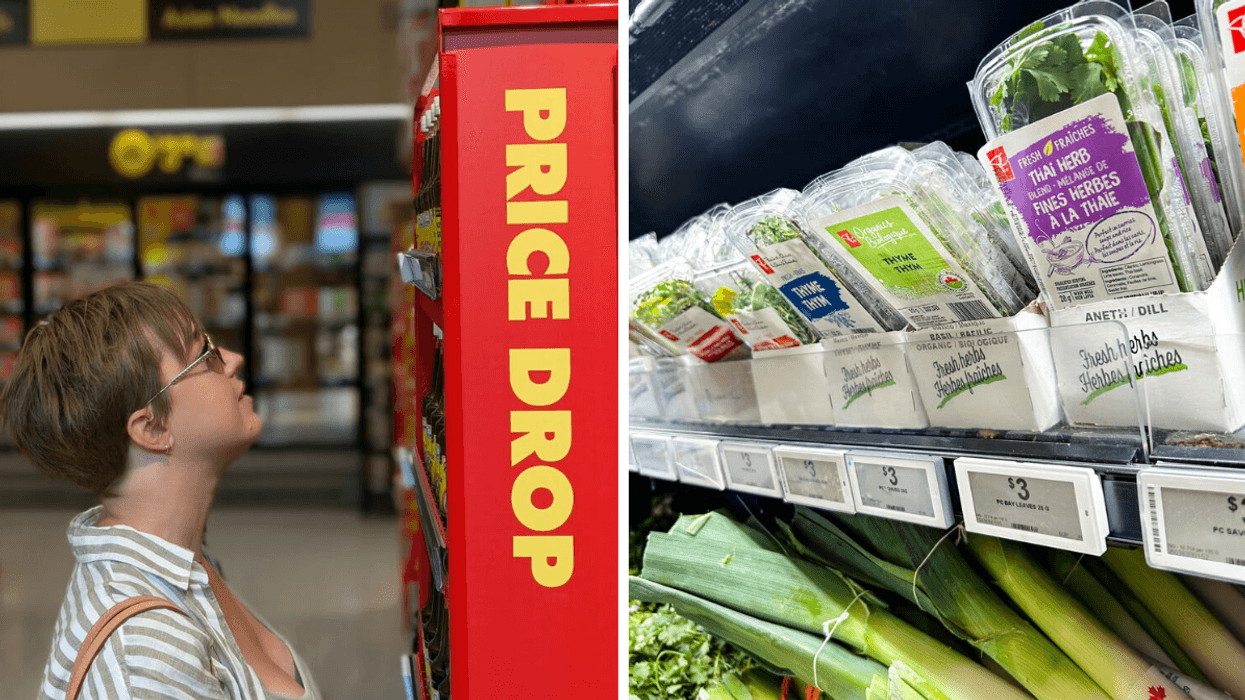
Over the last few months, I have done a lot (like, a LOT) of grocery store research. I've visited Ontario's three biggest stores, compared shopping experiences and now it's time to get down to the details that actually matter: prices.
As food costs skyrocket alongside rent, consumer goods, travel and pretty much everything else in Canada, it's getting harder and harder to figure out what's actually worth our money.
Tack on the fact that just about every store, brand and company is promising the biggest bang for our buck, and we've got ourselves a recipe for confusion — and consumer burnout.
Who has the time to wander from store to store comparing prices on everything?
Well, in the interest of distilling endless piles of information, I popped over to two of Ontario's big three grocery stores to get the scoop on how much things actually cost, so you can shop accordingly (and maybe save some cash in the process).
No Frills
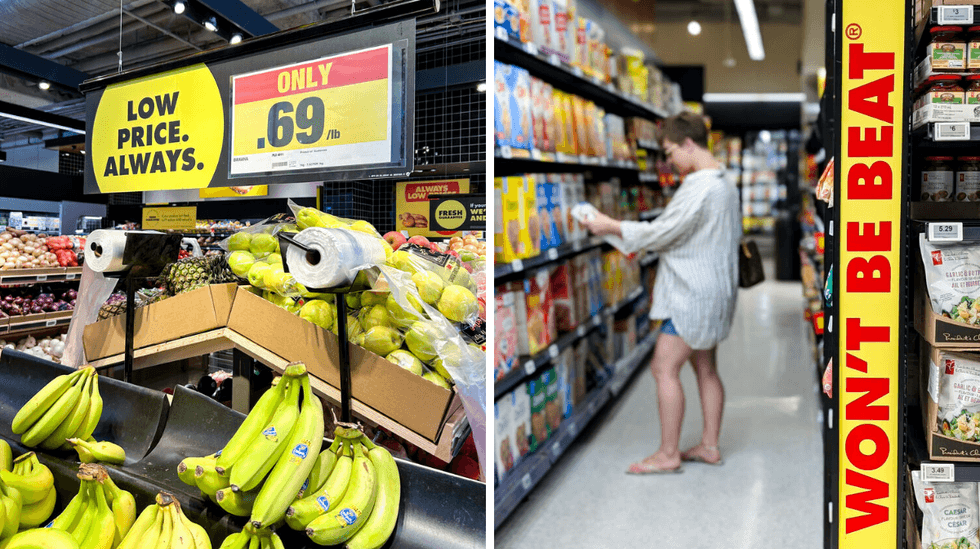
I love price matching!
One might argue that as a subsidiary of the notorious Loblaw Companies Limited, No Frills would be similarly high-priced. After taking a thorough look around, however, I'm pleased to report that I was wrong.
Not only did I spot markdown signs everywhere, but No Frills' price-matching policy gives it a serious competitive advantage. There's just one problem: you might not actually find a better deal elsewhere.
Fresh herbs were priced at a whopping $0.50 less than the competitors' options.
Bananas, too, were $0.20 cheaper here. Even protein was significantly cheaper (for reference, chicken was a mind-boggling 50% cheaper per kilogram than at Metro).
Staples like bread also floored me with the price difference: a loaf that ran $4 at No Frills was $4.68 at Metro.
In fact, I was hard-pressed to find any items that were more expensive at No Frills. And though the shopping experience is far from boutique, the stores are clean and the product selection is excellent, with produce, meat and other perishables that are clearly fresh and cycled out regularly.
Did it have every single item I could possibly dream up? No. But so what? If I can save $10, $15, $20 or more on every grocery trip, I don't care if I can't get persimmons in the winter.
Metro
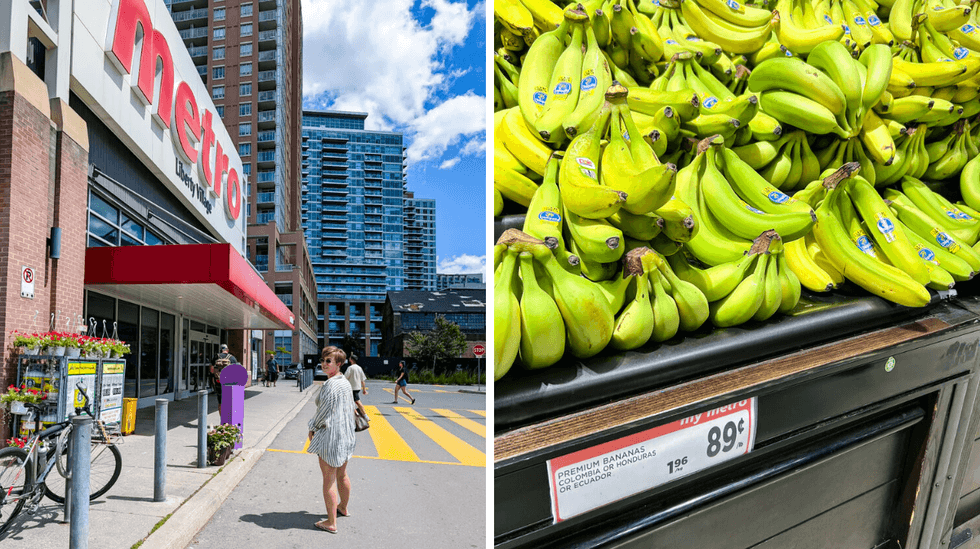
Even the humble banana was pricier.
A direct price comparison between Metro's offerings and the ones at No Frills revealed a troubling detail: almost every item was more expensive.
A bag of flour (2.5 kg of Robin Hood All-Purpose, for anyone keeping track of the details) may have been $4.99 here, but my hopes of finally finding a cheaper alternative at Metro were quickly dashed when I saw that was the sale price.
A budget-friendly staple is all well and good until you find out that the original price is actually an eye-watering $7.79, compared to No Frills' $5.99 for the same bag. I repeat, THE EXACT. SAME. BAG.
If I could describe my feelings towards Metro's prices in one word, it would be: frustrated.
Yes, the selection is larger than No Frills'. But I shouldn't need a degree in advanced mathematics (or accounting) to keep track of where I should shop for individual products. Should I buy bread now at a higher price, or keep my fingers crossed and hope that another grocery store is nominally cheaper than Metro?
The burden placed on consumers to research and find the best deals — when the goalposts seemingly keep shifting from week to week — is, frankly, inhumane.
In all fairness, not all grocery stores are created equal. There's a multitude of factors that need to be properly considered: How well-staffed is the store? Are there enough employees to properly stock, restock and audit the products? Are there supply chain issues? Are there environmental events affecting the availability of certain products? And how does all of that affect the price?
I'm not unreasonable. I can grasp that there's nuance, OK?
And $0.20 might not seem like much at first, but when every penny counts, these discrepancies make all the difference. In some cases, a couple of bucks here and there can mean the difference between eating well and just... eating (or, worse yet, not eating at all).
Having said that, the price differences are actually a good thing. It means market competition is working as it should.
Between bread and beef, there's been no shortage of price-fixing allegations in Canada, so seeing big-name grocery chains actively trying to outdo one another on costs gives me hope that maybe, one day, we can finally look at our grocery bills without immediately calculating what other expenses we'd have to cut just to feed our families.
The opinions expressed in this article are the author's own and do not necessarily reflect the views of Narcity Media.
These prices are confirmed at the time of publishing, but they can change at any time. Taxes and fees may not be included.