B.C. election focuses on taxes, but economist calls ideas 'different kinds of bad'
British Columbia economist Ross Hickey compares the tax policies of all three major parties in the provincial election campaign to candy — the kind that gives you a stomach ache.
"I think what all these politicians, and maybe the public, (are) forgetting is that we may not like taxes but there's a difference between better and worse tax policy and the proposals that they're making are leaning toward worse tax policy, all of them," he said.
"They look like candy. It's nice right now to have, but it's gonna ruin our dinner."
Taxes have become a central theme in the first half of the election campaign, with the B.C. Conservatives promising cuts in a bid to "supercharge" the economy, the NDP seeking to fund health care at the expense of top earners, and the Greens proposing a tax on wealth, not income.
But Hickey, an associate professor of economics in the faculty of management at the University of British Columbia's Okanagan campus, labels all the options as "different kinds of bad" ideas that are "the most politically savvy pandering policies," as they try to lure voters to the polls on Oct. 24.
"The BC NDP called a snap election because of the political convenience. They don't have a new economic policy agenda that they're putting forward. They're just going because they think that the other side is weak," he said of the decision to call the election two years early.
"The other sides, these other parties, the Greens and the Conservatives, weren't prepared with the economic policy platform for this election, and so they're trying their best to scrape something together, and what can you come up with on short notice?"
NDP Leader David Eby is proposing to suspend gasoline taxes, while bringing in a new tax bracket for people making more than $1 million and increasing taxes on the two highest existing income brackets starting at about $190,000.
"We're asking (the highest earners) to pay a little bit more so we can deliver health care for British Columbians that they need," he said earlier this week.
Eby has said the changes would generate $1 billion in 2028-29, while the Conservatives say increasing taxes will drive away much-needed doctors.
Hickey questions the NDP calculations, suggesting $1 billion in revenue is unlikely when you factor in people's response to a new tax.
"When you increase marginal tax rates, that gives people an incentive to work less," he said.
"So you have to account for that when you calculate how much revenue you're going to get," he said, suggesting independent economists estimated the increases would garner between $500 million and $700 million.
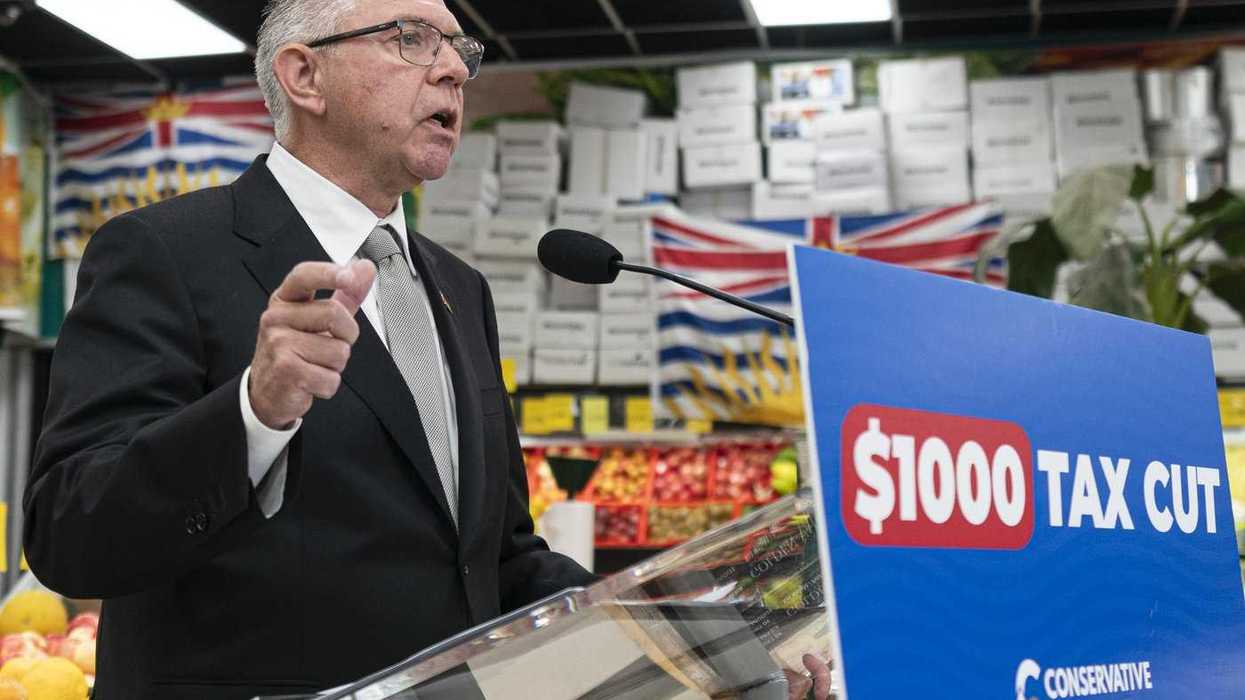
The Conservatives promise no new taxes, the elimination of the PST on some items and cuts to provincial taxes by $1,000 a year for nearly every working British Columbian.
The party platform says they would achieve the tax cut by raising the province’s basic personal exemption to $32,000 from $13,216.
Hickey said increasing the exemption level would put money in pockets but not motivate people to work in the same way a cut to marginal tax rates would.
He estimates the Conservative tax cut would cost about $2 billion.
"We already have a deficit of $13 billion in this province. So that's saying, if we don't change anything else, we're going to go from $13 billion to $15 billion. Now who pays that … that's the future generations of B.C.," he said.
Interim Conservative leader Lorne Doerkson has not said how much his cuts would cost, but argued they were needed to "supercharge" the economy, which lost 20,000 jobs in September.
"The reality is we have to supercharge the economy first and get things going because that is our revenue. That is how we fund everything in this province," he told reporters earlier this week.
The BC Greens' election platform includes a promise to introduce a one-time "fair share tax" on extreme wealth, beginning at five per cent on net wealth above $50 million, 10 per cent above $100 million, and 20 per cent above $1 billion.
The party estimates the changes would raise approximately $22.2 billion.
Leader Emily Lowan has criticized Eby for co-opting "the language of the left" after she said he refused her proposal for an extreme wealth tax while he was in power.
Hickey said there are a lot of options for the extremely rich to move their wealth to more tax-friendly jurisdictions.
"Lots of studies have shown that people respond quite dramatically to these wealth taxes," he said.
"They've tried them in a lot of European countries. They haven't done a very good job of raising revenue because people move their wealth. So that's actually kind of ugly. We want to encourage people to keep their investments in British Columbia."
Hickey, who said he is not associated with any of the parties, said one of the best ways to raise revenue for the province is a harmonized sales tax, but acknowledged no political party would touch the idea.
Former premier Gordon Campbell introduced an HST in 2010 but the backlash was so severe that Campbell resigned and the idea was scrapped.
"We're in this really bad spot because no one is strong enough as a leader to lead and give us the tax policy that we need, not just the tax policies that we want," said Hickey.
"That's the problem."
This report by The Canadian Press was first published Oct. 9, 2026.
By Ashley Joannou | Copyright 2026, The Canadian Press. All rights reserved.