Here's How To Vote By Mail In Canada's Election So You Don't Have To Leave The House
The deadline to apply to vote by mail is Tuesday, September 14!
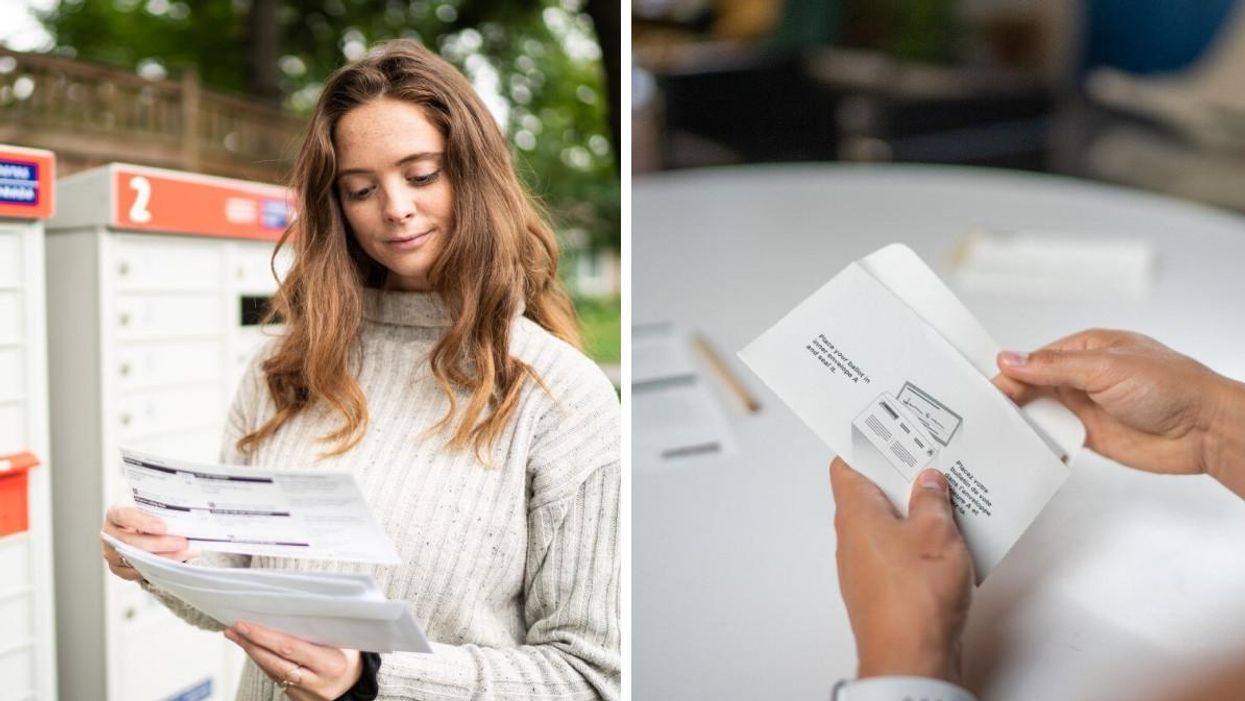
If you don't want to venture out of your home on election day and head to the polls, here's how to vote by mail in Canada for the federal election in 2021.
Voting by mail is a special ballot process and once you have applied to vote by special ballot and been approved, you can't change your mind and then go vote at a polling station.
To register and vote in the federal election, you have to be a Canadian citizen, at least 18 years old on election day and be able to prove your identity and address. If all of those apply to you and you don't want to leave the house to head to a polling station, here's the process of voting by mail.
How do I apply to vote by mail?
To vote by mail, you can apply online or in person at any Elections Canada office across Canada. You must apply before Tuesday, September 14, at 6 p.m. ET if doing it online and before Tuesday, September 14, at 6 p.m. local time if at an office.
It's best to apply as soon as possible so that there's time for the special ballot voting kit to get to you and for your marked ballot to make it to Elections Canada.
You must provide proof of ID and address when you apply, regardless of how you do it. Online, you need to upload copies of your proof and in person, you need to show it to an election worker.
To apply online, you'll be guided on-screen about how to fill out the application and you'll be asked to confirm that you're a Canadian citizen and eligible to vote in the election.
To apply at your local Elections Canada office, you have to fill out and print a registration form. If you can't print it, you can call or go to the office and request a form. Once you've signed your completed form, you can submit it to the office in person, by mail or by fax along with proof of ID and address.
Elections Canada said the process of approving applications and sending out voting kits typically takes 72 hours but it could take longer with this election.
How do I fill out my ballot?
If your application is approved, you'll get a special ballot voting kit. It includes a special ballot, a blank white envelope, and an envelope with your name and riding and a space for your signature, all with a pre-addressed return envelope with prepaid postage and voting instructions.
Filling out this ballot is different than what you do at a polling station on election day. On your vote-by-mail ballot, write the first and last name of your chosen candidate in the riding you're voting in.
You don't have to write the name of the political party but if you do, your vote will still be counted as long as you also have the name of the candidate you're voting for written there. If you write just the name of a political party, your vote won't be counted.
After you've written the first and last name of who you're voting for, put your completed ballot in the unmarked envelope provided in the kit and seal it.
Then put the unmarked envelope into the envelope that has your information on it, seal it and then sign and date the declaration that's on the outer envelope.
How do I mail my marked ballot?
Once you've filled out your ballot, follow the instructions from your voting kit and return your ballot using the pre-addressed return envelope that came with it.
The postage is prepaid so you don't need to add a stamp to the envelope.
When mailing your ballot, make sure you leave enough time for it to go through the mail and be delivered by Canada Post to Elections Canada.
If the return address is in Ottawa, the ballot needs to be received by 6 p.m. ET on election day, which is Monday, September 20.
If the return address is your local Elections Canada office, it needs to be received by the time the polls close in your riding on election day.
Be aware that your vote won't be counted if your ballot arrives after the deadline!
- How To Vote In Canada's Federal Election As A Student Explained ... ›
- Elections Canada Explained How We'll Vote During A Pandemic ... ›
- Trudeau Is Getting So Much Online Hate During The 2021 Election - Narcity ›
- If Canada’s Federal Election Was Held Today Justin Trudeau Wouldn’t Be Prime Minister - Narcity ›
- If Canada’s Federal Election Was Held Today Justin Trudeau Wouldn’t Get The Most Votes - Narcity ›
- Poll Shows Justin Trudeau Wouldn't Get The Most Votes If Canada's Federal Election Was Held Today - Narcity ›
- Canada's Major Parties Have The Highest Percentage of Gender Diverse Candidates Ever - Narcity ›
- We Asked Canadians To Name The Party Leaders Running In The Election & It Got Awkward - Narcity ›
- Canada’s Federal Election Results Could Take Longer This Year & You Can Blame The Pandemic - Narcity ›
- The Canadian Federal Election Is Almost Here & These Are All The Ways You Can Vote - Narcity ›
- Advance Voting In Canada's Federal Election Is Happening Only On These 4 Days - Narcity ›
- Taking Selfies With Election Ballots Is Actually Illegal & Here’s How To Avoid Any Trouble - Narcity ›
- A Cat From Guelph Is Unofficially Running In The 2021 Elections & His Campaign Is Purrfect - Narcity ›