172 seats won't be enough for a Liberal majority in Canada's current Parliament — Here's why
An upcoming Montreal-area by-election will decide who really controls the House of Commons.
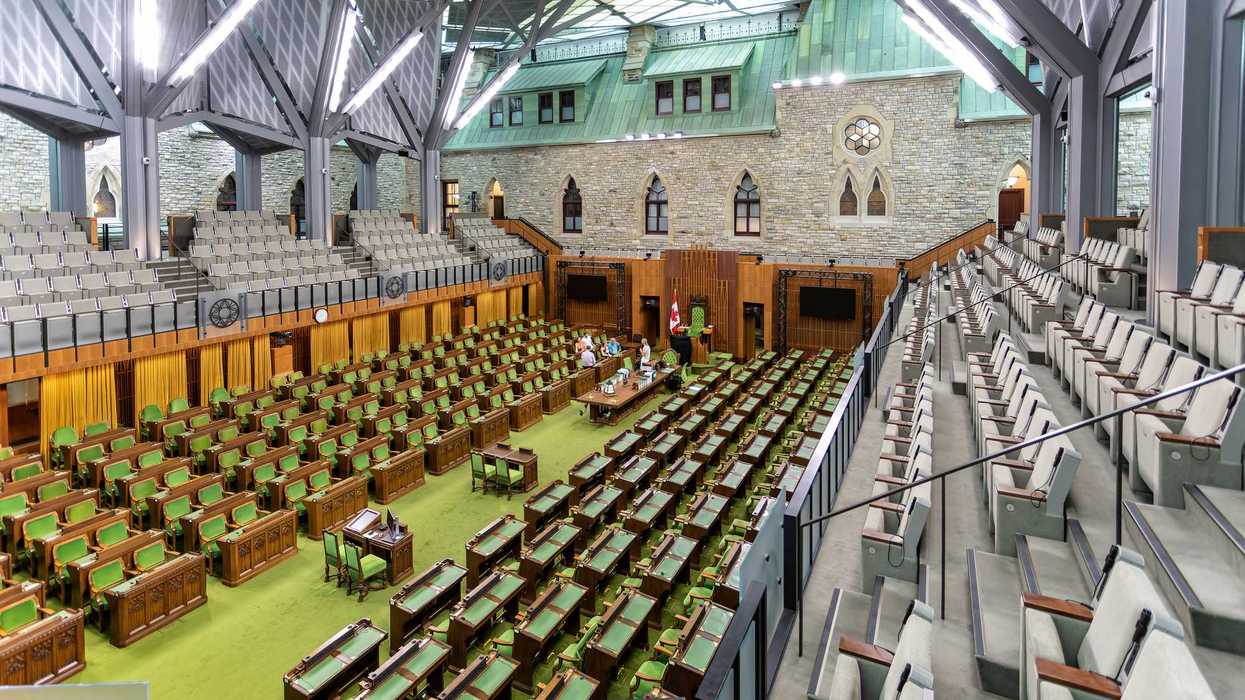
Inside the temporary House of Commons chamber in the West Block on Parliament Hill in Ottawa.
Contrary to popular belief, the choice made by voters in the Montreal-area riding of Terrebonne in the April 13 by-election will have major implications on moving bills forward in the House of Commons.
The rules of procedure in the Commons mean that, in this current Parliament, the magic number allowing a government to have a free hand is not 172 seats — a majority of the 343 seats — but actually 173.
Currently, three seats are vacant. Observers agree that the Liberals should manage to hold onto their two strongholds in the Toronto area, which would bring their seat tally to 172 MPs.
If Liberal Tatiana Auguste wins Terrebonne — the question of who controls the House of Commons would be moot.
The Liberals won the riding on Montreal's North Shore by a single vote in April 2025 over Bloc Québécois candidate Nathalie Sinclair-Desgagné, but the Supreme Court of Canada invalidated the result last month after a court challenge by the former Bloc MP over irregularities.
If Sinclair-Desgagné emerges victorious, that creates a scenario where the government would have 172 seats and the opposition parties would hold 171.
In the current legislature, the members of the House elected a Speaker from the Liberal party, a significant footnote under such tight margins.
In fact, it is rare for the Speaker to vote in the House of Commons. According to the rules of the House of Commons, he uses his "casting vote" only in the event of a tie, which would be the case in such a case.
According to the "House of Commons Procedure and Practice, 4th edition," which is frequently cited in Parliament, the Speaker is, in theory, free to vote according to his conscience, just like all other MPs.
However, this could draw him into a partisan debate and risk casting doubt on his impartiality. As such, convention dictates that "the Speaker normally votes to maintain the status quo."
How, then, would current Speaker Francis Scarpaleggia, a Liberal MP from Montreal, vote in the event of a tie?
His office told The Canadian Press that he would follow established practice.
At third reading, the final stage of the legislative process in the House of Commons, "he would vote against it to maintain the status quo," said his spokesperson, Olivier Duhaime. And at earlier stages, he would vote "for" to encourage discussion, hoping that the elected officials would eventually reach an agreement.
This means that the Liberals, even if they had an official majority of 172 seats, would need the support of at least one other MP to pass one of their bills.
However, the biggest dilemma would arise when the Speaker must vote on matters of confidence — those that could cause the government to fall and trigger a general election. Financial issues — the passing of the federal budget being the prime example — are necessarily such matters.
So what would happen if the Speaker were to vote on the budget bill during third reading?
"Here, we're faced with two conflicting factors: namely, what is the interpretation of the status quo in this case? Is it to vote against and bring down a government, or is it to not make a change to the existing situation?" his office said.
"That would be a case-by-case interpretation the Speaker would have to make. I can’t tell you which way he would lean in this instance."
For Geneviève Tellier, a professor at the University of Ottawa's School of Political Studies, the Liberal government seems willing to do whatever it takes to stay in power and legislate with the cards it has in hand.
"And if that means: I need one more vote and I’m willing to sacrifice my Speaker to appoint someone from the Opposition, well, why not, let's do it," she said.
Nothing prevents Prime Minister Mark Carney from proroguing Parliament. That would force a new election for Speaker. But it is difficult to predict the outcome of the only vote that is secret in the House of Commons.
"The position is very appealing to many MPs," said Tellier. "And so, even if there were a party line, the temptation not to strictly follow that party line exists.
"There are certainly those who will raise their hands for it, from all sides of the House."
Ultimately, there are still a few options for the governing party. First, the parties could try to find common ground. Second, the Liberals could recruit a fifth floor-crosser from the opposition benches.
In the case of deadlock, Carney could justify calling a general election.
"It's very possible that this could happen," Tellier said.
This report by The Canadian Press was first published March 27, 2026.
- Upcoming by-elections could give Mark Carney's Liberals a majority — Here's how it works ›
- 'One elbow up, one down': A look back at Mark Carney's first year in office ›
- Carney is now 2 seats from a majority after another floor crossing, with 3 more up for grabs ›
- Mark Carney is denying claims he's considering proroguing Parliament if he gets a majority - Narcity ›
- Mark Carney says floor-crossing MPs will have to adopt Liberal 'values' - Narcity ›