Canada-US Border Rules — Here's Everything You Should Know About Visiting The United States
Get ready if you're planning a trip!👇✈️
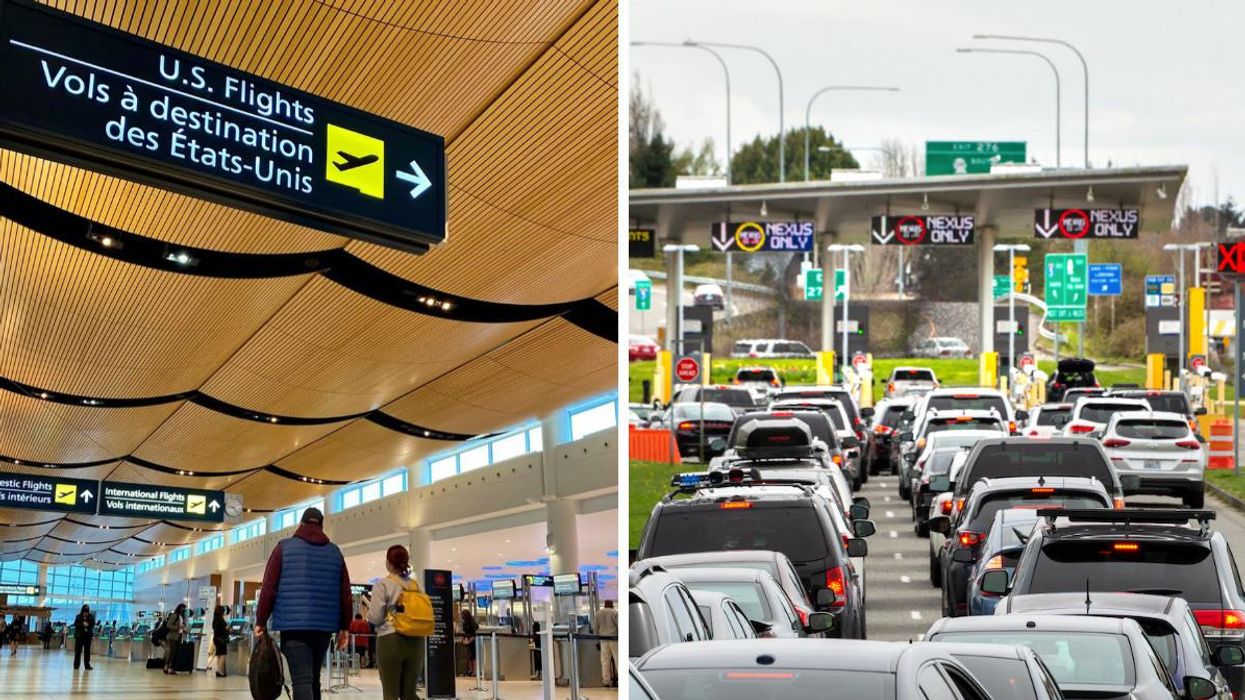
Winnipeg Airport sign showing U.S. flights. Right: Cars lined up at the Canada-U.S. land border.
Travel restrictions at the Canada-U.S. border have changed a lot since March 2020 and it can be a little confusing and overwhelming if you're planning a trip for the first time since before the COVID-19 pandemic.
As of April 1, the rules have been updated once again, and there are a few things to keep in mind whether you're driving across the land border or catching a flight.
From keeping up to date with the latest mask rules to understanding Canada's pre-entry requirements and COVID-19 vaccination restrictions, here are a few things to keep in mind before booking that cross-border adventure.
Driving into the U.S.
Some land border restrictions at the Canada-U.S. border remain in place.
However, fully vaccinated travellers driving into the United States from Canada are not required to show proof of a negative COVID-19 test.
They are likely to be asked for proof of COVID-19 vaccination status, though.
It means fully vaxxed Canadians are able to cross the U.S. land border without having to take a COVID-19 test of any kind.
This applies regardless of whether an individual is travelling for an essential or a non-essential reason.
Flying into the U.S.
To enter the United States via plane (if you are a non-U.S. citizen or non-U.S. immigrant), the CDC says you must be fully vaccinated with the primary series of an accepted COVID-19 vaccine.
There are only limited exceptions to this rule.
This means that Canadians are only allowed to catch a plane to the U.S. if they've been fully vaccinated.
The same rule applies to anybody in Canada taking a federally-regulated plane anyway, so unless you have a valid exemption you must be fully vaxxed both to catch the flight and meet pre-entry requirements in the United States.
Before being permitted entry into the U.S., air travellers will also be asked to show a negative COVID-19 test result or documentation of recovery from COVID-19.
Face mask rules
While provincial mask mandates are lifting all over Canada, the federal government has not lifted its own rules regarding face coverings.
This means that at all federally-regulated airports and on planes leaving from and landing in Canada, appropriate face coverings are still required.
In the United States, however, a judge recently ruled that airlines, airports and mass transit systems should make their own decisions about mask requirements.
Certain airlines, like Delta and United Airlines, have already dropped the restrictions, per CTV News.
Passengers taking a flight between Canada and the United States should check the specific rules with the airline they are travelling with to find out more about masking requirements.
Returning to Canada
On April 1, Canada ended the pre-entry COVID-19 test requirement for fully vaccinated travellers.
It means those travelling via land, air and water can skip COVID-19 testing prior to arrival, provided they are considered fully vaccinated under Canada's guidelines.
It means returning to Canada from abroad is a lot cheaper, as travellers are no longer expected to fork out money for pricey pre-entry tests, which could cost up to $200 per person.
It also means it's possible for fully vaxxed individuals to drive across the Canada-U.S. border without having to take any COVID-19 tests at all.
While pre-arrival testing has been scrapped, random molecular testing remains in place. This means some people may be selected to take a COVID-19 test when they get to Canada.
Those chosen for a random test are not required to quarantine while awaiting their test result.
Unless exempt, all unvaccinated or partially vaccinated passengers aged five and over must continue to provide an accepted pre-entry COVID-19 test.
Before you get going, check out our Responsible Travel Guide so you can be informed, be safe, be smart, and most of all, be respectful on your adventure.
- Feds Say Unvaccinated Canadians Should Not Travel Abroad At All ... ›
- Canada's Travel Rules Require Travellers To Wear Masks In Public ... ›
- 6 Things Canadian Airports Want All Passengers To Know Before ... ›
- Alberta Is Named The 'Dope Destination' In North America & 4 Other Provinces Made The List - Narcity ›
- The US Is Extending The Canada-US Border Vaccination Requirement For Canadian Travellers - Narcity ›