7 eerie ghost towns and abandoned places you can actually visit in Canada
Perfect for a spooky road trip. 🚙
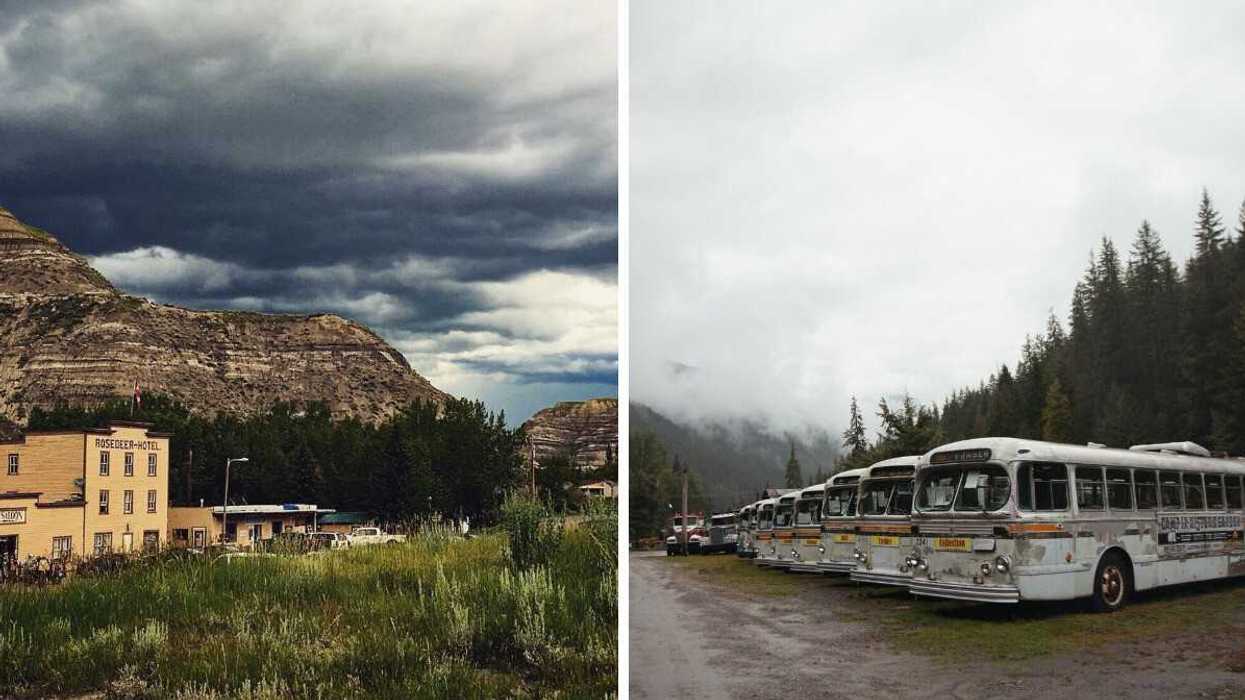
A ghost town in Alberta. Right: Abandoned buses in a ghost town in B.C.
If you love exploring the eerie side of small towns, you don't have to go far to find some seriously spooky spots.
Scattered across the country are forgotten towns, abandoned buildings and once-bustling places that have been left behind, creating haunting destinations that feel frozen in time.
From former mining communities surrounded by wilderness to abandoned settlements with crumbling buildings and fascinating histories, these ghost towns offer a glimpse into the country's past — with a little extra creepiness thrown in. Here are seven haunting ghost towns and abandoned places to plan a visit to.
Wayne, AB
Why You Need To Go: Located in the Canadian Badlands, Wayne was once a bustling coal-mining hub that today is all but abandoned.
The town was once home to over 2,000 people, but when the mines in the Drumheller area closed down in the 1930s, the town slowly died. Today, the town is home to just 28 people.
The destination can be found about 15 minutes south of Drumheller, and is one of the few places where you can visit a saloon with real bullet holes in the walls in a ghost town said to have actual ghosts.
Take a scenic drive to the town and cross the 11 bridges to Wayne, a series of one-lane metal bridges.
Carrying traffic over the winding Rosebud River and the now-defunct railway tracks — once used to transport coal through local mining communities — these spans are in the Guinness Book of World Records as the most bridges to be found within the shortest distance.
In Wayne, visit the historic and iconic Rosedeer Hotel and Last Chance Saloon, the only remnants of the once-thriving town. Established in 1913, the Rosedeer Hotel was built in the booming coal mine era by the Rosedeer Coal Mining Company, and has been referred to as the “Bucket of Blood” because of the fights the miners got into.
Today, the Last Chance Saloon and Rosedeer is a vintage saloon and hotel featuring seven themed rooms, and is even said to be haunted.
Sandon, BC
Why You Need To Go: Sandon is a historic community located in the Slocan Valley in B.C.'s West Kootenays region.
Set in a narrow gulch, it is split by a fast-flowing creek and surrounded by high, steep mountains.
Known as the "Silver City," Sandon was once the centre of what was the richest silver-lead producing region in Canada, and was a thriving town with more than 5,000 residents, a booming economy, two railways, and even brothels by 1897.
When the silver ran out, the town faded and was eventually abandoned; in 1955, a flash flood demolished many of its buildings.
Today, Sandon is still an active community, though it has fewer than 20 residents. The town features a few buildings, including the original City Hall from 1900 and the Powerhouse, as well as a fleet of trolley buses eerily waiting—ghostly buses in a ghostly town.
The ghost town’s fascinating story is chronicled in a museum located in the historic Slocan Mercantile General Store, which features the original brick material and detailing typical of a commercial building of stature in its era.
While the museum is only open until Thanksgiving, the Sandon townsite is never closed, and outdoor exhibits may be viewed at any time.
Val-Jalbert, QC
Why You Need To Go: Val-Jalbert is a historic village found on the banks of the Ouiatchouan River in Quebec.
The village was founded in 1901 through the establishment of a pulp and paper mill. However, when production at the mill was permanently suspended in 1927, the village inhabitants deserted the site. It was abandoned within a few years and became a ghost village, sitting idle for decades.
Revived in the 1960s, the village is a heritage site popular with tourists today. Val-Jalbert now comprises over 90 buildings and remains, including 42 still-standing structures and original period buildings.
The main ones are the convent-school, the general store, the post office, several houses and the pulp mill. Some of the houses have been restored, while others eerily crumble away with time.
Tickets to visit the village can be purchased online. The ticket applies to daily visits until mid-October, though the village is also open into the winter season.
While you're here, don't miss the impressive Ouiatchouan waterfall and its beautiful natural surroundings.
Parkhurst, BC
Why You Need To Go: Tucked away in the woods just north of Whistler Village, you'll find the remnants of an active mill town fading into the forest.
Parkhurst is an abandoned logging settlement that was the first non-Indigenous settlement in what is now known as Whistler. The ghost town offers a glimpse into the area's early days and how the popular mountain destination came to be.
Dating back to 1926, the mill town was once the heartbeat of the area. The mill eventually closed in 1956, but the homes and buildings of the area went on to live a second life, becoming a sort of sanctuary for "ski bums."
Today, the area is abandoned, with few structures remaining, slowly being reclaimed by nature. There are crumbling vehicles, buildings, and, eerily, a house with a graffitied image of a face watching over the area.
You can drive and hike into the ghost town on the Sea-to-Sky Trail, an out-and-back style trail of 4.7 kilometres. For the adventurous, Parkhurst can also be viewed from the water on a stand-up paddleboard, canoe or kayak.
Bankhead, AB
Why You Need To Go: Located within Banff National Park, Bankhead was once a thriving town of nearly 1,000 people, and was built next to the operations site of an anthracite coal mine.
Called the "20-year town" because it operated from 1903 to 1922, residents abandoned Bankhead after a 1922 labour strike resulted in the closure of the mine, according to Atlas Obscura.
Today, you can see the crumbling ruins of Bankhead in the mountains of the park and enjoy an easy 1-kilometre loop hike through the abandoned coal mining town.
You can see the remains of multiple buildings and a locomotive, and get stunning views of the surrounding mountains, including Mount Rundle.
Once you're done exploring the ghost town, you can head to some of Banff's most stunning spots, including Lake Minnewanka and Two Jack Lake.
Dorothy, AB
Why You Need To Go: Once a bustling settlement in the Prairies, Dorothy is a near-ghost town located just east of Drumheller that's become a favourite stop for photographers and history lovers.
The hamlet was settled around the beginning of the 20th century, and is said to have had around 100 residents at its peak. Today, the town is not abandoned, but only a few residents remain.
There are a number of buildings visitors can explore, including historic churches, a hall/school house, a bunk house, and Peake cabin, all of which are all open year-round for viewing.
The Alberta Pacific Grain Co. elevator, which is said to be the hamlet’s proudest landmark, is privately owned, according to Travel Drumheller, and therefore can only be viewed from the outside, as is the old store.
The hamlet is small but worth a stop—especially at sunset or sunrise, when it looks even more beautiful.
Indiana, ON
Why You Need To Go: Located in Ontario's Haldimand County, Indiana is a former village that was once home to about 300 people.
The village was laid out by David Thompson, a promoter of the Grand River Navigation Company, which transformed the Grand River into a navigable waterway for commercial activity during the 1830s.
The village thrived as a result of the company's activity. However, once the railway was built, Indiana faded, and today, all that's left of the former village are its cemetery, pasture land and orchards, as well as one remaining house known as the Hill House.
Thompson also developed an estate known today as Ruthven Park, a mid-19th-century country estate with a Greek Revival villa that was built in 1847.
Today, the area is a national historic site and is open to visitors. The property has also earned a reputation for being haunted.
Before you get going, check out our Responsible Travel Guide so you can be informed, be safe, be smart, and most of all, be respectful on your adventure.