
Grocery shopping somehow gets more complicated every year. We're told to shop local, eat organic, avoid too much plastic, scan ingredients, get enough protein, eat more fibre and somehow still keep the bill under control.
And then there's another question: where should you actually shop?
So, in the name of journalism — and feeding myself for the week — I decided to compare two of Ontario's most recognizable budget grocery options: Walmart and Food Basics.
To be honest, I wasn't primarily looking at grocery prices. I wanted to see how the stores compared when it came to selection, convenience, ease of shopping and whether I could actually get through a weekly grocery run without losing my mind.
After shopping at both, the biggest difference wasn't necessarily what I spent — it was what the experience was actually like.
So, here's how Walmart and Food Basics compared.
Walmart

Walmart has everything — literally!
The biggest pro of grocery shopping at Walmart is also somehow its biggest con: Walmart has everything.
And I mean everything.
You can walk in because you need bananas and leave three hours later with bananas, shampoo, a new bath mat, Valentine's Day decorations in December, a prescription, school supplies and a McDonald's hash brown.
There is something incredibly convenient about that.
As someone who's secretly a teacher by day, Walmart proved to be particularly dangerous for me during back-to-school season. I walked in determined to stick to my weekly grocery list and somehow ended up in the appliances aisle debating whether a miniature kettle would be a safety hazard in my classroom.
That's where Walmart earned its first real advantage over Food Basics before I had even started comparing groceries: it's a true one-stop shop.
The grocery selection itself is huge too. There seem to be endless versions of everything — name brand, store brand, different flavours, different package sizes and different price points.
Take Goldfish crackers. You might find the original version, different flavours, individual packs, larger cartons or alternatives like Annie's organic cheddar bunnies. If you like having options, Walmart delivers.
The international food selection is another plus. Depending on the location, you can find aisles dedicated to products and ingredients from different cuisines, which adds more variety than I would usually expect from a standard grocery run.
When it came to price, though, the difference between Walmart and Food Basics was much smaller than I expected.
For the basics I was buying, Walmart wasn't dramatically more expensive. In fact, some of the packaged and pantry items I compared were slightly cheaper, which helps explain why I've always considered Walmart a good place to stock up.
But price isn't the only thing that matters to me when I'm grocery shopping. The experience matters too.
And this is where Walmart starts to lose points.
The stores are huge, and a quick grocery run can easily turn into a scavenger hunt. I'll look up an aisle number online, confidently head in that direction and somehow end up beside windshield washer fluid when I was looking for paper towels.
Sometimes the organization feels like a test specifically designed for me to fail. How am I supposed to instinctively know that the Lysol wipes are over there near the plastic forks? Why am I circling the store for an item that I know exists but cannot seem to find anywhere? Am I grocery shopping or participating in The Amazing Race?
There are so many departments that even a short shopping list can involve a lot of walking. If I'm grabbing three things and want to be home in 20 minutes, Walmart is rarely my first choice.
That said, the superstore does offer conveniences that help offset some of those frustrations. For example, online grocery ordering makes it easier to avoid wandering the store altogether.
Plus, Walmart Canada also offers sensory-friendly shopping hours at participating locations on Monday, Tuesday and Wednesday mornings, with measures including reduced lighting and fewer in-store sounds. That's the kind of seemingly small accommodation that can make a very big difference for shoppers who experience sensory overload.
Another frustration is that some products are kept in locked cases. Why am I waiting in front of a locked glass case for someone to release a completely mundane household item into my custody?
So, for me, Walmart's value is pretty clear: it's best when you're doing a bigger shop and want to combine groceries with other errands.
If I need food, toiletries, cleaning supplies, classroom essentials and a few household items in one trip, Walmart is hard to beat.
But if I just want groceries quickly, all that choice can become part of the problem.
Walmart is built for big hauls, stock-up trips and cottage weekends — not necessarily for grabbing three things and getting home fast.
Food Basics
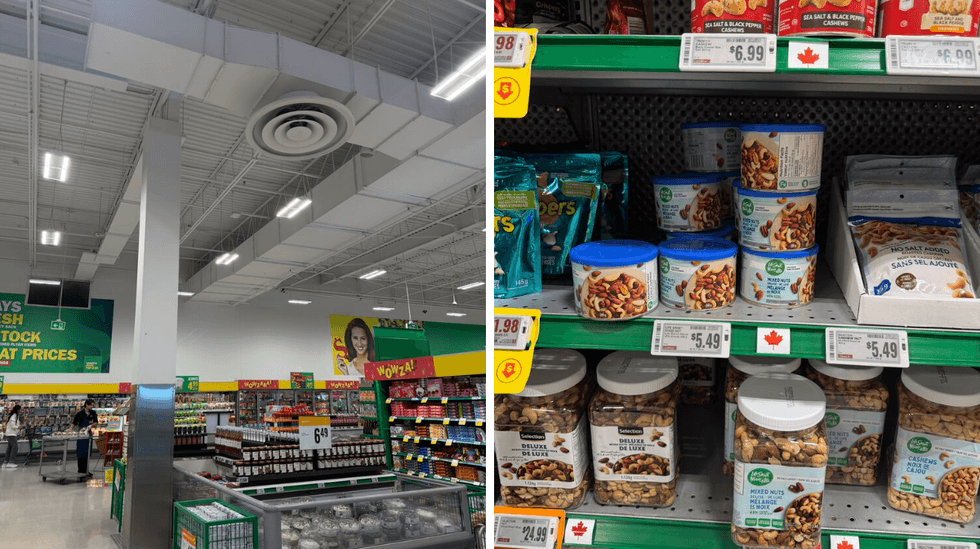
Food Basics is grocery shopping with a purpose.
Food Basics, meanwhile, is grocery shopping with a purpose.
You enter. You buy food. You leave.
Revolutionary.
Unlike Walmart, I'm not going to accidentally wander into the home decor section and emerge $47 poorer because I decided my bedroom desperately needed a seasonal throw pillow.
Food Basics doesn't win on sheer range, but that's also part of the appeal. It focuses on groceries, and the selection is good without feeling overwhelming.
I can find my pasta, vegetables, yogurt, chicken, snacks and whatever else is on my list without feeling like I have to cross three postal codes to get from produce to household supplies.
And when I compared prices, the difference between Food Basics and Walmart was pretty small.
Where Food Basics stood out more for me was fresh food and weekly deals. This feels like the kind of store where it really pays to check the flyer before you shop — yes, Dad, I listen to you — and build your meals around what's discounted that week.
Food Basics also carries lower-priced private-label options, including Selection products, so there are still ways to save without defaulting to the most expensive name-brand version.
There was also one policy I somehow didn't know about until I was standing in line and eavesdropping on the woman in front of me. If an advertised item is out of stock, Food Basics says you can ask for a raincheck, which is valid for 30 days, and get 10% off the advertised price when you come back.
The obvious downside is that Food Basics can't compete with Walmart when it comes to anything beyond groceries.
If I suddenly remember I need a phone charger, birthday card, mascara and printer paper while I'm shopping, Food Basics isn't going to save me.
But after directly comparing both, I'm starting to think that might actually be a positive.
Food Basics feels much better suited to a normal weekly grocery run because there are fewer distractions, less ground to cover and fewer opportunities to leave with things you never planned to buy.
Maybe I don't need to be tempted by a $12 candle every time I buy lettuce.
The Verdict
This one was annoyingly close.
If we're talking strictly about the prices I encountered, neither store came out dramatically ahead. Both delivered what I want from a discount grocery store: affordable staples, cheaper alternatives to name brands and enough selection that I didn't feel like I was sacrificing too much to save money.
Where they really differ is the shopping experience.
If I'm doing a massive Sunday reset and my list includes groceries, toilet paper, shampoo, Advil, cleaning supplies and approximately seven other things I forgot to buy during the month, I'm going to Walmart.
There is simply no competing with being able to knock out half your errands under one roof.
But if you ask me where I'd rather do my regular weekly grocery shop?
I'd pick my Canadian friend, Food Basics.
For the kind of shopping I do most often, I found it easier to navigate, less overwhelming and better suited to getting in, buying what I actually need and leaving.
Walmart wins on selection and convenience.
But Food Basics wins on simplicity.
And considering I once walked into Walmart for one thing and somehow forgot the only item I went in for because I got distracted by everything else, simplicity might be exactly what I need.
My winner: Food Basics.
But if you see me at Walmart next week eating a McDonald's hash brown while pushing a cart full of groceries and classroom supplies, mind your own business.
The opinions expressed in this article are the author's own and do not necessarily reflect the views of Narcity Media.
- I went shopping at 3 of Ontario's biggest grocery stores and one is unquestionably better - Narcity ›
- I did my grocery shopping at Safeway, Superstore, and Choices — the costs were so different - Narcity ›
- I ranked Canada's biggest grocery stores as a newcomer and my top 3 will shock you - Narcity ›