Canada has a colour-changing lake with stunning turquoise water that looks like the Maldives
It's like a slice of the tropics — no passport required. 🌴
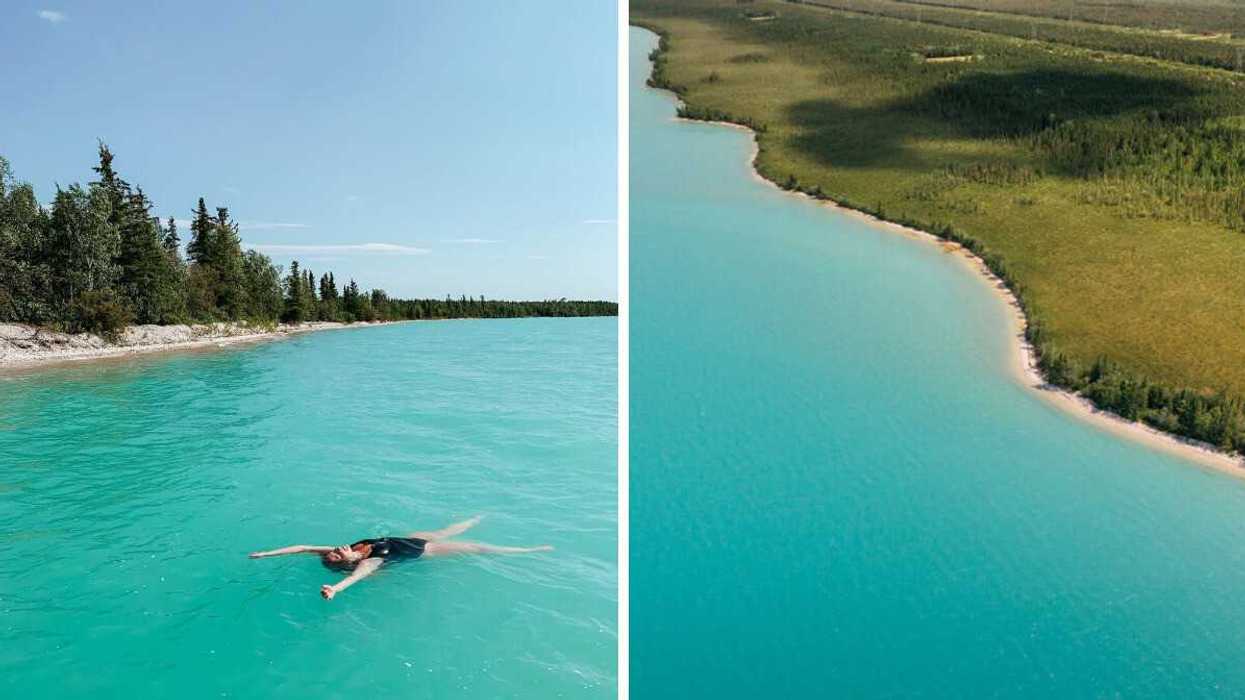
A person swims in a blue lake. Right: A turquoise lake in Canada.
Craving a tropical escape? When you picture a beach getaway with dazzling turquoise water, your mind probably jumps to a Caribbean destination.
But as it turns out, you don't need to leave the country to find similar tropical vibes. The True North is home to a jaw-dropping, lesser-known natural wonder with stunning turquoise waters that's like a tropical escape — one that doesn't require an international flight.
Set in central Manitoba at the northern tip of Lake Winnipeg, Little Limestone Lake is a unique spot unlike almost anywhere else in the country.
The lake boasts incredibly blue turquoise water that looks downright tropical — more akin to something you'd see in the Maldives or Cuba, rather than Canada.
Little Limestone Lake is a marl lake, meaning it's rich in calcium carbonate. When it's warm, the marl forms into calcite, creating crystals that are suspended in the water and give it a milky, rich blue hue. When temperatures fall, however, it dissolves, and the water becomes clear.
This means that, depending on the heat of a particular day, the colour of the lake can change from a clear blue to a stunning milky turquoise hue (like what you'd find in the Caribbean).
The lake's colour can range from dull blue-grey to brilliant aquamarine, all over the course of a single day.
This also means that the colour of the lake will vary depending on the time of year. The best time to visit the lake is in the summer, from late June to August, which is when you're likely to experience the best colour changes and pleasant weather.
While the lake is not the only one in the world, it is Canada's largest marl lake, and, according to the Canadian Parks and Wilderness Society (CPAWS), is known to be the largest and most dramatically colour-changing marl lake on the planet.
The lake can be found in Little Limestone Lake Provincial Park, about five hours north of Winnipeg and under an hour away from Grand Rapids, Manitoba, set along a remote stretch of Hwy 6 through the traditional territory of the Mosakahiken Cree Nation.
The park is free to visit, though visitors here will need to make sure they have everything they need with them as there are limited services and amenities available, whether you're paddling, fishing or hiking.
As there are no services here, all visitors should practice "Leave No Trace" principles and pack out whatever they bring in.
Little Limestone Lake is the perfect lake for swimming, tubing, kayaking, canoeing or spending the day lakeside, taking in the scenery. While it's not literally a tropical destination, temperatures here easily reach and surpass the high 20s in the summer.
Pair the hot weather with the tropical hue of the water, and it'd be easy to forget you're still in Canada.
Fishing is also popular here, with northern pike, whitefish, perch and walleye found in the lake.
According to a provincial spokesperson, the park lies over a landscape containing many unique caves, sinkholes, disappearing streams, underground springs and lakes.
There's also plenty of wildlife in the park, including moose, bears, wolves, lynx, beavers, muskrat, spruce grouse, double-crested cormorant, various ducks and geese and many songbirds.
No camping is permitted within the park, including the islands on the lake. However, visitors can seek permission to camp on the adjacent Mosakahiken Cree Nation land by calling the band office. Camping and lodging are also available at Grand Rapids, about 40 minutes from the lake.
Little Limestone Lake proves you don't have to board a long-haul flight to experience breathtaking turquoise water.
Hidden in the heart of Manitoba and a little off the beaten path, this remarkable natural wonder delivers scenery that will transport you to the tropics, making it definitely worth the detour.
Before you get going, check out our Responsible Travel Guide so you can be informed, be safe, be smart, and most of all, be respectful on your adventure.